



Editor’s Note
In light of the renewed debate regarding the necessity of joint theatre commands in India, we at BharatShakti have decided to present various perspectives on this issue. Today, we are publishing a comprehensive article based on a talk given in July 2017 at a higher Defence Organisation Conference held at the Army War College in Mhow. The author, R. Adm. Sudarshan Shrikhande, is well-known to readers and viewers of both BharatShakti and StratnewsGlobal.
You may have already read recent articles on this subject:
- Theatre Commands: Back to the Drawing Board?
- Theatre Commands: Towards A Unique Indian Model Inspired by Global Best Practices
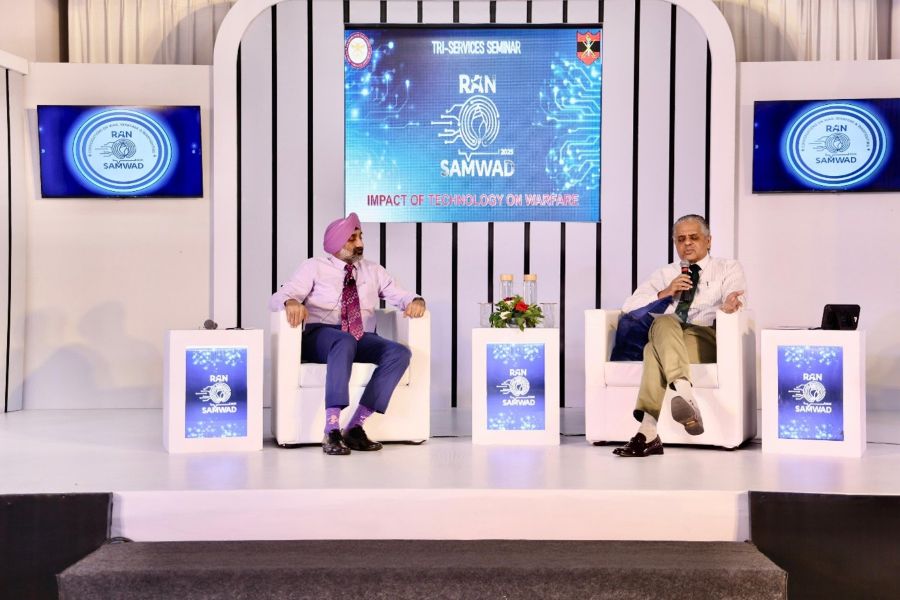
- Healthy Debate or Strategic Dissonance? Ran Samwad Reflections on Theatre Commands
Today, we discuss Adm Shrikhande’s insights from 2017, which still seem relevant. There has not been much real progress since then in creating joint commands as envisaged later after the Prime Minister Modi’s 15 August 2019 announcement, except for the creation of a Chief of Defence Staff (CDS) and the Defence Military Affairs (DMA) and for relatively minor functional organisations and the merging of some training institutes that are “low-hanging fruits” to use a cliche.
Certain aspects of the 2017 presentation need to be understood within the context of that period, when the establishment of the long-anticipated position of Chief of Defence Staff (CDS) still seemed uncertain. Although this talk has not been published previously, some of Shrikhande’s ideas were later reflected upon and even revised in three articles he wrote for “Bharatshakti” on Jointness between 2019 and 2021:
- CDS: From Infighting to Warfighting; From Integration to Jointness August 20, 2019
- Beyond A Triangular Conception: The “Peninsula” Command April 26, 2020
- Centrality of Indian Air Power via a “Central Command” June 28, 2021
This piece is relatively lengthy and will be published in two parts, diverging from our usual shorter formats, but it may be worth your time.
Walking The Talk Towards Effective Jointness
“Geography is not joint, but warfare has become ever more noticeably so over the course of the past century…” Colin Gray in “Always Strategic: Jointly Essential Landpower”
“Jointmanship is not backslapping in public, playing golf together and stating that they all belong to one course in NDA.” Admiral JG Nadkarni (quoted by Maj Gen Suman)
Attitudinal resistance to Jointness and its manifestation, in say, integration at joint military command levels, has been the bane of a better quality of jointness almost everywhere in the world. Single-service “Loyalty” is hardly a correct ingredient for overall military effectiveness. It has repeatedly interfered with what is the right thing to do at the national level.
One of the architects of the American victory in World War II, Admiral Ernest King, said in 1945, “If the Navy’s welfare is one of the prerequisites to the nation’s welfare – and I sincerely believe it to be the case – any step that is not good for the Navy is not good for the nation.” Variants of such thoughts, in fundamentally well-meaning people in uniform, are by no means rare anywhere in the world.
In a closely related context, Admiral Arun Prakash, chairing this session, has been a rare proponent of and participant in true jointness while still in uniform. Recognising the oft-present reality of a misplaced sense of single-service turf-protection, he has even said, “…that since no Chief would like to preside over his own divestment, it is unrealistic to expect a favourable recommendation for the CDS system from the Services.”
 Before getting into sharing some thoughts on issues about Integrated Theatre Commands, let me spend just a few minutes on background aspects that could lead us to ITCs.
First, a quick historical review of jointness in the US. In some ways, it culminated in the US as far back as January 1942 with the establishment of the Joint Chiefs of Staff by a small administrative order a month after the U.S. entered into the war consequent to Pearl Harbour, 7 December 1941. The first meeting was formally held on 7 February 1942.
However, the US did have an Army and Navy Board formed in 1903 by a joint order by the Secretaries of War and Navy. While the Board was not very effective, including during World War I, it did, between 1920 and 1938, make war plans known internally as Rainbow plans. Amazingly, War Plan Red, with Britain as an adversary, were also being updated until the early 1930s, just in case! War Plan Orange, better known to the world, was against Japan.

In mid-1941, the US Navy’s General Board recommended setting up a joint general staff, headed by a single Chief of Staff to generate “general plans for major military campaigns and to issue directives for detailed supporting plans for the War and Navy Departments.” This proposal became the genesis of the JCS, thanks to the Japanese attack on Pearl. In a semantic sense, the Indian Defence Planning Staff under a DG (DGDPS), created in 1986, was somewhat similar in spirit to the USN’s June 1941 proposal. Given the US Navy’s later resistance to jointness, the irony is quite remarkable.
Another amazing angle, at a time when many feel that jointness can work only when legislatively formalised: In June 1943, the JCS sent a first draft of the Executive order for FDR to formalise its existence.
President Roosevelt told the JCS, “It seems to me that such an order would provide no benefits and might in some ways impair the flexibility of operations.” (Above four paras based on Rearden’s book.)
Jointness, with all its positives, friction, theatre commanders like MacArthur, cooperation and confrontation with Allies, culminated in victory in 1945.
A few things were clearer by the 1945 Conferences. The US was the big kid on the block; the Soviets would once again be adversaries, and others were either junior partners or the vanquished.
During the Second World War, service chiefs played the roles of Executive Agents, especially where MacArthur and Nimitz were concerned.
After the War, King’s attitudes against jointness hardened, and Marshall’s matured. Admiral Richardson headed a “fact-finding panel” formed in the closing months of the war. Funnily, he ended up penning a dissenting note to his own panel’s urging for a single Defence (sic) Dept under one head secretary and a uniformed chief of staff.

For both valid and many invalid reasons, the U.S. Navy hindered genuine progress in achieving jointness within the U.S. military context, even after the enactment of the Goldwater-Nichols Defence Reorganisation Act of 1986 (Public Law 99-433). I will revisit some common misconceptions about the GNA shortly.
The current US theatre command system began as a result of World War II, and in December 1946, Truman approved the UCP. It had 7 geographic and one functional command. This was the Strategic Air Command.
When discussing the structure that Indian Integrated Theatre Commands should adopt, we need to take into account how the US and its allies in NATO and the Pacific organise their theatre commands. Their approach includes several intra-theatre commands, inter-theatre overlaps, and linkages to functional commands.
This was followed by the National Security Act of July 1947, which created the National Military Establishment (NME) with three Services and one Secretary of Defence. Among other things, the CIA and NSC were also created. In 1949, 1953, and 1958, there were some more reforms that augmented the SEC DEF’s role in military decision-making.
Let us cut to the GNA in 1986. Some quick matters about the GNA:
- On the whole, the Services did not want it. This was the initiative, push and determination of members of the Senate and House Armed Services Committees with Sen Sam Nunn, Sen Barry Goldwater and Congressman William Nichols in lead roles.
- Among the Joint Chiefs of Staff members, the then Chairman, Air Force General David Jones, sincerely supported it as the Chairman of the Joint Chiefs of Staff when the process began. The Navy Chief, Adm Watkins and Marine Corps Commandant, Gen Kelly, were bitter opponents. Army Chief of Staff General Wickham opposed the bill due to concerns about Navy Secretary Lehman and a misplaced belief regarding the diminished relevance Service Chiefs would face if such legislation became law. The Chairman of JCS at its final year of discussions was Admiral Crowe. He supported much of it, saw the need for reforms, but was concerned that the chiefs were opposed, and he did not want to break ranks.
- In many ways, it was Gen David Jones’ opening words that set the ball rolling on the GNA Bill. In India, there is a general perception that the GNA was a political initiative imposed on the Services. But, in a sense, the trigger came from David Jones, a serving USAF officer! I don’t think we should forget this in India. In February 1982, he opened before the HASC, with honesty rarely seen at that level, by saying, “It is not sufficient to have resources, dollars, and weapon systems; we must also have an organisation which allows us to develop the proper strategy, necessary planning, and the full warfighting capability. We do not have an adequate organisational structure today.” (These are what Locher calls the famous nine words!)
- Unlike an oft-held impression among commentators, military or outside, the very purpose of the GNA was not to make the CJCS more powerful but to reiterate civilian supremacy and improve the quality of military advice that went beyond inter-service squabbling and was often merely a consensus on the least common denominator, quite literally like the Common Minimum Programme of coalition politics! In this audience, some may find this difficult to believe, but here is the first sentence of the 88 pages that make the GNA:
“An Act to reorganise the DOD and strengthen civilian authority in the DOD, to improve military advice to the President, NSC, Secretary of Defence, to place clear responsibility on the commanders of the unified and specified combatant commands to accomplish the specified missions….”

- The second misconception revolves around the commonly used phrase in India, “single-point military advice.” This phrase implies that the only source of such advice is the Chief of Defence Staff (CDS) or the Chairman of the Chiefs of Staff Committee (Pmt Chairman). It appears in at least three sections of the Approach Paper for this seminar and has been widely referenced in various commentaries advocating for the establishment of a CDS.. The GNA very unambiguously requires the CJCS to be the “Principal Military Adviser” and the other members of the JCS as “military advisers”. This is not merely semantics. No government would like to restrict itself to single-point military advice. The term has never been used or even implied in the US at any point. The same could also be said of Churchill’s COSC, the Soviet Stavka under Stalin, or any time since 1949 in China.GNA clearly elaborates on this in Section 151. The presence of multiple advisers is essential for a cabinet, enhancing the quality of advice from the COSC, with the Chairman and CDS serving as the principal advisers.
- The audience participating in the Higher Command course, along with anyone involved in proposals aimed at enhancing jointness in warfighting, would greatly benefit from reading the 88-page Goldwater-Nicholos Act (GNA), as well as two excellent books that explore the evolution and challenges of jointness within the U.S. context. These books are “Council of War: A History of the Joint Chiefs of Staff 1942-1991”, by Steve L Rearden and “Victory on the Potomac: The GNA Unifies the Pentagon” by James Locher III. Personally, for me, they have been most useful in researching a monograph on jointness for India.
- Locher points out that “even if Wickham (the Army Chief in 1985) and other chiefs thought that reforms were needed, they did not want them taking place on their watch.” This is precisely the point that Admiral Arun Prakash has made.
- In words that cannot be put better, Locher, himself a graduate of USMA, West Point, writes, instead of “Duty, Honour, Country…I was hearing something different. It sounded like “Turf, Power, Service.”
Rear Admiral Sudarshan Y Shrikhande, IN (Retd)
(Tomorrow: The Indian CONTEXT)

RADM Shrikhande is a 1979 graduate of the National Defence Academy. His qualifications include Masters in Weapon and Sonar Engineering from the Soviet Naval War College, (1985-88); M.Sc Indian Staff College (1995), MPhil from the Indian Naval War College and highest distinction from the US Naval War College (2003) and a PHD from Mumbai Univ (June 2025) for his thesis on sea-based nuclear deterrence for nuclear deterrence stability for India.
He has commanded three ships. He has been a defence attaché in Australia and the South Pacific. Ashore, he has held a variety of operational and training assignments. In flag rank, he served as Chief of Naval Intelligence, Chief of Staff, SNC, Joint HQ staff duties, and, in the nuclear forces command, as Flag Officer for Doctrines and Concepts.
In retirement since 2016, he is a visiting professor at several institutions, including NDC and CDM. Staff and War colleges spanning strategy, operational art, RMA, Peloponnesian War, Indo-Pacific geopolitics, leadership and ethics and Atmanirbharta/Self-Reliance in defence production. He has participated in Track 2 discussions with some countries, attended various national/international conferences and workshops, and written for national and international journals. He is a visiting professor at the Naval War College, Goa; Honorary Senior Fellow with ANCORS, Wollongong and a Distinguished Fellow at the Australia-India Institute, University of Melbourne.


