






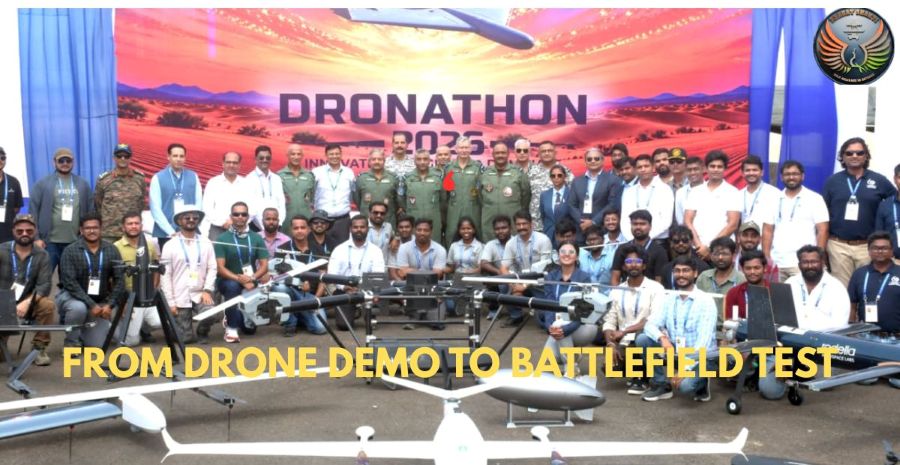
The Indian Air Force has moved to a more operational approach to unmanned warfare with the launch of its first Dronathon-2026, putting more than 20 Indian defence companies, start-ups, MSMEs, DPSUs and innovators through live demonstrations at the Pokhran Field Firing Range.
The three-day exercise, inaugurated by Vice Chief of the Air Staff Air Marshal Ashutosh Dixit on Monday, is aimed at testing emerging unmanned systems in conditions closer to the battlefield, rather than limiting their evaluation to controlled technology demonstrations.
The central thrust of Dronathon is to determine whether indigenous unmanned technologies can deliver reliable and effective operational effects in demanding and contested environments. The IAF is assessing their reliability, effectiveness and ability to adapt to changing operational requirements and emerging threats.
The demonstrations, scheduled through September 16, cover surveillance and reconnaissance, autonomous operations, swarm technologies, electronic warfare and counter-unmanned aircraft systems (CUAS).
The exercise comes as drones and autonomous systems rapidly reshape the battlefield, with recent conflicts demonstrating their growing role in surveillance, precision strike, electronic warfare and counter-drone operations.
UAS roadmap for industry
In a significant move to give industry greater clarity on future requirements, Air Marshal Dixit also released the ‘IAF UAS Roadmap’ at the inaugural ceremony.
The roadmap is intended to signal the IAF’s priority capability areas and help industry, academia and research organisations align indigenous development with the force’s future operational needs.
The IAF’s approach extends beyond the development of individual drone platforms. It is looking to build an integrated unmanned ecosystem covering propulsion, sensors, payloads, communications, autonomy, electronic warfare, countermeasures and airspace management.
The roadmap could therefore provide a clearer direction to India’s expanding drone industry on where the IAF sees the most pressing capability gaps.
Vayu UTtaM demonstrated
The opening day also saw the IAF demonstrate Vayu UTtaM, an indigenously developed multi-mode Unmanned Traffic Management system, at Pokhran.
During the live demonstration, Vayu UTtaM detected and tracked both military and civilian unmanned aircraft. The system is designed to enable coordinated management of UAS operations in increasingly congested airspace and support the identification and timely mitigation of unauthorised or rogue drones.
Its potential application is not limited to military operations. The IAF sees possible use in airspace safety, critical infrastructure protection, civil aviation and public safety as drone proliferation makes management of low-altitude airspace increasingly complex.
Dronathon-2026 signals a significant shift in the IAF’s engagement with the domestic unmanned-systems industry from showcasing what a technology can do to determining whether it can perform when subjected to operational demands.
The exercise is also expected to give the IAF a closer assessment of the maturity of India’s indigenous unmanned ecosystem and its ability to support future high-intensity operations.
Team BharatShakti