



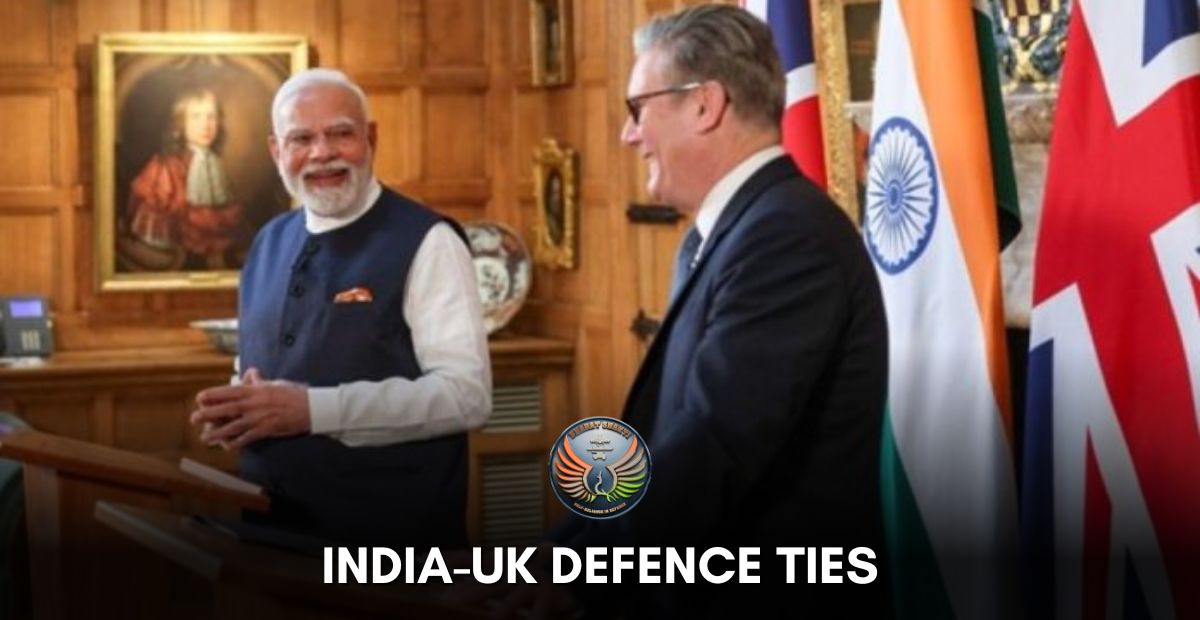
As British Prime Minister Keir Starmer prepares for his first official visit to India next month, defence and strategic cooperation will take centre stage. With trade talks largely concluded following the July Free Trade Agreement, both countries are now moving to strengthen military and industrial partnerships.
His visit, scheduled for the second week of October, will include bilateral talks with Prime Minister Narendra Modi in New Delhi, as well as a keynote address at the Global Fintech Fest 2025 in Mumbai.
This visit comes at a time when India is widening its defence collaborations beyond long-standing partners. London is emerging as a strong option as New Delhi works to reduce dependence on traditional suppliers while also maintaining a balance with larger powers.
Building Together, Not Buying Alone
BharatShakti has reported earlier that India and the UK have already launched a 10-year Defence Industrial Roadmap. The plan includes joint development of weapons systems, co-production agreements, and a focus on shared intellectual property. Rather than buying off-the-shelf platforms, India is seeking co-design and shared control over technology.
British firms such as Rolls-Royce are in active talks to support India’s Advanced Medium Combat Aircraft (AMCA) programme, while BAE Systems and Webley & Scott are already working with Indian partners to manufacture defence equipment locally.
A proposed government-to-government cooperation model is also being developed, aiming to align both public and private sector players in long-term defence projects.
Also Read: India-UK Vision 2035: Paving Way for Strategic Ties in Technology and Defence
Training, Interoperability, and Joint Operations
Indian and British armed forces already conduct regular exercises across all branches: Ajeya Warrior (Army), Konkan (Navy), and Indra Dhanush (Air Force). The next phase of cooperation includes embedded instructors, joint staff colleges, and expanded access to logistics and support.
With India positioned as a forward logistics hub and the UK maintaining permanent military facilities across the Indo-Pacific, both sides are discussing new maritime coordination roles.
One project in the pipeline is a Regional Maritime Security Centre of Excellence, backed by the UK and aligned with India’s Indo-Pacific Oceans Initiative. The centre would support surveillance and coordination to counter threats like piracy, smuggling, and illegal fishing.
Focus on Future Technologies
India and the UK are also investing in research and development for next-generation military technologies. Initiatives such as the Jet Engine Advanced Core Technologies (JEACT) and the Electric Propulsion Capability Partnership (EPCP) are already underway.
Defence officials say these projects reflect a shift in thinking: from importing complete platforms to building core systems together. The emphasis is now on creating systems “with India” rather than merely “in India.”
These efforts are supported by the Bilateral Technology Security Initiative (TSI), launched last year, which handles cooperation in sensitive fields such as artificial intelligence, cyber defence, quantum systems, and advanced materials.
Also Read: India Charts ‘Third Path’ in Defence with UK as Key Partner
Security, Counterterrorism, and Radicalisation
Beyond the defence industry, both governments are working on new protocols for intelligence sharing and counterterrorism. India is expected to raise issues related to extremist threats linked to diaspora groups operating from UK soil.
In recent months, UK authorities have taken steps to improve information flow and provide legal assistance on cases involving Indian interests. More formal mechanisms may be announced during the visit, according to officials familiar with the talks.
A Wider Indo-Pacific Strategy
The UK has been increasing its naval presence in the Indo-Pacific, with seven ships on deployment and military bases in Singapore, Oman, Bahrain, and the British Indian Ocean Territory. Its participation in regional exercises, including those led by India, reflects a long-term approach to engagement in the region.
India has welcomed this, especially as both countries push for an open and rules-based maritime order. The two navies last exercised together during Exercise Konkan, and are expected to explore more regular deployments and shared maritime awareness initiatives.
Long-Term Goals Under Vision 2035
The India-UK Vision 2035, adopted earlier this year, outlines plans across trade, education, climate, and security. Defence ties are a major part of this framework, with timelines for delivery built into the agreement.
The upcoming visit is expected to include reviews of ongoing projects, announcements of new defence initiatives, and agreements to expand cooperation in space, cyber, and critical technologies.
Both sides view this phase of the partnership as moving beyond traditional diplomacy toward a more practical model built on joint capabilities and shared strategic interests.
Huma Siddiqui


