The Indian Army has released fresh details on Operation Sindoor, the cross-border strikes carried out in May 2025, saying the coordinated mission crippled Pakistan-based terror infrastructure and marked one of the year’s key operational milestones.
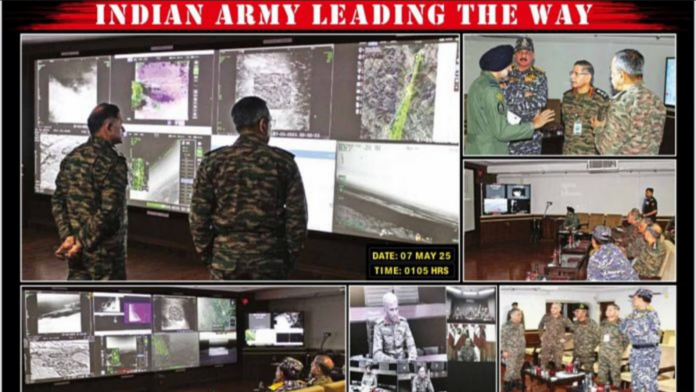
According to an official statement, the operation was conceived, planned, and controlled by the Military Operations (MO) Branch at Army Headquarters, with real-time execution monitored by the Directorate General of Military Operations (DGMO) Operations Room. The Chief of Defence Staff and the Chiefs of all three Services were present during execution – a rare instance of tri-service synchronisation that underscored the seriousness of the mission.
“Entire operational planning was carried out at the Military Operations Branch of the Indian Army. Execution was monitored from the Ops Room of the Indian Army’s Directorate General of Military Operations, with CDS and all three Service Chiefs present,” the statement stated.
The Army said the operation focused on dismantling terrorist infrastructure across the border in swift and calibrated strikes. In all, nine terrorist camps were destroyed – seven by the Indian Army using ground-based firepower and two by the Indian Air Force (IAF) through precision air strikes.
“Nine terrorist camps across the border were destroyed: Seven camps were neutralised by the Indian Army; Balance two camps destroyed by the Indian Air Force; Strikes were precise, calibrated and time-bound, reinforcing deterrence while maintaining escalation control,” it said.
Officials described the campaign as intelligence-led and time-bound, aimed at degrading terror launch capabilities while avoiding civilian and military targets.
Drone Attacks Thwarted
The Army also revealed that Pakistan attempted retaliatory attacks between May 7 and 10, deploying armed drones against both civilian and military targets. All such incursions were neutralised by Indian Army air defence units, with no casualties or damage reported.
The successful interceptions, the Army said, demonstrated the effectiveness of India’s layered air defence network and counter-UAS systems – a key capability on the modern battlefield.
Launch Pads Targeted Along LoC
Simultaneously, Indian forces targeted terror launch pads along the Line of Control (LoC), destroying more than a dozen such facilities using ground-based weapons. The Army said these actions disrupted infiltration routes and logistics chains supporting militancy in Jammu & Kashmir.
Security forces in the Union Territory subsequently neutralised several terrorists and foiled multiple infiltration attempts throughout the year, contributing to a more secure environment, officials added.
Pakistan Sought Ceasefire, Says Army
The sustained pressure, the Army said, led Pakistan’s military leadership to seek de-escalation.
“10 May 2025: Director General of Military Operations of the Indian Army was approached by his Pakistani counterpart with a request for a ceasefire – Understanding was reached to stop firing/military action,” the statement claimed.
The Indian Army’s version was later echoed publicly by Pakistan’s Foreign Minister Ishaq Dar, who confirmed that Pakistan’s DGMO had approached India after Indian forces struck the Nur Khan airbase, with mediation reportedly involving the US and Saudi Arabia.
Indian officials stressed, however, that the ceasefire was the outcome of effective deterrence rather than external pressure or unilateral restraint.
Strategic Message
Beyond its immediate tactical impact, Operation Sindoor was presented as part of a broader shift in India’s counter-terror strategy – signalling that terror attacks would trigger direct and credible military responses rather than remain confined to diplomatic channels.
With terror infrastructure degraded, infiltration routes disrupted, and multiple terrorists eliminated in Jammu & Kashmir through 2025, the Army said the year marked a turning point – one “defined not just by retaliation, but by sustained deterrence.”
Ravi Shankar

Dr Ravi Shankar has over two decades of experience in communications, print journalism, electronic media, documentary film making and new media.
He makes regular appearances on national television news channels as a commentator and analyst on current and political affairs. Apart from being an acknowledged Journalist, he has been a passionate newsroom manager bringing a wide range of journalistic experience from past associations with India’s leading media conglomerates (Times of India group and India Today group) and had led global news-gathering operations at world’s biggest multimedia news agency- ANI-Reuters. He has covered Parliament extensively over the past several years. Widely traveled, he has covered several summits as part of media delegation accompanying the Indian President, Vice President, Prime Minister, External Affairs Minister and Finance Minister across Asia, Africa and Europe.