



China will increase its defence spending by 7 per cent in 2026, maintaining a steady pace of military expansion even as the growth rate marks the lowest increase in five years. The budget, announced on Thursday at the opening of the annual session of the National People’s Congress (NPC), allocates 1.91 trillion yuan (about US$277 billion) for defence.
Although marginally lower than last year’s 7.2 per cent increase, the rise still outpaces China’s economic growth target of 4.5–5 per cent for the year. The sustained spending reflects Beijing’s long-term plan to transform the People’s Liberation Army (PLA) into a modern fighting force by 2035.
Security analysts and regional military attaches closely track China’s defence allocations as the country accelerates modernisation of its armed forces while expanding deployments across East Asia. At the same time, the leadership has launched a sweeping purge of senior officers to tackle corruption within the military establishment.
Presenting the government’s work report to parliament, Premier Li Qiang said China would improve combat readiness and speed up the development of “advanced combat capabilities.”
“These steps will strengthen our strategic capacity to safeguard China’s sovereignty, security and development interests,” Li said, adding that President Xi Jinping retains ultimate command authority over the armed forces.
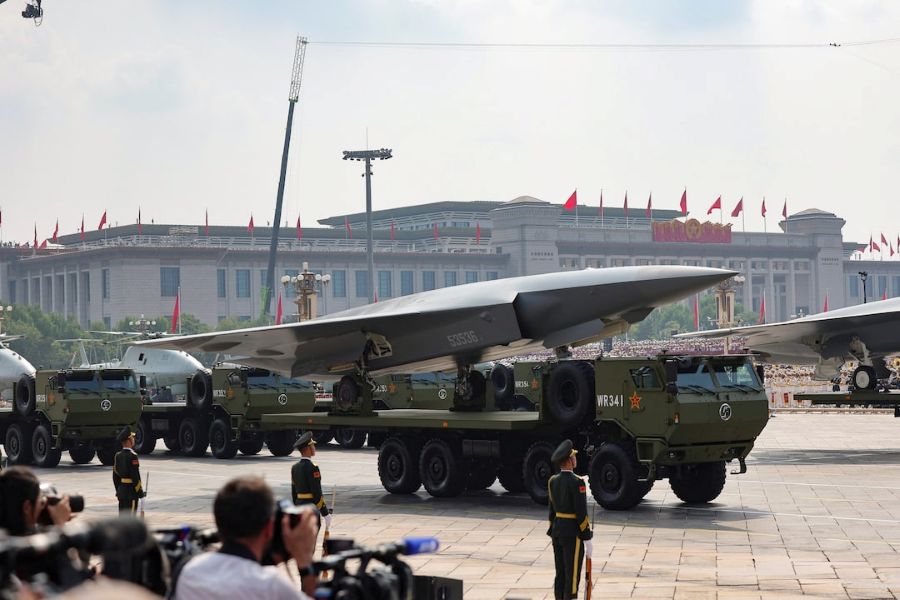
China’s defence budget has expanded steadily in recent years as the PLA inducts new generations of missiles, naval vessels, submarines and surveillance systems. The 7 per cent rise follows three consecutive increases of 7.2 per cent and is the slowest since 2021, when the budget grew by 6.8 per cent.
China remains the world’s second-largest military spender after the United States. However, American defence expenditure continues to exceed China’s by a wide margin, both in absolute terms and as a share of GDP.
For the 2026 financial year, US President Donald Trump initially proposed a defence budget of US$1.01 trillion, a 13 per cent increase over the previous year. The figure was later revised to about US$900 billion, with the Pentagon securing an additional US$150 billion in funding. Trump has also indicated that defence spending could rise to US$1.5 trillion by 2027.
The announcement of China’s defence budget comes amid heightened geopolitical tensions. Beijing has warned of “persistently rising geopolitical risks,” according to Li’s address to the NPC.
The premier said the PLA would continue to strengthen military training and war preparedness while accelerating the development of advanced combat capabilities to protect national sovereignty and security.
Li also referred to the ongoing “political rectification” within the armed forces, an apparent reference to the anti-corruption campaign that has swept through the PLA and the defence industry in recent years.
The drive has led to the removal or investigation of several senior figures, including members of the Central Military Commission (CMC), the country’s top military decision-making body. In one of the most significant purges in decades, two senior generals have been caught up in disciplinary probes.
Zhang Youxia, a long-time military associate of Xi, reportedly came under investigation in January, while another senior commander, He Weidong, was expelled from office in October last year.
The shake-up has left only two of the CMC’s usual seven members in place — Xi as chairman and newly promoted vice-chairman Zhang Shengmin.
Analysts say the corruption crackdown suggests Beijing intends to tighten oversight of military spending even as the overall defence budget continues to expand.
“Beijing will keep a tighter watch on military spending,” said Wen-Ti Sung, a Taiwan-based security analyst, noting that the government is also tightening expenditure across other sectors.
Li reiterated that the Communist Party would maintain “absolute leadership over the armed forces,” stressing that political loyalty remains a central pillar of military reform.
“Guided by the principle of ensuring political loyalty in the military, we will continue to improve military political conduct and make major strides towards the centenary goals of the People’s Liberation Army,” he said.
Some regional analysts believe the PLA’s upcoming centenary next year could lead to an uptick in military drills and deployments, particularly around Taiwan, the self-governed island that Beijing claims as its territory.
Team BharatShakti