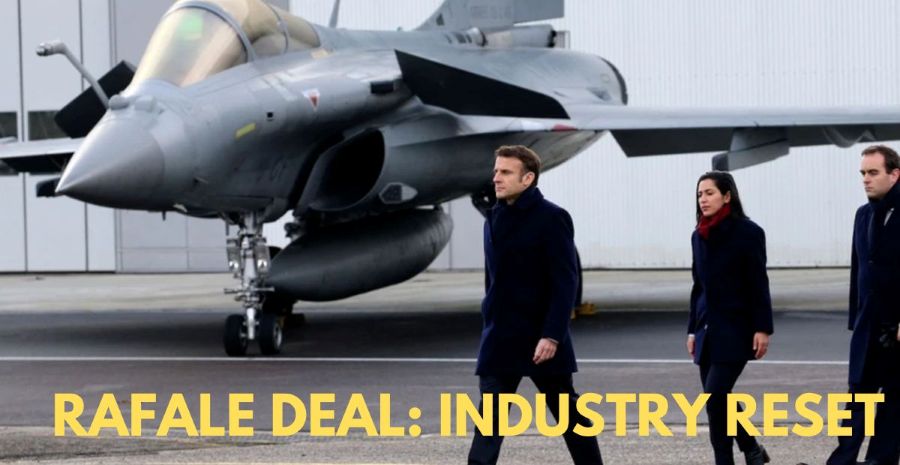
The Defence Acquisition Council’s nod for 114 Multi-Role Fighter Aircraft (MRFA) for additional Dassault Rafale jets is not only aimed at restoring squadron strength and reinforcing air dominance capability, but it’s a game-changer for the domestic fighter jet manufacturers. The decision comes at a time when the Air Force’s fighter squadron strength has shrunk below 30, well below the 42 considered essential in the event of a simultaneous war with Pakistan and China.
India has already inducted 36 Rafales, receiving the last of the C variants in December 2024. In addition, 26 Rafale M variants have been contracted for the Navy. A fresh, larger order would consolidate India’s position as one of the biggest operators of the French-built twin-engine fighter outside France. This point gains diplomatic weight with French President Emmanuel Macron scheduled to visit New Delhi next week.
Operational urgency
Senior IAF leadership has publicly underlined the aircraft’s performance in recent operations. Speaking ahead of Exercise Vayu Shakti on February 11, Vice Chief of the Air Staff Air Marshal Nagesh Kapoor described the Rafale as “a hero, among other heroes,” during Operation Sindoor last May.
During the four-day military standoff with Pakistan, Rafales are believed to have deployed the SCALP air-launched cruise missile, capable of striking hardened targets at ranges exceeding 250 km. The weapon’s long-range precision strike capability adds depth to India’s conventional deterrence posture.
From a force-structure standpoint, additional Rafales can be absorbed quickly. The IAF already has trained crews, maintenance infrastructure and logistics chains in place. It shortens induction timelines compared to an entirely new platform.
Industrial ripple effects
The bigger question is what the order means for India’s aerospace industry.
According to Defence Ministry officials, 18 of the proposed aircraft would arrive in fly-away condition, while the rest would be assembled in India. Initially, much of the kit would be imported, but localisation is expected to rise progressively, potentially reaching 60 per cent by value over the life of the programme, which will span over a decade.
That trajectory could create a meaningful manufacturing ecosystem rather than a screwdriver assembly line. Fuselage sections, avionics modules, wiring harnesses and other sub-systems are candidates for phased localisation.
Tata Advanced Systems Limited is already producing Rafale fuselage sections at its Hyderabad facility for both Indian and global orders. Output is expected to scale up to around 24 units a year by 2028. A larger Indian order would provide volume certainty, encouraging further capital investment and supply chain expansion.
The transfer of technology and exposure to advanced production processes could also feed into India’s indigenous fifth-generation fighter programme, the Advanced Medium Combat Aircraft (AMCA). Manufacturing experience at this level, especially in precision machining, composites and systems integration, is critical for reducing risk in future indigenous projects.
Breaking a long-standing monopoly
For over six decades, Hindustan Aeronautics Limited (HAL) has been India’s sole fighter aircraft manufacturer. A large MRFA contract structured around meaningful private-sector participation could gradually dilute that monopoly. Competition may improve timelines, cost discipline and innovation, areas that have historically drawn criticism.
Air Marshal Kapoor acknowledged that India’s private aerospace firms are largely engaged in assembly and component work rather than end-to-end aircraft manufacturing. However, he suggested that sustained exposure to complex fighter production could mark a shift toward deeper manufacturing capabilities.
Strategic and diplomatic weight
The Rafale deal also reinforces the broader India–France strategic partnership. Defence cooperation between the two countries spans submarines, space, and advanced aviation. The timing of the acquisition discussions ahead of President Macron’s February 15–20 visit adds diplomatic heft to the military dimension.
For the IAF, the priority remains clear: arresting the steady decline in squadron strength. But for India’s aerospace sector, the MRFA decision could prove equally consequential, shaping whether the country remains largely an assembler of advanced aircraft or begins to emerge as a serious design and manufacturing hub in its own right.
Ravi Shankar

Dr Ravi Shankar has over two decades of experience in communications, print journalism, electronic media, documentary film making and new media.
He makes regular appearances on national television news channels as a commentator and analyst on current and political affairs. Apart from being an acknowledged Journalist, he has been a passionate newsroom manager bringing a wide range of journalistic experience from past associations with India’s leading media conglomerates (Times of India group and India Today group) and had led global news-gathering operations at world’s biggest multimedia news agency- ANI-Reuters. He has covered Parliament extensively over the past several years. Widely traveled, he has covered several summits as part of media delegation accompanying the Indian President, Vice President, Prime Minister, External Affairs Minister and Finance Minister across Asia, Africa and Europe.