



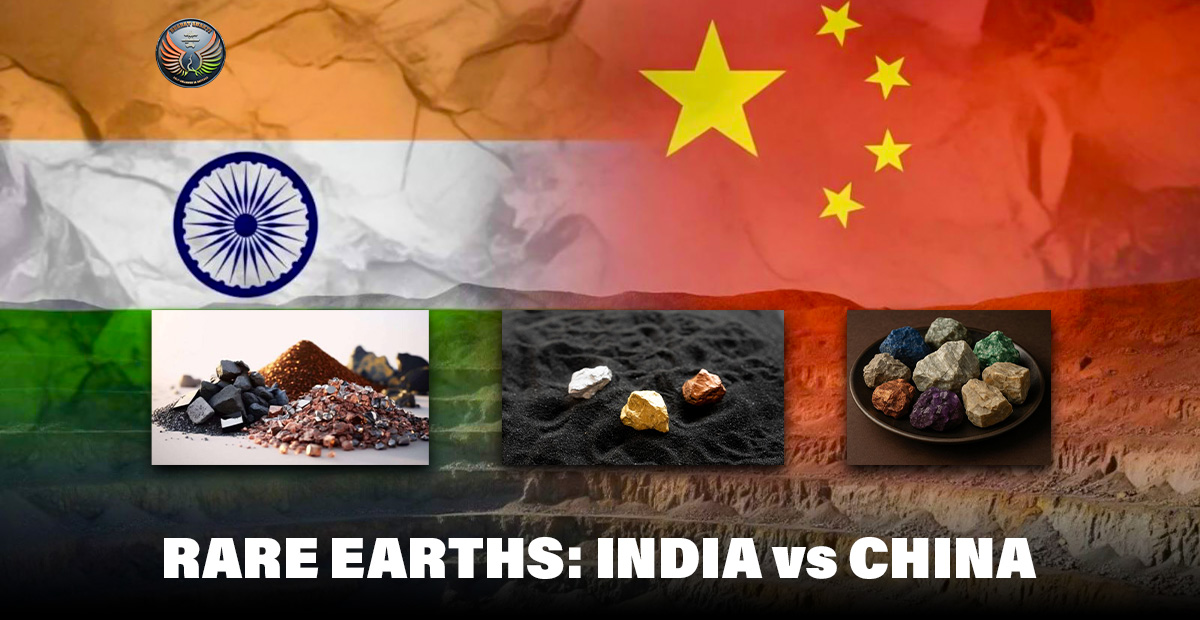
Rare Earths in Defence Applications
Rare earth elements (REEs) are the backbone of 21st‑century warfare and play an indispensable role in precision-guided missiles, stealth aircraft, directed-energy weapons, secure communications, and space platforms.
Key Defence Applications
- Aircraft: Fighter jets, bombers, transport planes and helicopters contain numerous rare-earth magnets.
- Missiles: Guidance systems and control surfaces in precision‑guided munitions.
- Naval Vessels: Sonar systems, propulsion motors and advanced radar.
- Armoured Vehicles: Magnet‑based actuators and communication systems.
- Space Platforms: Satellites and secure communication systems.
Permanent Magnets in Military Hardware
- Rare‑earth magnets, especially neodymium‑iron‑boron (NdFeB) and samarium‑cobalt (SmCo), are known for their exceptional strength, durability and heat resistance. It makes them indispensable for electric motors, actuators and guidance systems where reliability is non-negotiable.
- F-35 Lightning II, used by the U.S. Air Force, Navy, and Marine Corps, requires over 900 pounds of rare earth materials per aircraft for its electric actuation systems, radar and engine. Fighter jets like the F-35 rely on these magnets for propulsion and control. Similarly, legacy fighters (F-16, F/A-18) and modern stealth aircraft (B-2, B-21 bombers) use NdFeB magnets in radar and targeting systems, and SmCo magnets in engine and thermal applications.
- Naval ships and submarines are among the largest consumers of rare earth magnets. Modern warships use electric-drive propulsion, advanced radars, and sonar transducers, all of which depend on powerful magnets. For instance, an Arleigh Burke–class destroyer contains roughly 5,200 pounds of rare earth elements, in everything from the Aegis radar’s high-power microwave tubes to the ship’s propulsion and steering motors.
- Nuclear submarines like Virginia-class require about 9,200 pounds of rare earth materials, including large permanent-magnet motors.
- Even satellites and space-based systems rely on rare earth magnets for attitude control and other functions.
Missile Guidance and Avionics
- Avionics components like radar modules, navigation systems, and helmet displays use rare earth magnets for motion control and signal processing.
- Rare earth magnets and alloys are used in gyroscopes, accelerometers and guidance systems.
- Dysprosium and terbium improve magnet durability under extreme conditions.
- Precision-guided munitions depend on REEs for accuracy and reliability.
Stealth Technology
- Rare earth oxides are used in radar-absorbing materials to reduce aircraft signatures.
- Yttrium and gadolinium contribute to coatings that enhance stealth capabilities.
- Over 90% of advanced military radar systems incorporate REEs.
Night Vision and Optics
- Yttrium, Europium and Terbiumare used in phosphors for night vision goggles and targeting systems.
- Lanthanum glass improves clarity in optical lenses for surveillance and sniper scopes.
- These technologies enhance battlefield awareness and tactical advantage.
Electric Propulsion in Military Vehicles
- REEs enable lightweight, efficient motors for unmanned aerial vehicles (UAVs), submarines and hybrid tanks.
- Neodymium magnets are critical for electric propulsion systems, reducing fuel dependence and noise.
- It supports stealth operations and extended endurance.
Electronic Warfare and Secure Communications
- Rare earths are used in high-frequency communication systems, jammers and secure satellite links.
- They improve signal strength, reduce interference and enable encrypted transmissions.
- Cerium and yttrium are used in advanced ceramic capacitors and filters.
Directed Energy Weapons and Lasers
- Neodymium-doped yttrium aluminium garnet (Nd:YAG) lasers are widely used for targeting, range-finding, and directed-energy weapons.
- REEs enhance beam stability and efficiency, critical for emerging laser-based defence systems.
China’s Dominance
China has some of the world’s richest rare-earth reserves, especially at the Bayan Obo mine in Inner Mongolia, the largest known deposit globally. It also has “ionic clay” deposits in the southern provinces, which are easier to mine and process compared to hard rock ores.
As a result, China currently controls about 70% of global rare-earth mining, nearly 90% of refining capacity and approximately 94% of permanent magnet production.
This dominance allows China to influence prices and availability worldwide, giving it an unparalleled edge and influence over the world’s supply chain and dictating terms in trade disputes and strategic negotiations.
A striking example of how Beijing leverages its near-monopoly in rare earths dates back to 2010, when China restricted exports of rare earths to Japan during a territorial dispute in the East China Sea. The move caused global prices to spike.
In October 2025, China’s Ministry of Commerce introduced new export controls on rare-earth materials and technologies. These measures restricted not only raw rare-earth exports but also equipment and assemblies manufactured abroad using Chinese technology.
U.S. Dependence
Almost all branches of the U.S. military are dependent on rare earth magnets and can’t do without them. According to the U.S. Department of Defence, nearly 78% of its fighter jets (F-35), naval vessels, and missile systems use rare-earth magnets.
The current U.S. defence consumption is roughly 3,000 to 4,000 tons of rare earth magnets per year. Over 95% of total U.S. rare earth consumption is imported, mostly from China.
The U.S. DoD and Department of Commerce project that by 2030, the Pentagon’s demand for specialised permanent magnets could reach 10,000 tons per year.
The Technical Chokepoint
A standard magnet loses its magnetism at absolutely high temperatures – say, inside a missile guidance system or F-35 engine. Adding tiny amounts of Dysprosium or Terbium, on the other hand, allows the magnets to maintain their strength at temperatures above 180°C. If China stops the flow of Dysprosium, the U.S. would not be able to build a jet engine or cruise missile.
The Diplomatic “Bending”
Even as the U.S. imposes chips-and-AI sanctions on China, it has been forced to exclude rare-earth companies from those sanctions.
The U.S. is frantically trying to build a “China-free” supply chain through the Mineral Security Partnership (MSP) policy, which involves literally begging countries like Vietnam, Brazil, and Australia to fast-track the development of rare-earth mines and, at times, offering massive financial incentives that it doesn’t normally provide to foreign entities.
In reality, the U.S. knows that despite best efforts, it is at least 4 to 6 years away from having a fully independent “mine-to-magnet” pipeline.
India’s Position in the Rare Earth Race
India has the world’s third‑largest reserves – estimated at 6–8% of global deposits, or about 6.9 million tonnes. Despite this, India lacks sufficient refining and production capability. India’s contribution to global production is under 2%, largely due to limited refining infrastructure, underinvestment and environmental challenges.
Strengths
- India ranks #3 globally, after China and Brazil.
- India’s partnerships with the U.S., Japan, and Europe align with global efforts to reduce dependence on China.
- Recent initiatives like the National Critical Mineral Mission (NCMM) signal India’s intent to move beyond policy declarations and aim to boost exploration, incentivise private investment and build refining capacity.
Weaknesses
- India lacks large-scale refining facilities, the most complex stage of the supply chain.
- India’s production of roughly 2,600 tonnes per year is negligible in global terms, leaving the country dependent on imported rare-earth permanent magnets.
- Flagship indigenous platforms – BrahMos missiles, Tejas fighters, INS Arihant-class submarines, and Akash air defence systems – all incorporate subsystems that rely on foreign-made REE magnets and materials.
India as an Alternative?
India’s biggest challenge is to convert its reserves into a strategic advantage. By investing in refining, encouraging private sector participation and integrating into allied supply chains, India could emerge as a credible alternative supplier.
India is also deepening partnerships with African nations to secure supply chains.
The race is not just about mining but about building a full value chain -from extraction to advanced defence applications.
Neeraj Mahajan (Author is Editor of Taazakhabar News (taazakhabarnews.com)

The author is Editor of Taazakhabar News (taazakhabarnews.com)