


In the aftermath of Bashar al-Assad’s ouster, the new Syrian regime led by Ahmad al-Sharaa has launched a sweeping effort to rebuild the Syrian military—an ambitious, if controversial, experiment that has raised alarms in regional and international circles.
A July 2025 report by Boaz Shapira in Alma Research and Education Center outlines how this “New Syrian Army” has emerged as a fragmented coalition of former rebel factions, many with Islamist or Salafi-jihadist affiliations, cobbled together under a thin veneer of national unity.
The reconstitution began within weeks of al-Sharaa seizing Damascus in December 2024. By January 2025, his administration had issued open calls to various militias and armed factions to integrate into a central military command. Approximately 130 groups have since joined the effort, many retaining their internal structures and operational autonomy despite nominal re-branding under army divisions.
The command structure blends ex-rebels from groups like HTS, SNA, and Ahrar al-Sham with defectors from the Assad-era army. The Ministry of defence is reportedly working to standardize records, weapons inventories, and personnel, while simultaneously overseeing a mass recruitment drive aimed at building a force of 300,000 soldiers divided into 20 divisions. However, coordination remains chaotic and inconsistent, with significant manpower disparities and overlapping chains of command.
Allegations of sectarian bias and favoritism are widespread. Trusted associates of al-Sharaa, including some non-Syrians, now head critical organs like military intelligence, the air force, and the Republican Guard. Several commanders, such as Abd al-Rahman Hussein al-Khatib and Asim Rashid al-Hawari, have known jihadist pasts and foreign affiliations.
The army is currently under-equipped, largely due to sustained Israeli airstrikes targeting Syrian weapons infrastructure in the wake of Assad’s fall. These strikes destroyed air defence systems, ballistic missiles, and even aircraft. Yet this may be a temporary situation. Turkey has stepped in as a key supplier, already providing basic arms and rumored to be readying shipments of more advanced systems. Ankara’s political, economic, and military support for al-Sharaa is open and growing, prompting concerns about deeper Turkish entrenchment.
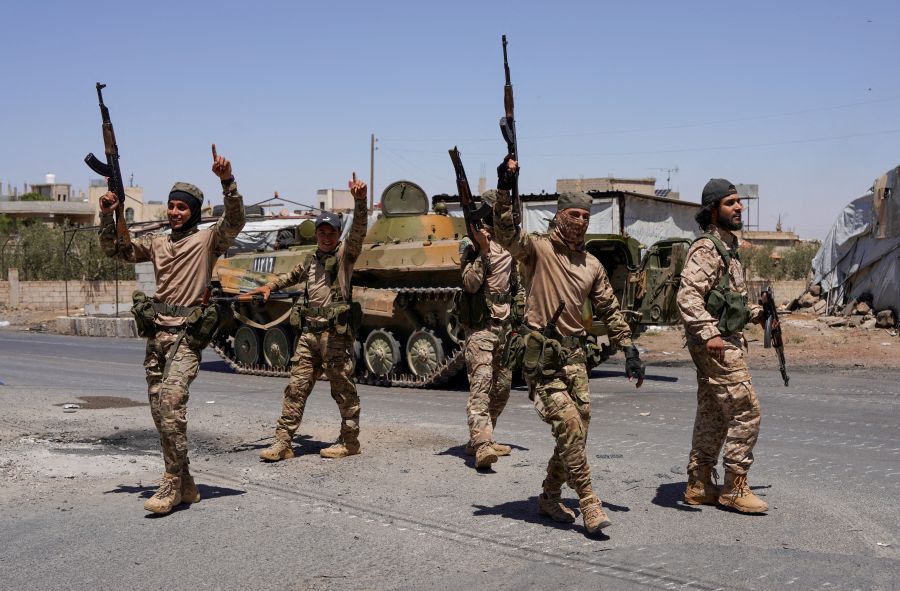
One of the report’s most disturbing findings is the ideological composition of the new force. Many units are populated by Salafi-jihadists—some ideologically close to ISIS and al-Qaeda—and a significant number of foreign fighters, including Uyghurs, Chechens, and Central Asians. These individuals, some of whom have received Syrian citizenship, openly display extremist affiliations and, in at least one instance, wore ISIS patches during recent clashes in Suwayda. The report identifies a suicide attack by a uniformed army member during the fighting as further evidence of radicalization.
Multiple divisions—including the 40th, 44th, 52nd, and 82nd—were involved in recent military operations against the Druze population in Suwayda (July 2025) and the Alawite community in coastal Syria (March 2025), raising fears of ethnosectarian violence. Additionally, there have been incidents of internal dissent, salary protests, and infighting among tribal and ideological factions within the military.
In terms of weaponry, the army relies on outdated Soviet-era stockpiles, captured equipment, and donations from Turkey. Basic training is rudimentary, with only scattered reports of unit-level drills and severe inconsistencies in equipment and discipline. Nevertheless, the regime hopes that international legitimization—bolstered by U.S. President Trump’s May 2025 announcement lifting sanctions on Syria—will enable it to modernize its forces with broader international backing.
While al-Sharaa projects a reformist image and speaks of elections, women’s rights, and minority inclusion, the ground reality, as documented in the report, suggests a precarious experiment in military statecraft, propped up by competing loyalties and deeply embedded radical ideologies.
The long-term viability of this new army—and the regime it serves—remains in question. For now, Syria is fielding a patchwork military stitched from the remnants of civil war, with the appearance of unity masking the underlying chaos. Whether this structure becomes a national stabilizer or collapses under its contradictions will determine the trajectory of post-Assad Syria.
Ramananda Sengupta

In a career spanning three decades and counting, I’ve been the foreign editor of The Telegraph, Outlook Magazine and the New Indian Express. I helped set up rediff.com’s editorial operations in San Jose and New York, helmed sify.com, and was the founder editor of India.com. My work has featured in national and international publications like the Al Jazeera Centre for Studies, Global Times and Ashahi Shimbun. My one constant over all these years, however, has been the attempt to understand rising India’s place in the world.
I can rustle up a mean salad, my oil-less pepper chicken is to die for, and it just takes some beer and rhythm and blues to rock my soul.