



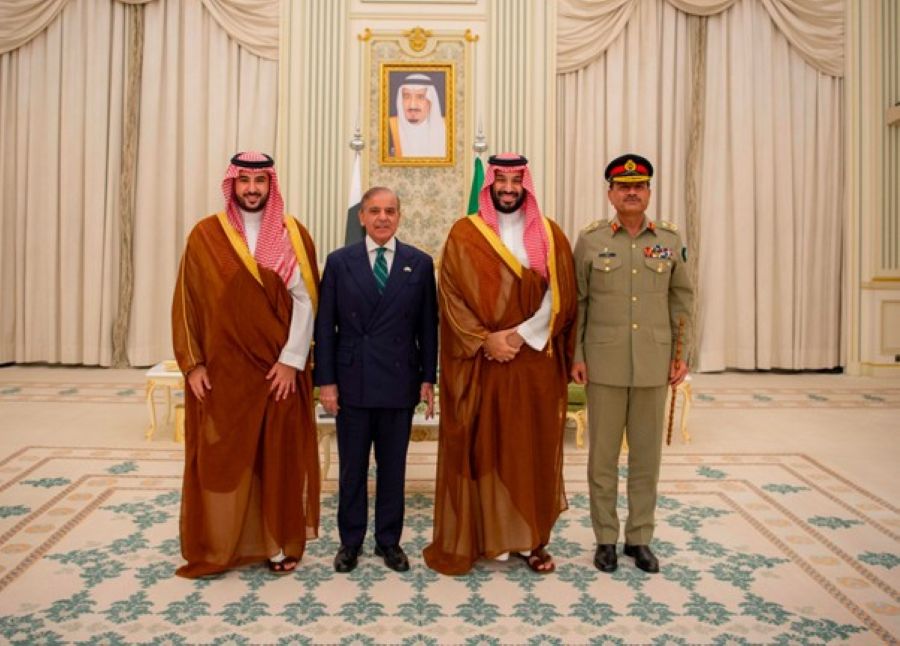
A week after Israel’s missile strike on targets in Qatar, Riyadh and Islamabad signed a sweeping mutual defence pact that is being read as much more than a routine military agreement. Strategic observers suggest the deal effectively brings Pakistan’s nuclear deterrence under Saudi Arabia’s umbrella, marking a major geopolitical shift in West Asia.
Saudi Crown Prince Mohammed bin Salman and Pakistan’s Prime Minister Shehbaz Sharif signed the pact in Riyadh on Wednesday, declaring that “any aggression against either country shall be considered an act of aggression against both.” A joint statement spoke of “historic partnership extending for nearly eight decades” and “shared strategic interests,” but stopped short of mentioning Pakistan’s nuclear arsenal – the only one held by a Muslim-majority nation.
Yet, the nuclear shadow looms large. “The strategic mutual defence agreement has formalised the Kingdom of Saudi Arabia’s desire to signal deterrence to Israel (and Iran) using Pakistan’s nuclear umbrella,” noted Nitin Gokhale, Editor-in-Chief of BharatShakti.
Waning Trust in Washington
For Riyadh, the pact is also a message to Washington. The US, once the undisputed guarantor of Gulf security, is now viewed with diminished confidence. “It is perhaps reflective of the Kingdom’s (or more specifically, Crown Prince Mohammed bin Salman’s) reduced faith in US security guarantees to itself, and other Gulf allies,” Gokhale observed.
The recent Israeli missile strike on Qatar and Washington’s inability or unwillingness to intercept only reinforced this perception. “By signing the pact with Pakistan, the Saudi Crown Prince is telling Washington: we’re diversifying our options,” Gokhale said.
Pakistan’s Strategic Boost – But with Risks
For Islamabad, the agreement is both a prestige boost and a strategic gamble. Tapping into religious and historical ties, it catapults Pakistan firmly into the Arab world’s security architecture. But this newfound relevance may come at a cost. “Pakistan may have created an unwanted neighbourhood problem for itself with Iran by signing the pact. Tehran would not be happy with Riyadh’s increased military and nuclear preparedness with Islamabad’s assistance,” he warned.
The Raheel Sharif Factor
The role of General Raheel Sharif, former Pakistan Army Chief and current Commander of the Islamic Military Counter Terrorism Coalition, may also have been decisive. “He enjoys significant clout in the Kingdom and may have helped (Pakistan’s Army Chief) Asim Munir seal the deal. In a way, the formal agreement brings their long-standing special defence arrangements out of the closet,” said Gokhale.
Strategic Fallout
The pact could complicate regional equations further:
- For Israel, it signals that Saudi Arabia may now possess a credible deterrent shield.
- For Iran, it raises anxieties about encirclement, even as Tehran quietly welcomes Riyadh’s drift from Washington.
- For Pakistan, it raises uncomfortable questions about the limits of nuclear non-proliferation and the risks of entanglement in Gulf rivalries.
“Pakistan’s arsenal casts a deterrence shadow which gives Saudi Arabia a de facto nuclear umbrella without formally breaching non-proliferation norms,” Gokhale said. “But it increases the chance that local conflicts could spiral into regionalised wars with nuclear consequences.”
In essence, the Riyadh-Islamabad pact is more than a defensive arrangement – it is a strategic realignment. One that exposes the weakening grip of the US in the Gulf, risks inflaming Iran-Pakistan tensions, and raises fresh questions on the stability of nuclear deterrence in West Asia.
Ravi Shankar

Dr Ravi Shankar has over two decades of experience in communications, print journalism, electronic media, documentary film making and new media.
He makes regular appearances on national television news channels as a commentator and analyst on current and political affairs. Apart from being an acknowledged Journalist, he has been a passionate newsroom manager bringing a wide range of journalistic experience from past associations with India’s leading media conglomerates (Times of India group and India Today group) and had led global news-gathering operations at world’s biggest multimedia news agency- ANI-Reuters. He has covered Parliament extensively over the past several years. Widely traveled, he has covered several summits as part of media delegation accompanying the Indian President, Vice President, Prime Minister, External Affairs Minister and Finance Minister across Asia, Africa and Europe.


