



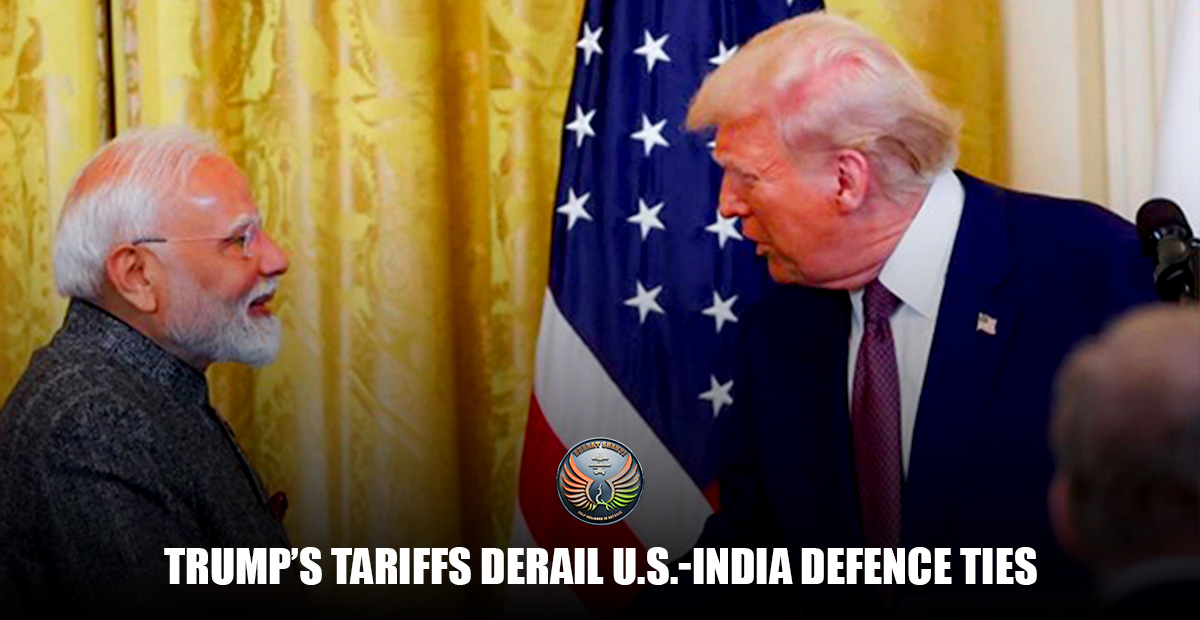
US President Donald Trump’s renewed imposition of tariffs and trade penalties on India has cast a shadow over multi-billion-dollar defence agreements, threatening to derail critical military modernisation efforts and complicate long-term strategic cooperation between the two nations.
Senior government officials have confirmed that India is now putting several high-value defence contracts with American firms on hold, a move widely seen as a direct response to Washington’s punitive trade measures. The freeze injects fresh uncertainty into what was until recently regarded as one of the world’s most promising emerging defence partnerships.
Major Defence Projects at Risk
At the centre of the disruption is the Indian Air Force’s over $20 billion tender to procure and locally manufacture 114 multi-role fighter aircraft, one of the largest global fighter acquisition programs. US defence giants Boeing and Lockheed Martin, both key contenders, had offered to shift production to India under the ‘Make in India’ initiative. But with bilateral tensions rising, the future of the deal hangs in the balance.
Also stalled is the contract for six additional Boeing P-8I long-range maritime surveillance aircraft, critical to India’s naval reconnaissance capabilities. The aircraft have proven instrumental in tracking Chinese activity near the Line of Actual Control (LAC) and bolstering India’s maritime presence in the Indo-Pacific.
Meanwhile, India’s plans to acquire Stryker armoured fighting vehicles, including amphibious variants and Javelin anti-tank missile integration, are now facing delays. Talks for establishing a global Stryker manufacturing hub in India, along with joint production of Javelin missiles with Bharat Dynamics Limited, are similarly under threat.
Rotary-wing platforms like the AH-64E Apache attack helicopters and CH-47F Chinook heavy-lift helicopters, both produced by Boeing and already in Indian service, may see disruptions in future orders and logistics support.
Operational Capabilities in the Crosshairs
The ripple effects of the trade fallout could also compromise the operational readiness of American-origin platforms already inducted by Indian forces.
The Indian Air Force’s strategic airlift capabilities, anchored by the C-17 Globemaster III and C-130J Super Hercules aircraft, depend on consistent spares and support from the US. Any export restrictions or supply chain disruptions could erode mission readiness.
Similarly, the Indian Navy’s surveillance and anti-submarine warfare efforts may be hindered if logistical support for the P-8I fleet and MH-60R Seahawk helicopters is affected. These platforms are vital in maintaining maritime domain awareness amid increasing Chinese naval forays into the Indian Ocean.
Air Defence and Firepower Vulnerabilities
India’s plans to operationalise the NASAMS-II air defence system over New Delhi, aimed at protecting the capital from aerial threats, may be jeopardised. The system relies on US components and technical assistance, both of which may now be in doubt.
Also at risk are precision-guided munitions like Hellfire missiles and Excalibur artillery rounds, which are central to India’s evolving high-precision strike capabilities. Disruptions in their supply could create significant gaps in battlefield lethality.
Strategic Technology Ties Under Pressure
Perhaps the most enduring damage lies in the potential stalling of strategic technology partnerships. The co-development of the GE F414 engine for India’s indigenous Tejas Mk2 fighter, as well as the planned acquisition of advanced MQ-9B Sea Guardian armed drones, may be put on the back burner amid rising unpredictability in US export policy.
A Delicate Diplomatic Balancing Act
Despite the escalating uncertainty, New Delhi remains publicly committed to strengthening defence cooperation with Washington.
“We have a strong defence partnership with the US, which has been strengthening over the last several years,” Ministry of External Affairs Spokesperson Randhir Jaiswal said last week. He added that the relationship has scope to expand further under the newly introduced COMPACT framework, Catalysing Opportunities for Military Partnership, Accelerated Commerce and Technology, launched during the recent Trump-Modi summit.
However, strategic circles in New Delhi warn that unless trade frictions are resolved swiftly, India may further diversify away from US defence suppliers, turning instead to indigenous solutions, European partners, or even Latin American options to shield its modernisation drive from geopolitical crosswinds.
Huma Siddiqui


