



Preface
This is the 10th year of BharatShakti being operational. Along with a host of other engrossing activities that we have initiated on our platform, we are also reproducing a series of old nuggets that we had published as Opinion pieces in these intervening years. They recall our objective at BharatShakti of providing you a deep insight and intellectually enriching reading on issues that are of strategic import for our defence and its core strength- the defence and aerospace industry. We do hope you will read and relish this journey
This article was first published on September 9, 2025
………………………………………………………………………………….
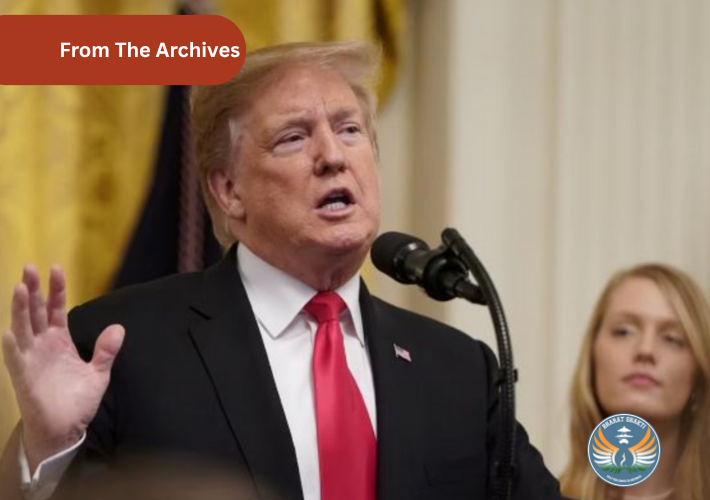
When Donald Trump accused India of “fuelling Russia’s war against Ukraine,” his comments quickly became a topic of discussion in Washington and Europe, highlighting yet another instance of his combative foreign policy rhetoric. However, a new report by the Observer Research Foundation (ORF) suggests that Trump’s remarks may be less about India’s actions and more about deflecting attention from a more uncomfortable truth: the United States has been the largest economic beneficiary of the Ukraine conflict. Since Russia invaded Ukraine in February 2022, the US defence industry has experienced significant growth, with record-breaking increases in orders, exports, and profits.
The ORF report highlights how the war has further cemented the US defence sector’s position as a dominant global arms supplier. Between 2020 and 2024, nearly half of Ukraine’s imported arms have come from the US, which represents close to 10% of total American arms exports. Since the beginning of the war, the US has provided at least $66.9 billion in military aid to Ukraine, but the nature of this assistance has now shifted from grants to highly profitable sales.
The US Military-Industrial Complex Recharged
The ORF report describes the Ukraine war as a catalyst for “explosive” growth in America’s military-industrial base. Since the Russian invasion in February 2022, the US defence sector has expanded its order books, boosted exports, and reaped surging profits, while entrenching its grip on NATO allies’ procurement systems.
Between 2020 and 2024, 45% of Ukraine’s imported arms came from the US, accounting for nearly 10% of total American arms exports. Over the same period, Washington’s share of global arms exports rose from 35% (2014–19) to 43% (2020–24).
Military assistance to Kyiv has also been staggering. From February 2022 to date, the US has provided almost $66.9 billion in direct military aid. But crucially, the trend is shifting. Whereas in the early stages of the war, Washington largely footed the bill, by 2024, the mechanism was pivoting toward sales financed by NATO partners and other allies.
From Aid to Sales: NATO Foots the Bill
The shift from aid to sales became stark in 2025. In August, the Trump administration approved an $825 million sale of extended-range attack munitions to Ukraine, with funding sourced from NATO states including Denmark, Norway, and the Netherlands. This model – NATO pays, US firms supply – has become the new template.
At a July 14, 2025, meeting between Trump and NATO Secretary-General Mark Rutte, allies agreed to channel more than $10 billion into American arms purchases through the NATO Pooled Ukraine Readiness Line (PURL) initiative. Each participating state is required to fund $500 million tranches, locking them into sustained procurement commitments. Within weeks, European countries, including the Netherlands, Denmark, Norway, Sweden, Germany, and Canada, had pledged nearly $2 billion in pooled funding, all of which was funnelled toward US-made weapons.
It represents not just burden-sharing but burden-shifting – away from Washington’s taxpayers and onto America’s allies, while still ensuring the lion’s share of contracts flow to the US defence sector.
Profits Surge Across the Board
The financials highlight the war-driven boom. In 2024 alone:
- Foreign Military Sales (FMS) hit $117.9 billion, up 45.7% from 2023.
- Direct commercial sales reached $200.8 billion, rising 27.6% year-on-year.
- Five US defence majors – Lockheed Martin, RTX, General Dynamics, Northrop Grumman, and Boeing – captured over a third of all Pentagon contracts.
The ORF report notes that these gains are not isolated to Ukraine. Continuous conflicts from Iraq and Afghanistan to the ongoing contest with China have created steady windfalls. Yet the Ukraine war has turbocharged the cycle, pushing NATO to pledge defence spending increases to 5% of GDP by 2035, a 150% jump from the long-standing 2% target.
Trump’s Rhetoric vs. Trump’s Record
Trump’s denunciations of India – accusing New Delhi of indirectly bolstering Moscow – contrast sharply with his own administration’s quiet entrenchment of the war economy. Since taking office in January 2025, he has repeatedly claimed that “under my leadership, the war would not have happened.” Yet, in practice, his government has doubled down on the NATO-driven funding mechanisms that keep Ukraine well-supplied while fuelling America’s arms industry.
In December 2024, as President-elect, Trump criticised the Biden administration’s decision to allow Ukraine to use US-made long-range weapons against Russia. However, the ORF data indicate that under Trump’s tenure, the shift to sales has intensified, creating a self-reinforcing system where NATO allies underwrite US weapons production.
It exposes the contradiction at the heart of Trump’s narrative. By pinning blame on India, he obscures the reality that it is the United States’ own military-industrial complex that has been most “fuelled” by the conflict.
Eisenhower’s Warning Revisited
The report closes with a sobering reminder of Dwight D. Eisenhower’s 1961 farewell address, in which the former US President warned of the “unwarranted influence” of the military-industrial complex. Six decades on, the Ukraine conflict demonstrates how prescient that warning was.
Wars have become not only geopolitical struggles but also economic engines for America’s defence industry. From Iraq and Afghanistan to Ukraine, each conflict has entrenched a cycle of rearmament and profit-seeking, shaping Washington’s foreign policy incentives in ways that encourage perpetual confrontation.
Conclusion: Deflection and Dependency
Trump’s tirade against India may play well to his domestic audience, tapping into his familiar rhetoric of blame and deflection. But the ORF report makes clear that the true story of the Ukraine war is the re-energising of the US military-industrial complex.
By shifting costs onto NATO allies while monopolising supply chains, Washington has turned the conflict into a windfall for its defence sector. In this context, India’s role in the war – however Trump frames it – is peripheral compared to the structural dependence the US has built between European security and American arms.
The Ukraine conflict may have drained European treasuries, battered Ukraine’s infrastructure, and tested Russia’s resilience, but for the United States, it has been nothing short of a defence industry jackpot.
Team BharatShakti


