


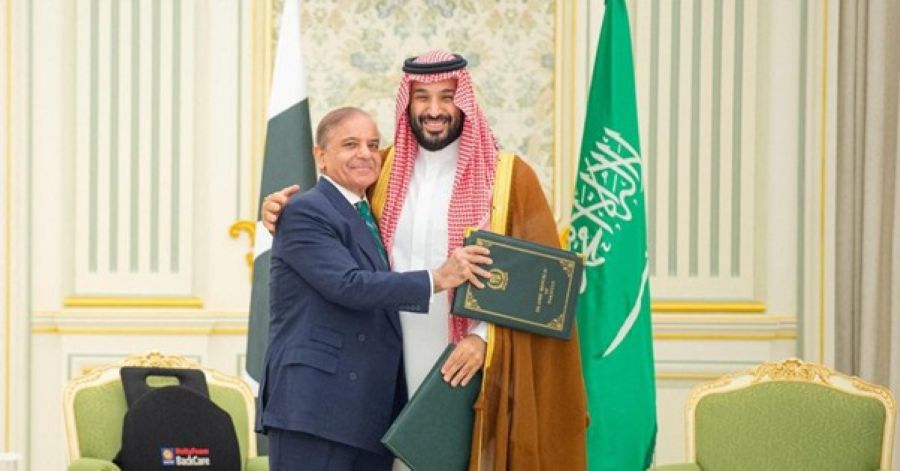
Saudi Arabia and Pakistan have signed a Strategic Mutual Defence Agreement that pledges a collective military response in case of external aggression, a first-of-its-kind pact between the two Islamic powers that could reshape the strategic landscape of the Middle East and South Asia.
The agreement, inked during Pakistan Prime Minister Shehbaz Sharif’s state visit to Riyadh, marks the formal institutionalisation of long-standing military ties between the two nations. It comes amid intensifying global realignments, with Saudi Arabia apparently moving away from its traditional dependence on the United States for security, and toward a more diversified and nuclear-backed security arrangement.
A New Strategic Bloc Emerges
The joint statement described the pact as a “comprehensive defensive agreement that encompasses all military means,” a phrase interpreted as signalling access to Pakistan’s nuclear deterrent. Though not confirmed, senior Saudi officials have declined to deny the nuclear aspect of the agreement.
Geopolitical observers are calling this development the Middle East’s most consequential security alignment in decades, with one senior diplomat noting, “This may be the U.S.’s Suez moment.”
The pact effectively introduces a new nuclear-backed axis in the region, counterbalancing the US-Israel alignment. Pakistan, notably, does not adhere to a “no first use” nuclear policy, raising concerns about escalation risks in future conflicts.
Implications for India: Strategic, Economic, and Diplomatic
India reacted cautiously to the development, stating that it had been aware of the ongoing discussions between Riyadh and Islamabad.
“We will study the implications of this development for our national security as well as for regional and global stability,” said Randhir Jaiswal, official spokesperson of the Ministry of External Affairs. “The government remains committed to protecting India’s national interests and ensuring comprehensive national security in all domains.”
However, strategic analysts in New Delhi are treating the development with concern for several key reasons:
Security Threat from the West: With Pakistan, India’s main adversary, now a formal military guarantor of Saudi Arabia, one of India’s largest energy suppliers, the implications for India’s energy security and strategic posture are significant.
Death Knell for IMEC? The Saudi shift could severely undermine the India-Middle East-Europe Corridor (IMEC), the Biden administration’s flagship initiative aimed at linking India to Europe via Saudi Arabia as a counter to China’s Belt and Road Initiative. If Riyadh aligns further with the China-Pakistan axis, IMEC’s viability comes into question.
Diplomatic Tightrope: The pact forces India into a more complex balancing act. While India has built robust ties with Riyadh in recent years, this agreement means that any future India-Pakistan tensions could pull Saudi Arabia into a position of alignment with Islamabad, a new and unwelcome scenario for Indian strategists.
The broader implications
Decline of U.S. Credibility: That such a pact was signed without significant U.S. resistance highlights the eroding influence of Washington in the Gulf. The U.S.’s traditional role as Saudi Arabia’s primary security provider is now being openly questioned.
Rise of Chinese Influence: With Pakistan importing over 80% of its military hardware from China, and given Beijing’s deep involvement in both CPEC and Saudi infrastructure, this pact indirectly strengthens China’s strategic reach into the Persian Gulf.
Petrodollar Under Threat: With Riyadh no longer solely reliant on U.S. protection, it may now be freer to price oil in non-dollar currencies, further weakening the global dominance of the U.S. dollar in energy markets.
Middle East Polarisation: The pact comes in the aftermath of Israel’s controversial strike on Doha earlier this month, and some analysts see it as a Gulf response to perceived Western indifference. The Saudi-Pakistan alliance could further complicate the already fragile prospects of Israel-Saudi normalisation, especially given that Pakistan does not recognise Israel.
India’s challenge now is to preserve its strategic foothold in the Gulf, while responding to the reality of a more assertive Pakistan, now armed with a new level of geopolitical legitimacy and strategic depth through its partnership with Riyadh.