



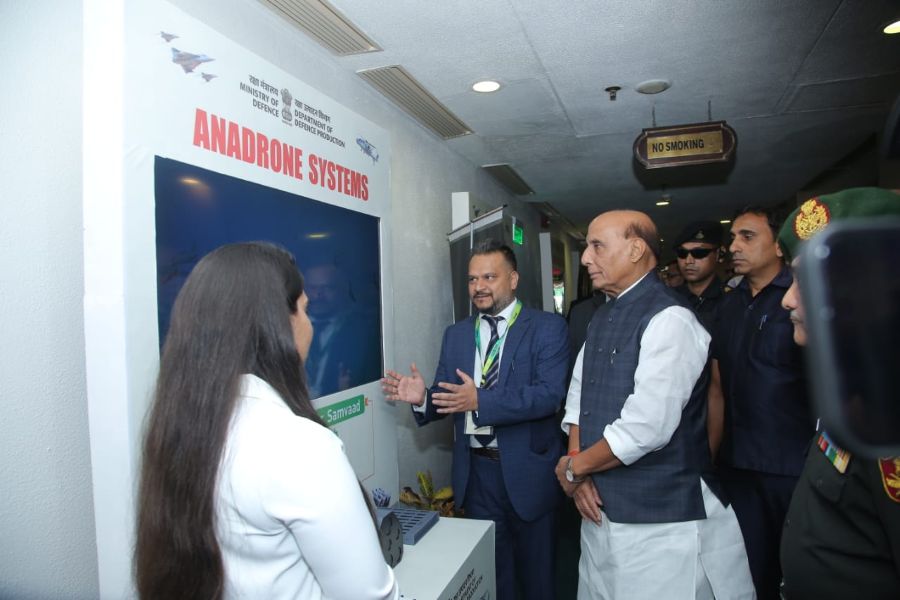
The nature of warfare is shifting rapidly, with future conflicts expected to be shaped increasingly by cutting-edge technologies, such as artificial intelligence, autonomous systems, and quantum computing. It was a key theme during the ‘Raksha Navachar Samvaad’ interaction with iDEX startups held in New Delhi.
Speaking at the event, Defence Minister Rajnath Singh said, “The battlefield has changed. The wars of tomorrow will be fought with algorithms, autonomous systems and AI.” He added that technologies such as drones, anti-drone systems, quantum computing, and directed-energy weapons will define the way wars are fought in the coming years. He referred to the recent Operation Sindoor as an example of this evolving trend.
The event, organised by Innovations for Defence Excellence (iDEX) under the Ministry of Defence, brought together innovators, startups, officials, and industry leaders to discuss advancements in defence technology and innovation.
Push for Self-Reliance and Indigenous Innovation
Singh highlighted India’s growing focus on indigenisation, noting that capital acquisitions from domestic sources have increased significantly, from Rs 74,000 crore in 2021–22 to Rs 1.2 lakh crore in 2024–25. He described this as more than a fiscal shift, calling it “a change in mindset, from dependence to confidence.”
He also pointed out that under India’s public procurement policy, at least 25% of annual defence procurement is reserved for Micro and Small Enterprises (MSEs), with over 350 items specifically earmarked for them.
India’s First Defence Unicorn?
Addressing the country’s startup ecosystem, Singh called on innovators to set ambitious goals and work towards creating India’s first defence-sector unicorn. “We have over 100 unicorns today, but none in defence. Let the first emerge from among you, it will be a matter of national pride,” he said.
Since its launch in 2018, the iDEX initiative has supported over 650 startups and facilitated the procurement of prototypes worth over Rs 3,000 crore. Singh described this progress as a major step forward in democratising defence innovation in India.
Policy Framework
Singh outlined several reforms aimed at supporting startups and MSMEs in the sector. These include the upcoming Defence Procurement Manual (DPM-2025), which will provide five-year assured orders (extendable by an additional five years), and ongoing updates to the Defence Acquisition Procedure (DAP) to streamline trials and procurement processes.
He also referred to schemes such as the Technology Development Fund, the Defence Testing Infrastructure Scheme, and self-certification provisions as part of a broader strategy to strengthen innovation in the defence ecosystem.
“Our aim is to make India not only a defence manufacturer but also a defence innovator for the world,” he said.
Global Recognition and Partnerships
The minister acknowledged the contributions of Indian startups such as Refi M. Fibre and Gravity Systems, whose technologies were used in Operation Sindoor and are now gaining attention on global platforms, including the Dubai Airshow 2025.
He added that strategic partnerships are being formed with agencies such as the Department of Science & Technology, DPIIT, and financial institutions to provide end-to-end support to defence startups, from early-stage ideas to full-scale production.
The minister concluded by stating that defence manufacturing has become a key sector for private investment, R&D, and job creation under the Aatmanirbhar Bharat initiative. He said that with continued innovation and collaboration, India is well-positioned to become a leader in defence technology.
The event also featured panel discussions on topics such as scaling defence startups, bridging the gap between innovation and production, and accelerating self-reliance through R&D partnerships. Senior officials, including Chief of Defence Staff General Anil Chauhan, DRDO Chairman Samir V. Kamat, and Secretary (Defence Production) Sanjeev Kumar, were also present.
Huma Siddiqui