






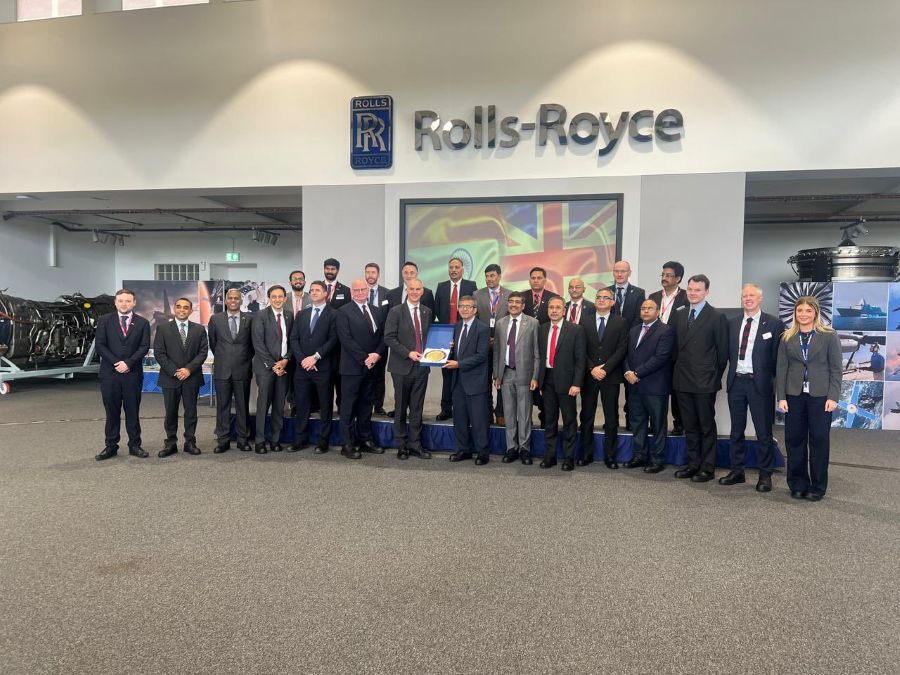
United Kingdom Prime Minister Keir Starmer will arrive in India on Wednesday for his first official visit, with defence cooperation and advanced technology high on the agenda. The two-day trip marks a potential inflection point in the India-UK Comprehensive Strategic Partnership, with renewed discussions expected on jointly developing a next-generation fighter jet engine.
Focus: Fighter Engine Co-Development Back on the Table
At the centre of the dialogue is the proposed co-development of an advanced jet engine that could power the second tranche of India’s Advanced Medium Combat Aircraft (AMCA). British defence major Rolls-Royce, a long-time technology partner of India, is keen to secure the deal as London pushes to expand strategic defence ties.
While India earlier announced plans to collaborate with France’s Safran for the AMCA engine, British officials remain hopeful of re-entering the contest. Sources in London indicate that no final decision or formal communication has yet been conveyed to the UK government or Rolls-Royce, keeping the door open for negotiations.
“Rolls-Royce is the only company to have designed and developed a brand-new jet engine in the past two decades,” said a senior official familiar with the discussions. “We are confident of offering India deep technology transfer and shared intellectual property under a trusted partnership.”
Engine Cooperation as Cornerstone of Defence Roadmap
The jet engine initiative is part of a 10-year Defence Industrial Roadmap unveiled by India and the UK earlier this year. It identifies priority areas such as Jet Engine Advanced Core Technologies (JEACT) and Electric Propulsion Capability Partnership (EPCP), aimed at co-developing high-end propulsion and electric systems with shared IP rights and production in India.
India’s Shift: From Buyer to Builder
The evolving partnership reflects India’s strategic transition from being a major defence buyer to a co-designer of military technology. New Delhi’s procurement philosophy is increasingly driven by technological sovereignty and capability-building, with a preference for joint development and indigenous manufacturing.
British defence companies such as BAE Systems and Webley & Scott are already producing equipment locally in India, while Rolls-Royce continues to deepen its engagement with Hindustan Aeronautics Limited (HAL) across aerospace and marine propulsion programmes.
Expanding Military and Maritime Collaboration
Starmer’s visit is also expected to yield announcements on joint training, maritime security, and intelligence sharing. The two sides are advancing plans for a Regional Maritime Security Centre of Excellence to enhance surveillance and domain awareness across the Indo-Pacific. In this area, the strategic priorities of both nations are increasingly converging.
Bilateral military exercises—Ajeya Warrior (Army), Konkan (Navy) and Indra Dhanush (Air Force)—are set for expansion, with proposals for embedded training and shared logistics hubs.
AI, Cyber, and Quantum: The Next Frontier
Beyond defence hardware, the Bilateral Technology Security Initiative (TSI) will drive cooperation in AI, cybersecurity, quantum computing, and advanced materials, reinforcing India and the UK’s roles as innovation partners in next-generation warfare and digital resilience.
Indo-Pacific and Vision 2035
With British naval assets now stationed across Singapore, Bahrain, and the British Indian Ocean Territory, the UK’s presence in the Indo-Pacific complements India’s maritime vision. The ongoing Exercise Konkan underscores this convergence, as both sides explore joint patrols and expanded intelligence-sharing frameworks.
Starmer’s visit is expected to accelerate timelines on key defence projects, especially the jet engine collaboration, while advancing the India-UK Vision 2035—a roadmap linking trade, technology, and security into a long-term strategic compact.
Huma Siddiqui