



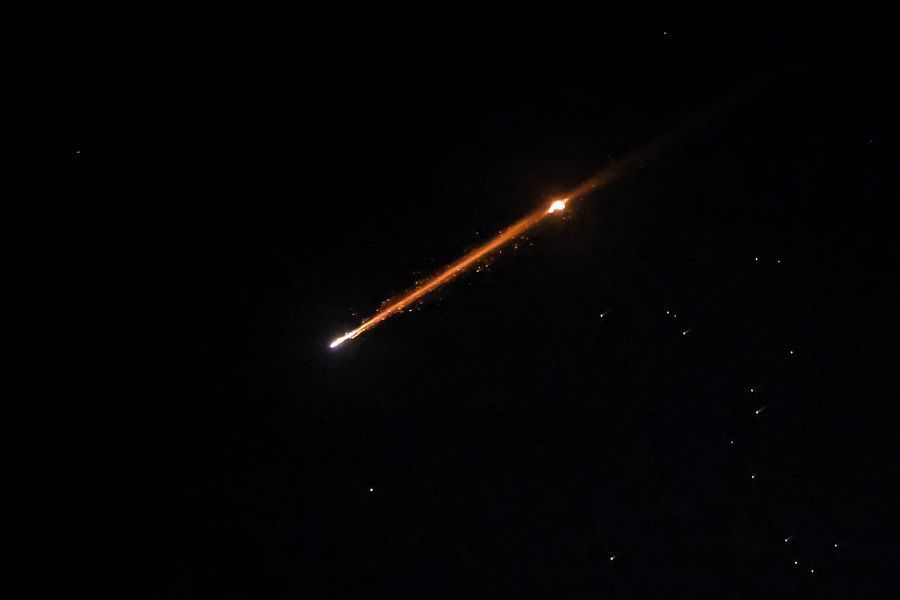
Iran’s latest wave of strikes on Israeli and U.S.-linked targets marks a shift in both intensity and capability, with the Islamic Revolutionary Guard Corps (IRGC) showcasing advances in missile precision, range, and targeting.
At the centre of the operation—referred to as True Promise 4—is the reported debut of the “Nasrallah” missile system. Iranian claims suggest the system was used to target major energy infrastructure, including oil facilities in Haifa and Ashdod. The missile is described as an upgraded, guided version of the Ghadr ballistic missile, indicating an evolution from traditional fixed-trajectory systems to ones capable of adjusting course in the final phase of flight, complicating interception efforts.
While detailed specifications remain undisclosed, analysts assess that the system likely falls within the medium- to long-range ballistic missile category and prioritises precision targeting over area bombardment. It may also have the range to strike targets beyond Iran’s immediate region. The naming of the system carries political overtones, linking it to broader regional narratives while underscoring strategic targets such as Haifa.
The Nasrallah system was not deployed in isolation. Reports indicate that Iran used a mix of missile platforms, suggesting a layered and coordinated strike strategy. Among the systems cited are the Ghadr missile, including multi-warhead variants aimed at complicating air defence responses; the Kheibar Shekan, a newer solid-fuel missile designed for faster launch and survivability; the Qiam missile, a liquid-fuel system noted for manoeuvrability during descent; and the Zolfaghar, a precision-guided missile typically used for shorter-range tactical strikes.
Targets reportedly extended beyond Israeli infrastructure to include U.S.-linked military facilities such as Al-Kharj, Al Dhafra, and Sheikh Isa bases, which are associated with air operations, logistics, and command functions.
The combination of solid- and liquid-fuel missiles is seen as significant. Solid-fuel systems allow for quicker launches and reduced pre-launch detection, while liquid-fuel missiles can carry heavier payloads or achieve longer ranges. Using both types in tandem increases operational unpredictability.
A notable aspect of the latest strikes is the apparent emphasis on precision over volume. By deploying guided ballistic missiles, Iran appears to be focusing on accurately hitting critical infrastructure—including military hubs, communications networks, and energy facilities—rather than relying on large-scale saturation attacks. This approach suggests a strategy to maximise impact while conserving resources.
Alongside its missile operations, Iran is also highlighting developments in air defence. Reports indicate that an infrared search and track (IRST) system was used to detect a U.S. F-35 stealth fighter. Unlike radar-based systems, IRST relies on heat signatures, which stealth aircraft are unable to fully mask.
Iran is also believed to have deployed the “Majid” (AD-08) short-range air defence system, a heat-seeking missile platform, in what it describes as a successful engagement against an F-35.
Taken together, the developments point to a broader shift in Iran’s military approach, combining improved missile guidance, diversified launch systems, and enhanced air defence capabilities in its latest round of retaliation.
Huma Siddiqui