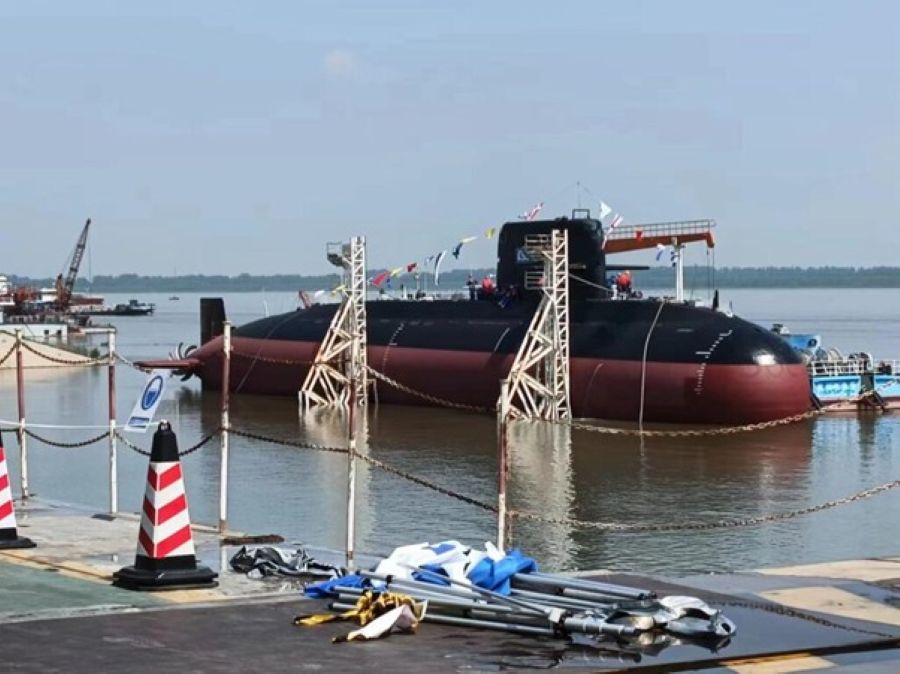
Pakistan on Thursday commissioned its first Hangor-class submarine, PNS/M Hangor, at a ceremony in Sanya, China, marking a significant step in Islamabad’s efforts to modernise its undersea fleet. President Asif Ali Zardari attended the event alongside Chief of Naval Staff Admiral Naveed Ashraf, according to an official statement.
Zardari, who arrived in China over the weekend, travelled from Changsha in Hunan province to Sanya in Hainan for the commissioning ceremony. The induction of the submarine comes amid growing emphasis by regional navies on securing sea lanes and maintaining operational presence in contested waters.
Speaking at the ceremony, Pakistan’s Navy Chief underscored the importance of advanced naval capabilities amid increasing uncertainty at key maritime choke points. He said the Hangor-class, equipped with modern sensors, advanced weapons and air-independent propulsion (AIP), would enhance Pakistan Navy’s ability to safeguard sea lines of communication across the Arabian Sea and the wider Indian Ocean.
The submarine is part of an eight-boat programme signed with China in 2015, estimated at around $5 billion. Under the agreement, four submarines are being constructed in China, while the remaining four are being built at Karachi Shipyard under a technology transfer arrangement.
Beyond the induction itself, the programme points to a deeper shift in China’s defence manufacturing capabilities. The Hangor-class is derived from China’s Type 039A Yuan-class submarines, which had faced delays in export configurations due to restrictions on German-origin propulsion systems. With the introduction of a Chinese-developed diesel engine, widely believed to be based on earlier European designs, Beijing appears to have reduced its dependence on foreign suppliers for critical submarine components.
If the new propulsion system proves reliable, it could open the door for China to expand its footprint in the global naval export market, particularly among countries seeking cost-effective alternatives to Western platforms.
For India, the development carries both operational and strategic implications. Pakistan’s acquisition of AIP-capable submarines is expected to improve its ability to conduct longer-duration, low-detection patrols in the northern Arabian Sea, strengthening its anti-access posture in waters close to India’s western seaboard.
The submarines are expected to be equipped with torpedoes and anti-ship missiles, and could potentially carry submarine-launched cruise missiles, adding a new dimension to Pakistan’s deterrence posture at sea.
However, India retains an advantage in the undersea domain through its nuclear-powered submarine fleet, including ballistic missile submarines that offer longer endurance and sustained deployment capability.
India has in recent years commissioned three indigenously developed nuclear-powered ballistic missile submarines (SSBNs)– the INS Arihant, INS Arighaat and INS Aridaman – with another undergoing sea trials. These platforms provide New Delhi with a strategic edge in terms of reach and persistence. It gives the Indian Navy a credible strategic deterrence and endurance advantage, which Pakistan’s upcoming Hangor-class fleet, despite its AIP capabilities, cannot match in terms of persistence or reach.
Also Read: China-Pakistan Tango at Sea: What Beijing’s Submarine Delivery in 2026 Means for India
Even so, Pakistan’s expanding conventional submarine fleet is likely to complicate the operational environment. Pakistan’s induction of AIP-equipped submarines will narrow the tactical gap, especially in the northern Arabian Sea, by enhancing its stealth and endurance in coastal and near-sea operations, areas of key concern for India’s western seaboard defences. Indian naval planners may need to place greater emphasis on anti-submarine warfare, surveillance, and undersea domain awareness to maintain their advantage.
The commissioning also reflects China’s broader maritime strategy in the Indian Ocean, where it has steadily expanded its presence through infrastructure, partnerships and defence exports. By supporting Pakistan’s naval modernisation, Beijing not only strengthens a key strategic partner but also enhances its own familiarity and access in a region critical to global energy and trade flows.
While the Hangor-class may not dramatically alter the balance of power, it marks a gradual shift in the undersea dynamics of the region, one that New Delhi will be watching closely.
Team BharatShakti