


The strategic landscape of the Indo-Pacific is undergoing a subtle but consequential shift. During the first administration of Donald Trump, the Indo-Pacific emerged as a central organising concept of American strategy, with platforms such as the Quad receiving sustained political emphasis. In the current phase, however, that centrality appears less pronounced. The Indo-Pacific remains important, but Washington no longer frames it as the primary theatre of strategic articulation.
This change does not imply American disengagement. Rather, it introduces a degree of strategic ambiguity. For regional powers, the implication is clear: the responsibility for maintaining balance in the Indo-Pacific is increasingly shifting inward, toward those who are geographically and materially invested in its stability.
Simultaneously, developments in Northeast Asia are sharpening regional dynamics. The re-election of Sanae Takaichi has reinforced Tokyo’s more explicit strategic posture, particularly regarding Taiwan contingencies. China’s response has been consistent with its broader pattern of calibrated assertiveness, as it has expanded its maritime and grey-zone activities across the Indo-Pacific. These actions are not episodic; they are part of a sustained effort to reshape regional realities without triggering overt conflict.
For India, Indo-Pacific stability is not a distant concern. It is a direct strategic imperative. India’s geographic position, bridging the Indian Ocean and the wider Pacific, naturally situates it at the centre of regional dynamics. Yet India’s approach has remained consistent: it avoids formal alliances and instead favours flexible, interest-based partnerships that preserve strategic autonomy.
This preference is not merely historical; it is strategic. Rigid alliances risk hardening fault lines, while ambiguity backed by capability can create deterrence without escalation. The challenge, therefore, lies in designing frameworks that enhance regional resilience without transforming the Indo-Pacific into a theatre of competing military blocs.
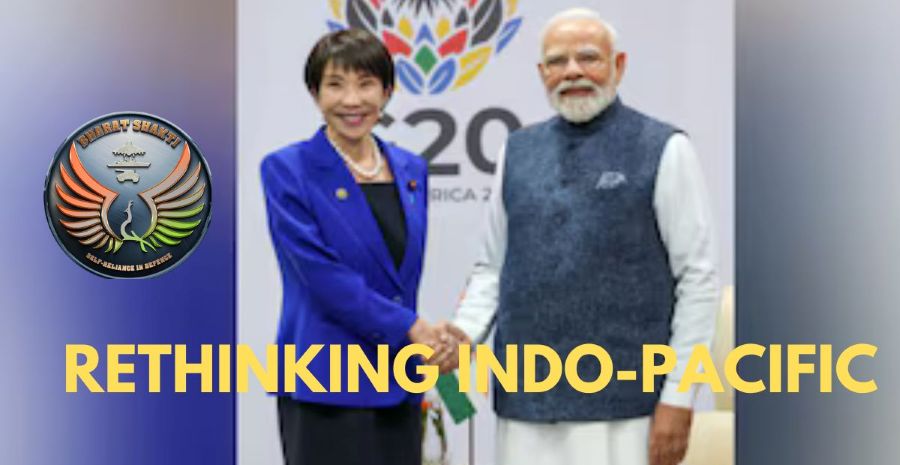
It is in this context that recent developments in India–Japan defence cooperation acquire deeper significance. Japan’s decision to fundamentally revise its long-standing restrictions on defence exports marks a structural shift in regional security economics. For decades, Tokyo’s technological capabilities remained constrained by policy. That constraint has now been lifted.
The implications are immediate and far-reaching. Japan can now engage in full-spectrum defence industrial cooperation, including the export of advanced military platforms and technologies. India, identified as a trusted partner, stands to benefit directly from this shift.
Emerging discussions on co-development and co-production of advanced systems, including next-generation naval platforms such as stealth frigates, indicate a transition from transactional engagement to an industrial partnership. It is not a buyer-seller relationship. It is the beginning of a co-creation ecosystem.
For India, this aligns seamlessly with its emphasis on defence indigenisation. For Japan, it revitalises its defence industrial base through external collaboration. For the Indo-Pacific, it introduces a new axis of capability generation that is both credible and stabilising.
Yet the true significance of this shift lies not in bilateral gains, but in what it enables at the regional level.
In this context, a JAI (Japan-ASEAN-India) Indo-Pacific construct emerges as a strategically relevant proposition. The core strength of JAI lies in complementarity. Japan contributes high-end technology, precision manufacturing and advanced systems integration. India brings scale, cost-effective production and a rapidly evolving defence industrial ecosystem. ASEAN provides geographical centrality, operational context, strategic legitimacy and resilience to the supply chain.
Japan’s revised export policy acts as the critical enabler that was previously missing from this framework. What was once conceptually sound but structurally constrained is now operationally viable.
Through JAI, defence industrial cooperation can be extended to Southeast Asia in a manner that strengthens capability without imposing alignment.
ASEAN occupies a pivotal position in the Indo-Pacific. It sits astride critical sea lanes and maritime chokepoints, yet many of its member states face capacity gaps in areas such as maritime domain awareness, coastal defence and logistics. Addressing these gaps is essential not only for national security but for maintaining the openness of the wider maritime commons.
JAI offers a pathway to do precisely that.
By focusing on platforms such as patrol vessels, coastal surveillance systems, unmanned systems and communication networks, the initiative enhances what may be termed deterrence by denial. It raises the cost of coercion without altering the political posture of states.
This distinction is crucial.
Traditional alliance systems generate deterrence through collective military commitment, often backed by forward deployment. While effective, they also risk escalation and bloc formation. JAI, by contrast, generates deterrence through distributed capability. It enables states to defend their own interests more effectively, without being drawn into formal security alignments.
In doing so, it preserves strategic autonomy, which remains a central concern for both India and ASEAN.
For ASEAN states, this model aligns with their long-standing preference for inclusive and non-binary frameworks. It strengthens ASEAN centrality not as a rhetorical construct, but as a functional reality supported by capability.
For India and Japan, it provides a means to contribute to regional stability without assuming the role of security guarantors. They act as enablers rather than anchors of a military bloc.
Importantly, this approach also moderates escalation dynamics. Defence industrial cooperation operates below the threshold of overt militarisation. It is gradual, scalable and sustainable. It builds resilience over time rather than projecting power abruptly.
In a region where strategic signalling is often calibrated and incremental, such an approach is particularly effective.
The convergence of Japan’s export policy shift and India–Japan defence industrial cooperation has therefore created a window of opportunity. It allows for the operationalisation of a framework like JAI that was previously constrained by policy limitations.
The broader implication is clear. The future of Indo-Pacific stability may not lie in expanding alliances, but in strengthening networks of capability.
The JAI Indo-Pacific construct demonstrates that it is possible to generate credible deterrence without entering into formal military alliances. It offers a model in which stability is achieved through capacity building, complementarity, and distributed resilience.
In that sense, JAI is more than a trilateral arrangement. It is a strategic approach that reconciles deterrence with autonomy, and capability with stability.
As the Indo-Pacific continues to evolve, such models may well define the next phase of regional order.
Lakshman Kumar