China’s push into robotics is no longer limited to factories or novelty demonstrations – it is steadily expanding into governance, surveillance, and now, the battlefield. From robot traffic police units unveiled last week in Hangzhou to unmanned delivery systems and AI-driven monitoring, Beijing is embedding automation into everyday systems. But behind this visible shift lies a far more consequential transformation: how China intends to fight future wars.
A detailed report by the Foundation for Defence of Democracies (FDD), titled “China’s War Wolves: From Commercial Tech to Combat Power,” argues that China is not just modernising its military, it is restructuring it around artificial intelligence, robotics, and autonomous systems. The report highlights how civilian innovation is being rapidly converted into combat capability.
At the core of this shift is the concept of “intelligentised warfare,” a term the Chinese military uses to describe the next phase of conflict. It goes beyond traditional mechanisation and even digital warfare, focusing instead on integrating AI, big data, and autonomous systems into real-time operations. The objective is clear – to gain an advantage by seeing faster, deciding faster, and acting faster than an adversary.
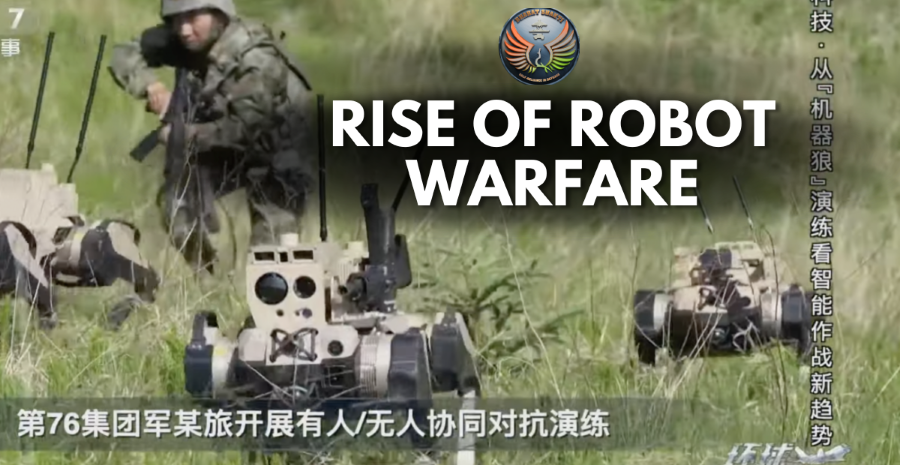
One of the most striking examples is the development of robotic quadrupeds, often referred to in Chinese reporting as “robotic wolves.” Originally derived from commercial robotics platforms, these machines are now being adapted for military use. According to the FDD report, they are capable of conducting reconnaissance, navigating complex terrain using LiDAR sensors, carrying supplies, and potentially supporting combat operations.
Rather than operating alone, these robots are designed to function as part of coordinated, networked units. A “wolf pack” can share data, map environments, and assist troops in real time. It allows the Chinese military to extend its operational reach while reducing the direct exposure of human soldiers in high-risk environments such as urban warfare or amphibious assaults.
The strategic logic is significant. By shifting the most dangerous frontline tasks to machines, the Chinese military can reduce casualties while maintaining operational momentum. The report suggests this could influence Beijing’s risk calculus. A force that relies more on expendable systems than human lives may be more willing to push forward in high-intensity conflicts.
Taiwan is widely seen as a potential testing ground for such capabilities. Any cross-strait conflict would involve dense urban terrain, contested coastlines, and disrupted communications conditions where autonomous systems could play a decisive role. Robotic units could be deployed ahead of troops to scout positions, clear obstacles, or even absorb initial enemy fire during landing operations.
This transformation is being accelerated by China’s military-civil fusion strategy, which blurs the line between commercial and defence sectors. Private companies developing robotics, AI, and sensor technologies are effectively contributing to military capabilities. This approach allows China to leverage its vast technology ecosystem, reducing development timelines and scaling production more efficiently than traditional defence models.
However, the report also points to clear vulnerabilities. These systems rely heavily on communication networks, satellite navigation, and power supply chains. They can be disrupted by electronic warfare, cyberattacks, or even simple battlefield damage. Environmental factors, such as smoke, fog, or deliberate interference, can degrade sensors, including LiDAR and cameras.
Despite these limitations, the broader trajectory is unmistakable. China is moving towards a model in which human commanders set objectives, while machines increasingly execute them. This shift not only changes battlefield tactics but also raises deeper questions about control, accountability, and escalation in future conflicts.
The FDD report ultimately presents a stark assessment: China’s investment in robotics and AI is not just about technological advancement; it is about redefining warfare itself. If successful, it could lead to conflicts where speed, data, and machine coordination matter more than traditional military strength.
In that sense, China’s robotic push is not just a story of innovation. It is a signal of how the next generation of war may be fought and how quickly that future is approaching.
Resham Bhambani