



Pakistan’s attempts to project military success during Operation Sindoor collapsed against “hard facts”, the Indian military said on Thursday, asserting that Islamabad failed to inflict any major damage on Indian military infrastructure despite its aggressive claims after the four-day conflict last year.
Responding to a question from BharatShakti on Pakistan’s repeated claims of having caused substantial damage to India, Deputy Chief of the Air Staff (DCAS) Air Marshal Awadhesh Kumar Bharti said narratives and rhetoric could not substitute battlefield outcomes.
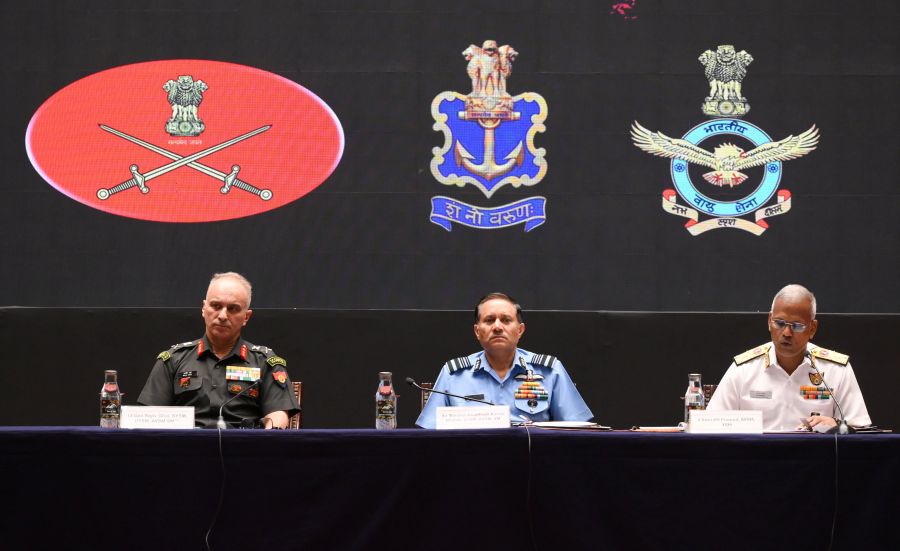
“They have not been able to inflict any major damage on our side. Neither any military infrastructure nor much of the civilian structures…whatever they may say, remember narratives and rhetoric do not give you victory. Victory is measured by hard facts,” he said during a tri-services interaction with the media in Jaipur on the sidelines of the Joint Commanders’ Conference and on the first anniversary of Operation Sindoor.
Air Marshal Bharti, who served as Director General of Air Operations during Operation Sindoor, said India had achieved all its military objectives before agreeing to a cessation of hostilities on May 10.
“We struck and decimated their nine terrorist camps on 7th May. The proof is there for everybody to see. We struck 11 of their airfields. We destroyed 13 of their aircraft either on the ground or in the air, including one high-value airborne asset at a record distance of 300 kilometres plus,” he said.
On why India agreed to halt military action, the Air Marshal said the mission had already been accomplished.
“Our mission was complete. But when the Pakistani establishment decided to side with terror and make it their own fight, we had no choice but to respond in kind,” he said.
“When we responded, it was lethal and ruthless. After taking the beating, the adversary’s senses kicked in. They asked for cessation of hostilities. We paused when the request came. We stepped back, but we didn’t blink. The message was delivered. Acts of terror will have consequences.”
The military leadership also dismissed suggestions that any foreign power mediated the cessation of hostilities.
No Terror Sanctuary Across the LoC Safe
Deputy Chief of Army Staff (Strategy) Lieutenant General Rajiv Ghai, who was Director General of Military Operations during the operation, said India’s “new normal” with Pakistan was now firmly established – any terror attack would invite punitive retaliation.
“We will hit everything…we will go after everything. I think that’s been made clear in the new normal that the Prime Minister stated last year. But the conditions, the timing and the method will be ours,” Lt Gen Ghai said.
Warning Pakistan over continued terror infrastructure across the Line of Control, he said India had mapped terror camps and launch pads in depth areas as well.
“We’ve identified terror launch pads, terror camps, terror infrastructure across the LoC… no sanctuary across the LoC is safe,” he said.
“The nature and numbers in these terror camps may keep fluctuating. Some of these camps and launch pads have moved further in depth, where they feel that they will be safer. No sanctuary is safe.”
Lt Gen Ghai also rejected Pakistan’s claims regarding Indian losses.
“Pakistan lost 100 soldiers. We have given out hard facts of military losses to Pakistan with irrefutable pictures and videos; show us one piece of evidence Pakistan has given about its claims,” he said.
Collusion between China and Pakistan
The Navy, meanwhile, underlined the growing importance of indigenous combat platforms in future conflicts.
Director General of Naval Operations (DGNO) Vice Admiral A. N. Pramod said platforms such as INS Vikrant, along with Kolkata and Visakhapatnam-class destroyers, validated India’s push for self-reliance in defence manufacturing.
“If challenged again, we will not merely respond, we’ll shape the battle space from the outset,” he said.
Vice Admiral Pramod also highlighted the deepening strategic and military alignment between China and Pakistan, noting Beijing’s refusal to condemn the Pahalgam terror attack.
“China refrained from condemning the Pahalgam attack. Similarly, when the UN Security Council press statements were made, China again influenced the process and references to The Resistance Front, directly involved in the attack, were not made,” he said.
“As General Ghai had mentioned, 80 per cent of Pakistan’s arms imports are from China. That’s a kind of economic, military and strategic relationship.”
On evolving missile threats from Pakistan backed by Chinese technology, Air Marshal Bharti said India was continuously upgrading its air defence network.
“India is constantly tracking evolving missile capabilities from Pakistan and China, while strengthening its own air defence network with S-400 systems and indigenous projects like Kusha and Sudarshan Chakra,” he said.
Procurement Drive on Full Swing
Two additional units of the Russian-origin S-400 are expected to be inducted this year, with one likely to be inducted this month and later towards the end of the year, bringing the total to 3 already operational with the Indian Air Force.
After Operation Sindoor, India is undergoing a significant transformation, involving new weapons, missiles, and upgrades to air defence systems and networks, encompassing both traditional and next-generation warfare. General Ghai remarked that Operation Sindoor was a pivotal moment in India’s strategic journey, stating, “It unfolded seamlessly and serves as the gold standard for operations.“
New Air Defence Shield, Space, AI
Deputy Chief of Integrated Defence Staff Lieutenant General Zubin A. Minwalla said India was now building an integrated and layered air defence architecture capable of dealing with drones, loitering munitions and missile threats simultaneously.
“We are working towards an integrated and layered architecture to ensure seamless protection against multiple threat vectors, including drones, loiter ammunition and missiles,” he said.
According to Lt Gen Minwalla, the Indian Army’s Integrated Air Command and Control System and the Akashteer battlefield air defence platform have already been linked to create a unified operational picture. These systems are now being integrated into a future Joint Operations Control Centre to improve real-time targeting and decision-making.
The officer also said India was integrating space-based ISR capabilities with air defence operations through close coordination with Indian Space Research Organisation and the Department of Space.
Simultaneously, a Defence Strategic Communication Division equipped with AI-enabled tools is being created to counter misinformation and information warfare in real time.
Calling Operation Sindoor a watershed moment, Lt Gen Ghai said the operation demonstrated India’s growing ability to conduct coordinated tri-service operations with precision.
“Operation Sindoor was a defining moment in India’s strategic journey. It played out in clockwork. It is the gold standard of operations,” he said.
Ravi Shankar, Jaipur

Dr Ravi Shankar has over two decades of experience in communications, print journalism, electronic media, documentary film making and new media.
He makes regular appearances on national television news channels as a commentator and analyst on current and political affairs. Apart from being an acknowledged Journalist, he has been a passionate newsroom manager bringing a wide range of journalistic experience from past associations with India’s leading media conglomerates (Times of India group and India Today group) and had led global news-gathering operations at world’s biggest multimedia news agency- ANI-Reuters. He has covered Parliament extensively over the past several years. Widely traveled, he has covered several summits as part of media delegation accompanying the Indian President, Vice President, Prime Minister, External Affairs Minister and Finance Minister across Asia, Africa and Europe.