Editor’s Note
In this piece, the author links the security of the Siliguri Corridor not only to military preparedness, but increasingly to political and demographic shifts unfolding across India’s eastern frontier. The article gains added relevance in the backdrop of the recent election results in Bangladesh, where the resurgence of Bangladesh Jamaat-e-Islami in border districts facing West Bengal and Assam has increased concerns over infiltration, radical networks and regional instability. Against this backdrop, the article stresses that coordination between New Delhi and the BJP-led governments in Assam and West Bengal will be critical to securing India’s vulnerable “Chicken’s Neck”.
The call for an all-of-nation approach to warfare is an adage universally echoed today. Such an approach, of course, includes the nation’s political leadership, including that at the state levels, especially the border states. These leaders have a huge role in strategising internal security and taking stock of external threats, allocation of funds to meet challenges, and ensuring the instruments involved – the services, border guarding forces, and central and state police forces – deliver in consonance with their respective mandates.
The geography of a nation and the states’ relationships with other nations, especially their neighbours, are also factors that exert greater influence on the multifarious issues that shape a robust national security architecture. Looking back at the Kargil Conflict between India and Pakistan in 1999, a major operational objective of General Parvez Musharraf, the then Pakistani Army Chief, was the capture of the Kargil heights, thereby enabling Pakistan to utilise these higher geographical features to dominate India’s supply routes to Leh and the Siachin glacier. He planned the utilisation of the terrain’s geographical advantage.
Vulnerabilities of Siliguri Corridor
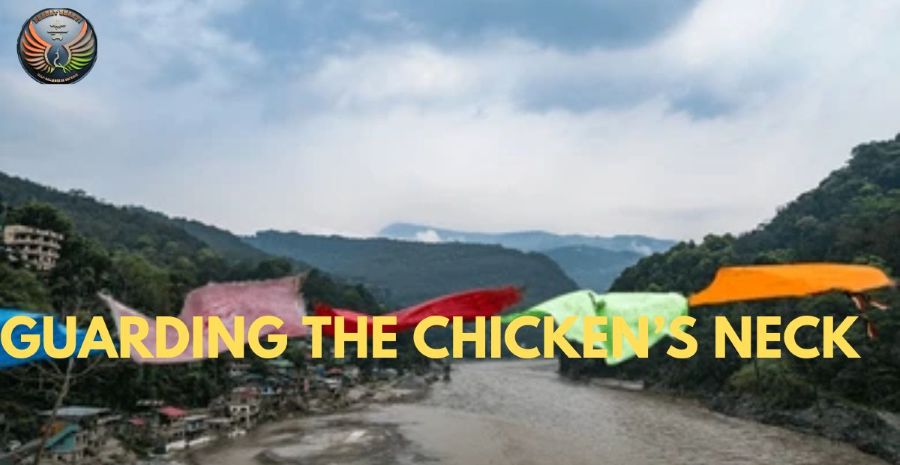
If the focus shifts to the geography of India’s Northeast, the Siliguri corridor stands out as a major vulnerability. Through this Corridor run the logistics lifelines to eight Indian states, including Assam, Meghalaya, Arunachal Pradesh, Mizoram, Nagaland, Manipur, Tripura and Sikkim. Over 50 million Indians reside in these states, and their day-to-day lives are heavily dependent on smooth passage through the Siliguri Corridor.
The Corridor starts in West Bengal and runs northeast for about 170 km. At its narrowest point, it measures just 21 km, forming a geographical neck that connects the Indian mainland to the eight northeastern states. The Siliguri corridor has Nepal to the west, Bhutan to the northeast, and Bangladesh to the south. In between Bhutan and the Indian state of Sikkim is a narrow wedge – the Tibetan Chumbi Valley area.
The national highway network passes through it. The railway link also runs through the Corridor. The road and rail networks carry essential goods for the five million people living east of Siliguri, approximately 5% of the Indian population. Critical oil pipelines also traverse through the Corridor. These links are also the backbone of military logistics required to maintain a substantial force that guards the Corridor and the borders beyond.
Operationally viewed, the Jampheri ridge in Bhutan overlooks the Siliguri corridor. The ridge provides direct observation into the corridor. The occupation of the ridge by hostile forces must be avoided at all costs. The Doklam standoff between Indian and Chinese soldiers of 2017 was triggered when the Chinese attempted to build a road towards Jampheri Ridge in Bhutanese territory that China also claims. The standoff lasted 73 days till the Chinese withdrew. However, they have erected structures in their areas that could be used as villages and also for billeting troops and warlike stores. They have also undertaken an infrastructure upgrade. According to Gen MM Naravane, retired Indian Army Chief, the Chinese are in the process of building another approach along the Amo Chu to Jampheri Ridge.
Insurgent groups and drug cartels utilise the corridor for human trafficking, smuggling, movement of insurgent cadres and their weapons and ammunition. Though insurgency in the region is receding, the situation requires close monitoring and quick reaction capability to stem the blowing up of incidents orchestrated by terror groups.
Indian border states have faced a regular influx of illegal migrants from neighbouring countries. The worst affected are the states of West Bengal and Assam, with the infiltrators being primarily Bangladeshi citizens. Allegations of lax state government agencies have been thick and fast in the past. The migration has led to demographic changes in the region, creating social tensions and violence.
It’s important to study the elections in Bangladesh and the Indian states of Assam and West Bengal. The February 2026 Parliamentary elections in Bangladesh helped the Jamaat-e-Islami, a fundamentalist party, make a major comeback. More alarmingly, most of Jamaat’s success is along the Indo-Bangla border belt, and that too across the West Bengal, Assam, and Meghalaya states of India. Across the border, in the elections, both Assam and West Bengal have opted for Bharatiya Janata Party-led governments, which is also the ruling party in New Delhi. Thus, the elections in Bangladesh aggravate vulnerabilities, while better coordination between New Delhi and the state administrations of Assam and West Bengal may be expected.
Mitigating Vulnerabilities
Indians have to ensure that relations with Bhutan remain strong. With Bhutan engaging China directly in dialogues to resolve boundary issues, it’s going to be a tightrope walk.
India-China relations need to retain their positive curve. However, the Indian response to Chinese incursions, should they again replay old cards, will need to be proportionate to deter such activities. Hopefully, the Indian response at Galwan in 2020 and in Eastern Ladakh would deter the Chinese from further misadventures.
Both the states of Assam and West Bengal have recently held elections, and the winning political parties have shown a strong commitment to addressing the issue of illegal migration. In fact, in Assam, the winning party has already completed a tenure in power and has actively undertaken the identification of illegal migrants. Such initiatives, like the SIR (Special Intensive Revision) of voter list, have helped identify false/ illegal voters.
An ideal situation would be for illegal migrants to return to their own countries; however, the scale of such migration and the long period over which it has occurred make the situation difficult to resolve.
In operations, the narrow corridor entails increased response time, and possible interference with movement of reinforcements as they transit through to face any adverse situation in the Corridor, or further East. As such, adequate forces need to be largely pre-positioned to ensure least mobilisation time. India has a Corps based at Siliguri, as also Rafale jets and the best available air defence systems covering this area. The current raising of a Mountain Strike Corps also provides considerable offensive capability. Other formations man the rest of India’s Northeastern borders. Presumably, adequate long range and high endurance surveillance and reconnaissance platforms would also have been deployed.
The Indian Armed Forces are currently grappling with restructuring to adopt a Theatre Command concept. As much as can be deduced, only two commands are being contemplated along the land borders, one along the Indo-Tibet border and the other along the India-Pakistan border. The Northeast, with its vulnerabilities, volatility, insurgencies, and the rather narrow overland linkage through the Siliguri Corridor, may qualify for hiving off as a separate theatre command.
To conclude, it needs to be reiterated that India has enjoyed the advantage since the liberation of Bangladesh in 1971, of its Eastern borders being largely peaceful, especially the over 4000km long border with Bangladesh. However, the situation could change in the next few years. A lot will depend on the relationship that evolves between India and Bangladesh.
Security management of the Siliguri Corridor is a major challenge. As always, the border states will need very committed political leadership to ensure illegal migrants don’t make the area any more vulnerable.
There is a requirement to continuously upgrade our defences of the Siliguri Corridor and the northeastern states, with emphasis on the latest weaponry, to achieve technological parity and, where possible, superiority in selected capabilities vis-à-vis the Chinese.
Brig SK Chatterji (Retd)

The officer was commissioned into the Regiment of Artillery after graduating from the Indian Military Academy.
A graduate of the Defence Services Staff College and the Army War College, he commanded a medium artillery regiment in a high-altitude sector and later an artillery brigade in the desert.
He retired as Deputy Director General (Strategic Communication) at Army Headquarters.
A prolific defence commentator, he is the author of Vintage Guns of India' and has co-authored and edited several other books.
His articles on defence and strategic affairs have appeared in leading newspapers and military journals in India and overseas.
Following his retirement from the Army, he served at the apex level of an Indian multinational before becoming the founding editor of BharatShakti, a role he held for over a decade.