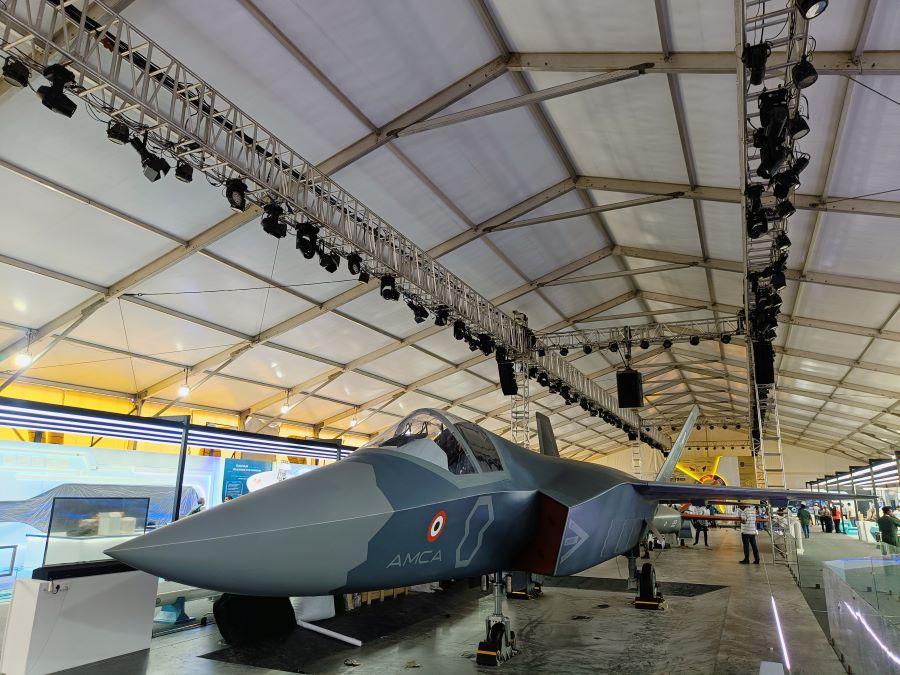
India has taken a major step towards developing its first indigenous fifth-generation stealth fighter, with the Ministry of Defence issuing a Request for Proposal (RFP) for the Advanced Medium Combat Aircraft (AMCA) programme to three shortlisted private-sector consortiums.
The bidders include the L&T-BEL combine, Tata Advanced Systems, and the Bharat Forge-BEML partnership, marking one of the most significant attempts yet to build a parallel fighter aircraft manufacturing ecosystem outside state-run Hindustan Aeronautics Limited (HAL).
The Aeronautical Development Agency (ADA), which is leading the AMCA design and development programme under the Defence Research and Development Organisation (DRDO), has sought bids for the construction of five flying prototypes and one structural test specimen of the 25-tonne stealth fighter.
The AMCA project, cleared by the Cabinet Committee on Security in March 2024 at an estimated development cost of Rs 15,000 crore, is expected to become India’s most ambitious combat aviation programme. Unlike earlier fighter projects, the government has deliberately opened the door for private industry participation in an effort to accelerate timelines, deepen aerospace manufacturing capability and reduce dependence on HAL’s existing production infrastructure.
The American GE-414 engine will initially power the twin-engine stealth aircraft, while future variants are expected to fly with more powerful 120-kN-class engines, jointly developed with France’s Safran for production in India.
Officials involved in the programme said the first prototype is targeted for rollout by 2027, with the maiden flight planned for 2028-2029. Full-scale serial production is expected in the mid-2030s.
Designed as a fifth-generation multirole combat aircraft, the AMCA will incorporate stealth shaping, internal weapons bays, advanced Active Electronically Scanned Array (AESA) radar, sensor fusion, artificial intelligence-enabled systems, electronic warfare capability and supercruise performance. The aircraft is expected to achieve speeds of up to Mach 2.
The Indian Air Force plans to induct at least seven squadrons of the aircraft beginning around 2035, as it seeks to modernise its combat fleet amid growing regional air power competition.
Defence officials view the AMCA programme as a strategic turning point for India’s aerospace sector, particularly because it places private industry at the centre of a frontline combat aircraft programme for the first time.
Earlier this month, the foundation stone was laid for the Rs 15,803 crore Integration and Flight Testing Complex at Puttaparthi in Andhra Pradesh, a critical infrastructure project that will support prototype integration, testing and certification of the AMCA platform.
Once operational, the aircraft is expected to carry a mix of indigenous weapons, including the Astra beyond-visual-range air-to-air missile, precision-guided bombs, glide weapons and long-range air-to-surface missiles. The stealth fighter is also being designed with advanced radar-evading features intended to penetrate heavily defended airspace.
The AMCA is expected to eventually complement and later replace portions of the Su-30MKI fleet in the Indian Air Force inventory.
The programme also comes at a time when India is pursuing multiple fighter acquisition tracks to address the IAF’s declining squadron strength. Parallel negotiations are underway with France’s Dassault Aviation for the direct acquisition and subsequent production in India of 114 multi-role fighter aircraft.
Military planners believe recent conflicts, including the four-day Operation Sindoor in May 2025, underscored the growing dominance of long-range precision air power, in which stand-off strikes by combat aircraft and missiles played a decisive role over traditional large-scale armoured warfare.
If the AMCA programme meets its timelines, India would join a small group of countries capable of independently designing and producing fifth-generation stealth fighter aircraft, alongside the United States, China and Russia.
Team BharatShakti