






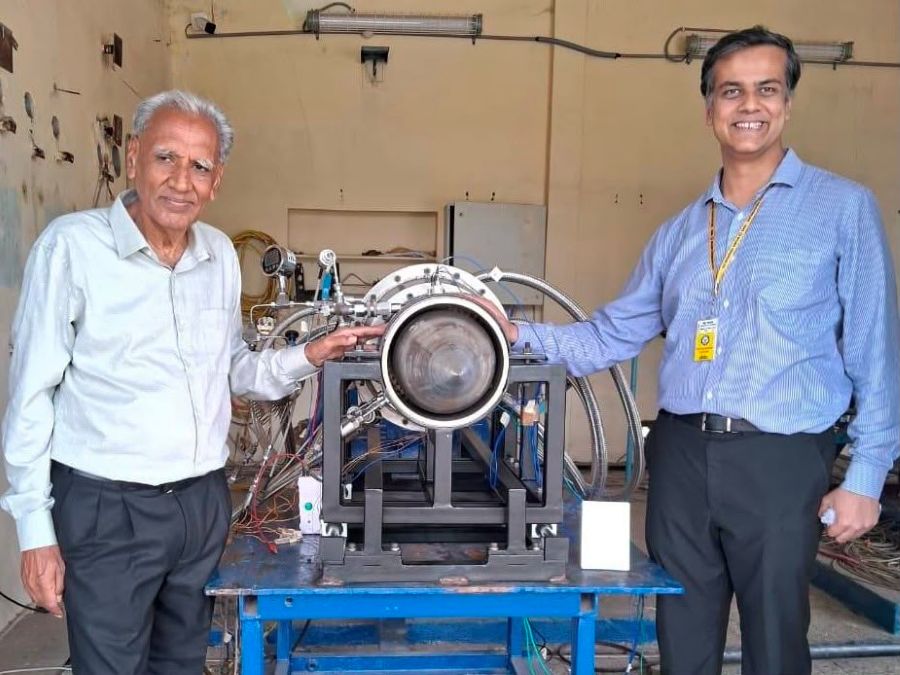
A private company has achieved a milestone in advanced propulsion technology with the successful demonstration of its first indigenous 5 kN air-breathing Rotating Detonation Engine (RDE). This development could power future cruise missiles, target drones and high-speed unmanned aerial vehicles (UAVs).
The engine, developed by IIT Madras-incubated defence startup D-Propulse, was hot-fired at a DRDO test facility, where it generated a stable 5 kN thrust. The trial validated the system at Technology Readiness Level (TRL)-5, indicating that the technology has been proven in a relevant operational environment.
The company said the achievement marks the transition from laboratory research to an integrated prototype and has set a target of delivering a flight-ready engine by December 2027.
The demonstration comes as several countries explore Rotating Detonation Engines for next-generation military propulsion due to their potential to improve efficiency while reducing complexity and manufacturing costs.
Unlike conventional jet engines, RDEs use pressure-gain combustion instead of the constant-pressure combustion employed in traditional gas turbines. The approach improves thermodynamic efficiency while eliminating moving parts within the combustor, resulting in a simpler and potentially more reliable engine architecture.
According to D-Propulse, the indigenous engine offers 15-25 per cent higher thermodynamic efficiency than conventional air-breathing propulsion systems. It also relies on precision machining rather than complex turbine assemblies, which could lower production costs and reduce manufacturing timelines.
The latest test campaign also demonstrated sustained multi-second pressure-gain combustion, validating continuous engine operation under test conditions and moving the technology closer to flight qualification.
“The successful demonstration is an encouraging milestone in advancing India’s indigenous capabilities in next-generation air-breathing propulsion,” said Vijay Kumar Saraswat, former DRDO Chief and former Member, NITI Aayog, who is also Chairman of D-Propulse.
The company said the prototype has been developed as a proof motor for a flight-capable design rather than a laboratory demonstrator. It is being tailored for future defence applications, including cruise missiles, target drones and high-speed UAVs.
With the successful TRL-5 validation, the programme has crossed an important development stage, positioning the indigenous propulsion system for further testing before eventual flight trials. If development progresses as planned, the engine could strengthen India’s efforts to build indigenous high-speed propulsion technologies and reduce dependence on imported systems for future missile and unmanned platforms.
Team BharatShakti