


The Narendra Modi government’s ambitious plan to transform Great Nicobar Island into a major strategic and economic hub in the Indian Ocean has once again come under scrutiny, with environmental groups and opposition leaders questioning its ecological and social costs even as the Centre doubles down on its national security and maritime trade rationale.
At the heart of the controversy is an estimated $11-billion (around Rs 91,000 crore) mega project that envisages a transshipment port, a dual-use civilian and military airport, a power plant, tourism infrastructure and a new township on India’s southernmost island. Critics have warned that the project could irreversibly alter one of India’s most ecologically sensitive regions and affect indigenous communities, while the government argues that the development is essential to safeguard India’s strategic interests in the Indian Ocean Region.
In a detailed briefing note for the press, the government defended the project as a strategic necessity, highlighting Great Nicobar’s location near some of the world’s busiest maritime routes.
The island lies barely 40 km from the Six Degree Channel and close to the Malacca Strait, through which a significant portion of global trade and energy shipments pass. Officials argue that growing geopolitical competition in the Indo-Pacific, coupled with threats such as arms smuggling, narcotics trafficking and illegal migration, makes a stronger Indian presence in the region imperative.
The Centre maintains that the project will serve dual objectives: reducing India’s dependence on foreign ports for cargo transshipment while simultaneously strengthening military reach in the eastern Indian Ocean.
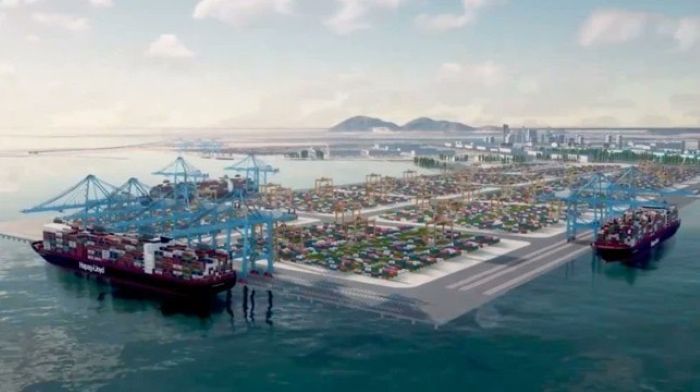
A key component of the plan is the proposed International Container Transshipment Port (ICTP) at Galathea Bay. Positioned close to the Malacca Strait, the facility is expected to handle international cargo currently routed through foreign hubs such as Singapore and Colombo.
The government has also defended the decision to establish a greenfield airport under the operational control of the Indian Navy, arguing that existing facilities at INS Baaz in Campbell Bay could not support future requirements.
According to the official note, five alternative locations were evaluated before Galathea Bay was selected. The expansion of INS Baaz was ruled out due to terrain constraints, limited space for future growth, aviation safety concerns, and the potential disruption of existing settlements.
“The possibility of INS Baaz being developed as a brownfield project met with limitations which forced the idea to be dropped,” the note said.
The Centre argues that the airport will significantly enhance India’s maritime surveillance capabilities, operational reach and disaster response capacity while also boosting tourism. The Airports Authority of India has projected an initial capacity of 1.35 million passengers annually by 2040.
However, environmental concerns continue to dominate the debate.
The project requires diversion of approximately 130.75 sq km of forest land, prompting criticism from conservationists who fear adverse impacts on biodiversity, including nesting habitats of the endangered leatherback turtle.
Responding to these concerns, the government said environmental assessments were conducted under existing regulatory frameworks, with the involvement of institutions such as the Wildlife Institute of India, the Zoological Survey of India, and the Salim Ali Centre for Ornithology and Natural History.
Officials claim that only 166.1 sq km of the island has been earmarked for development and that more than 81 per cent of Great Nicobar will remain under forests, national parks, biosphere reserves and tribal conservation areas.
The government has also announced a Rs 2,220-crore conservation programme spread over 30 years, focusing on wildlife protection, coral conservation and mangrove restoration.
On tribal concerns, the Centre insists that no indigenous communities will be displaced. It says the denotification of part of the tribal reserve has been offset by fresh notifications elsewhere, resulting in a net increase in protected tribal land. Consultations were conducted with tribal welfare authorities, the Nicobari Tribal Council and the Andaman Adim Janjati Vikas Samiti, according to the briefing note.
The government further points out that the project’s environmental approvals have withstood challenges before the National Green Tribunal (NGT), which declined to interfere with the clearances after reviewing the proposed safeguards.
Beyond security considerations, officials project substantial economic benefits. The development is expected to generate more than one lakh direct employment opportunities, besides creating indirect jobs in logistics, tourism and support services.
For the Modi government, Great Nicobar has increasingly become more than an infrastructure project. As strategic competition intensifies across the Indo-Pacific and concerns over maritime chokepoints gain prominence, New Delhi is presenting the island as a critical pillar of its broader vision to expand economic influence and military reach in the Indian Ocean. Whether that vision can be realised without triggering lasting ecological damage remains the central question at the heart of the continuing controversy.
Ravi Shankar

Dr Ravi Shankar has over two decades of experience in communications, print journalism, electronic media, documentary film making and new media.
He makes regular appearances on national television news channels as a commentator and analyst on current and political affairs. Apart from being an acknowledged Journalist, he has been a passionate newsroom manager bringing a wide range of journalistic experience from past associations with India’s leading media conglomerates (Times of India group and India Today group) and had led global news-gathering operations at world’s biggest multimedia news agency- ANI-Reuters. He has covered Parliament extensively over the past several years. Widely traveled, he has covered several summits as part of media delegation accompanying the Indian President, Vice President, Prime Minister, External Affairs Minister and Finance Minister across Asia, Africa and Europe.