


China and India expanded their nuclear arsenals in 2025 as nuclear-armed states continued to modernise their weapons programmes, reflecting a broader global trend away from disarmament commitments, according to the latest yearbook released by the Stockholm International Peace Research Institute (SIPRI) on Monday.
The report paints a troubling picture of the global nuclear landscape, warning that major powers are increasingly relying on nuclear deterrence while arms control frameworks continue to weaken.
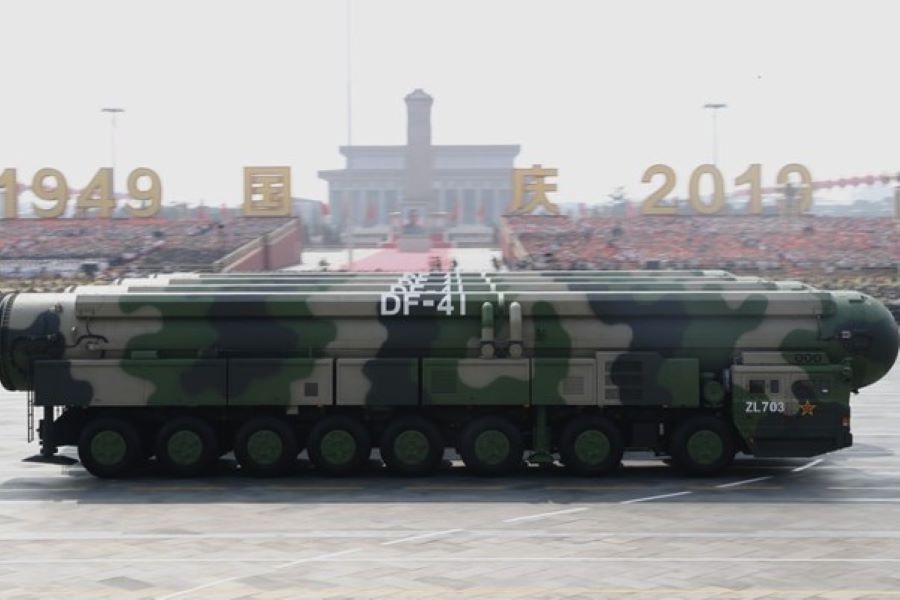
China added 20 warheads to its stockpile over the past year, taking its estimated inventory to 620 nuclear warheads as of January 2026, up from 600 a year earlier. SIPRI said Beijing’s nuclear arsenal is undergoing rapid modernisation and expansion and is expected to continue growing throughout the coming decade.
The Swedish think tank also assessed that China may have increased the number of warheads deployed with operational forces. While most Chinese warheads are believed to remain stored separately from launch systems, SIPRI noted that Beijing may now be deploying warheads on missiles in selected mobile units during peacetime exercises.
“This would mark a change from China’s long-standing policy of keeping warheads and missiles de-mated,” the report said.
SIPRI estimates that China’s deployed nuclear warheads increased to about 34 in January 2026 from 24 the previous year. The report suggested that, combined with an early-warning system currently under development, such deployments are intended to strengthen China’s second-strike nuclear capability.
The institute further estimated that China now possesses around 775 land-based missile silos and has already surpassed both the United States and Russia in the number of intercontinental ballistic missile (ICBM) launchers. Chinese ICBM inventories could approach those of Washington and Moscow by the end of the decade, it added.
India, meanwhile, is believed to have modestly expanded its nuclear arsenal during 2025 while continuing work on new nuclear delivery systems.
“The modernisation programme is increasingly focused on developing long-range weapons capable of reaching targets throughout China, although planning also continues to be focused on India’s long-standing rivalry with Pakistan,” SIPRI said.
The report noted that Pakistan also continued developing new delivery systems and accumulating fissile material, indicating that its nuclear arsenal could expand further in the coming years.
Referring to the brief India-Pakistan military confrontation in May 2025, SIPRI observed that India struck Pakistani air and missile bases that may have had nuclear-related roles. However, it noted that both countries took measures to prevent the conflict from escalating further.
Globally, all nine nuclear-armed states, the United States, Russia, China, United Kingdom, France, India, Pakistan, North Korea and Israel, continued modernisation programmes during 2025, with most introducing new nuclear-capable or nuclear-armed systems.
SIPRI estimated the world’s total nuclear inventory at 12,187 warheads in January 2026, down slightly from 12,241 a year earlier. However, the reduction was largely due to the dismantling of retired warheads by Russia and the United States. The number of operationally deployed warheads rose to 4,012, compared to 3,912 in the previous year.
Russia and the United States still account for roughly 83 per cent of all nuclear warheads, although their share is gradually shrinking as other countries expand their arsenals.
SIPRI Director Karim Haggag warned against growing dependence on nuclear deterrence in national security planning.
“Influential voices, including some world leaders, are advocating nuclear weapons as a guarantee against attack by a hostile state. But making national defence and security strategies dependent – or more dependent – on nuclear weapons could significantly increase nuclear risks,” Haggag said.
‘By reaching for nuclear solutions, states are creating new risks and fuelling arms-race dynamics,’ he said.
The report linked the worsening outlook to the erosion of arms control agreements, particularly the expiry of the New Strategic Arms Reduction Treaty earlier this year. The treaty, signed in 2010 and extended in 2021, was the last remaining nuclear arms control agreement between Washington and Moscow and had imposed limits on deployed strategic warheads and delivery systems.
‘The evidence is growing that the nuclear weapon states are sidelining, and even walking away from, their disarmament commitments and are instead flexing their nuclear muscles,’ said Hans M. Kristensen, Associate Senior Fellow with SIPRI’s Weapons of Mass Destruction Programme.
“Under these circumstances, not only are nuclear stockpiles expected to expand, but the numbers of deployed weapons will also most likely increase,” SIPRI warned.
The institute concluded that the rise in operational nuclear warheads is likely to continue and may accelerate as nuclear powers become increasingly secretive about the size and composition of their arsenals, raising fresh concerns about strategic stability and the future of global arms control.
Ravi Shankar

Dr Ravi Shankar has over two decades of experience in communications, print journalism, electronic media, documentary film making and new media.
He makes regular appearances on national television news channels as a commentator and analyst on current and political affairs. Apart from being an acknowledged Journalist, he has been a passionate newsroom manager bringing a wide range of journalistic experience from past associations with India’s leading media conglomerates (Times of India group and India Today group) and had led global news-gathering operations at world’s biggest multimedia news agency- ANI-Reuters. He has covered Parliament extensively over the past several years. Widely traveled, he has covered several summits as part of media delegation accompanying the Indian President, Vice President, Prime Minister, External Affairs Minister and Finance Minister across Asia, Africa and Europe.