


Editor’s Note
The author, who, as DG, Mechanised Forces, conceived the light tank project in 2017, argues that Zorawar remains the right answer to India’s high-altitude armoured requirements. He contends that the focus must now shift from rigid specifications to delivering a combat-ready platform.
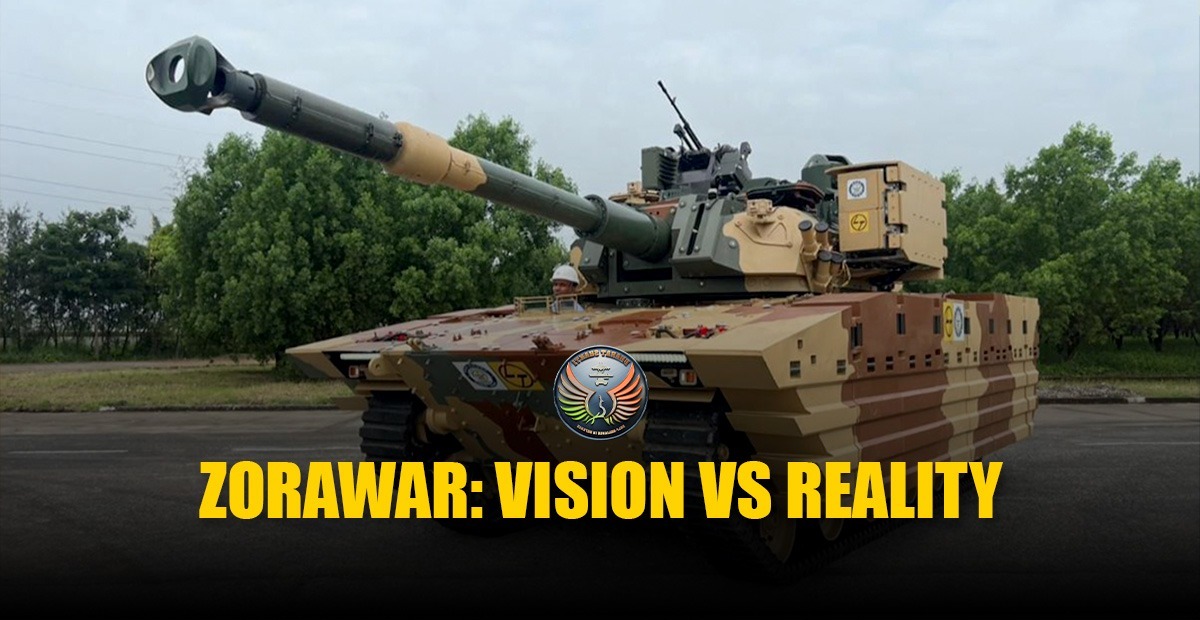
A decade ago, the case for an indigenous light tank rested on a single operational fact. The northern borders demanded an armoured platform that heavier steel could not deliver in time and space. The 2020 stand-off in Eastern Ladakh starkly exposed the gap. The requirement that emerged then was for a twenty-five-tonne-class platform. Air-portable. High power-to-weight ratio. Survivable in the world’s most unforgiving terrain. That clarity of purpose, established in 2017 by the then DGMF and sanctioned, gave Project Zorawar its early momentum.
It bears stating plainly that the programme remains one of the finer examples of speed in Indian defence design, with a prototype delivered from sanction to trial in a fraction of the time such projects usually take. Yet haste cannot be a reason to compromise capabilities or indigenisation.
Tank design is highly complex and requires state-of-the-art technology. Prototypes have been fired above 4,200 metres, and other technical trial parameters are under evaluation. Formal Army-led user trials will follow extensive internal evaluation in desert and high-altitude terrain. The Combat Vehicles Research and Development Establishment and L&T have made considerable efforts to deliver the prototype at a fast pace.
This article is not intended to diminish that achievement but to examine, with the candour the programme itself has always encouraged, two areas where course correction will determine whether Zorawar becomes the platform it was conceived to be.
Major Assemblies: Where Import Dependency Still Sits
A light tank is not a single system but an assembly of critical subsystems, and self-reliance must be measured assembly by assembly rather than by the finished silhouette. The table below reflects the programme’s current state as publicly reported.
| Subsystem / Component | Current Source / Supplier | Level of Indigenisation | Assessment |
| Hull and Chassis | DRDO-CVRDE in collaboration with L&T | High | Indigenous design with modular armour architecture developed in India; represents one of the most mature indigenous elements of the platform. It remains, however, the least technology-intensive of the platform’s major assemblies. |
| Engine and Powerpack | Cummins (USA), 760–1,000 hp | Low | The original MTU (Germany) powerpack could not be procured because of export restrictions. A domestic 700 hp engine is under development by CVRDE but has yet to enter production. |
| Main Gun and Turret | John Cockerill Defence (Belgium), 105 mm high-pressure gun and 3105 turret | Low | The current prototype relies on imported systems. Bharat Forge is developing an indigenous 105 mm gun for future production variants. |
| Ammunition | Initially sourced from Belgium | Low–Medium | Indigenous production has been identified as a priority, although complete localisation remains a work in progress. |
| Suspension System | DRDO-CVRDE | High | Indigenous hydropneumatic suspension specifically designed for high-altitude mobility and amphibious operations. |
| Electro-Optics and Sighting System | Safran PASEO (France) | Low | Thermal imaging, laser rangefinder, and hunter-killer sighting capabilities remain dependent on imported technology. |
| Fire Control System and AI-enabled Targeting | Foreign OEM, yet to be finalised | Low | Fire-control architecture incorporating AI-assisted target detection, tracking, and engagement needs to be indigenised. |
| Active Protection System (APS) and Counter-UAS Suite |
Foreign OEM, yet to be finalised |
Low | Continued dependence on imports underscores the need for sustained impetus on indigenous R&D. |
| Anti-Tank Guided Missile (Nag Mk-II) | DRDO | High | Fully indigenous missile integrated with the platform and successfully demonstrated in both direct-attack and top-attack engagement modes. |
Key Takeaway
| Overall Assessment | Observation |
| Current Indigenous Content | At best 40-45% by value and critical components, with indigenous content in several critical assemblies remaining grossly inadequate. Critical dependencies remain in the engine, turret, gun, electro-optics, APS, fire control system, and ammunition, which are likely to determine the pace at which the programme can achieve full strategic autonomy. |
The pattern is instructive rather than discouraging. Yet despite DRDO leading development end-to-end, indigenous content in Mark 1 remains low. The programme has relied on off-the-shelf sourcing to meet an urgent operational timeline, particularly for the powerpack, main gun, FCS, APS, and the optics suite. Dependencies persist. This was a reasonable trade-off at the prototype stage, when speed mattered. It becomes less acceptable as the programme approaches serial production, unless a published, funded, and time-bound indigenisation roadmap accompanies each of these assemblies.
The Qualitative Requirement Question
The second area warranting attention is meeting essential Qualitative Requirements. Over time, the Developing Agencies have been unable to meet essential parameters due to the weight limitation (25 tons + 10%) and the requirement to provide NATO STANAG Level 6 protection. This is essentially a fallout of the imported turret, which cannot be upgraded due to the original manufacturer’s restrictions. The present protection levels are grossly inadequate, as STANAG Level 4 protection barely withstands a 14.5 mm round. A tank that is vulnerable to, or can be defeated by, an Armoured Personnel Carrier (APC) can never be justified.
The changing nature of war makes it prudent to augment these protection levels with both Active and Passive protection measures to defeat our enemy’s mechanised forces qualitatively. Survivability is a multitiered, multilayered requirement across the entire domain of kinetic and non-kinetic threats. The threat envelope must also account for threats to drones and loiter ammunition, based on lessons learnt in contemporary conflicts. Protection, weight, and mobility are not independent variables; they need to be examined through the multidomain survivability lens.
Even if the present qualitative requirements cannot be met due to technological limitations, the User should be in sync with the Developing Agency to accept the present prototype with the best available capabilities, with a caveat for upgradation of subsequent prototypes to meet the overall requirement/threat.
At the same time, the mindset of mobility, firepower and protection must shift to agility, lethality, survivability, connectivity, adaptability, situational awareness and the ability to operate in a contested electromagnetic and drone environment. The Indian Army has shown an inclination to accept prototypes that meet sub-qualitative requirements, with certain add-ons, on the understanding that they will be upgraded subsequently as and when the technology is available.
This is a step in the right direction to handhold the Developing Agency’s efforts towards achieving self-reliance. Yet it needs institutionalisation; promises of future upgrades must be accompanied by accountability and time sensitivity.
A third important aspect is the derating of the engine and the life of major and minor assemblies in high-altitude, rarified atmospheric conditions. A 20% to 25% loss of power occurs in the powerpack at such high altitudes. Thus, the essential power-to-weight ratio of 25:1 and the desirable 30:1 need emphasis.
Lessons from MBT Arjun
India has walked this road before, and the lessons from the Arjun Main Battle Tank remain directly relevant. Arjun’s troubles were rarely about design intent and almost always about execution discipline. Weight crept steadily beyond the original specification, compromising mobility and rail transportability. Costs escalated well beyond initial projections as the programme extended over decades rather than years. Spares support and induction lagged, leaving user units without the sustained logistics backbone a tank regiment requires.
Indigenous ammunition failures and unreliability soared for years before stabilising. Indigenous content remained below the programme’s stated ambition, particularly in the engine and fire control systems. Timelines stretched across more than three decades, from conception to operational clearance. And the user interface and crew experience that determine whether a tank is trusted in the field took a back seat to on-paper specification compliance.
Zorawar was conceived as the corrective to that history: weight creep, cost overruns, spares shortfalls, import dependency, compromised capability, timeline slippage, and a neglected user interface. Preventing even one of these seven failures from recurring is not an academic exercise. It is the difference between a regiment that trusts its equipment and one that merely operates it. The primary reason for any such failure has been the focus on Indigenous Content rather than Indigenous Design.
The Developing Agency cannot remain a system integrator but must graduate to a System Designer, which requires serious R&D and the infusion of indigenous critical technologies.
Visualising Zorawar as a Connected, Survivable Platform
The requirement Zorawar must ultimately satisfy is not a lighter version of a main battle tank. It is a networked node in a contested, sensor-saturated, electronically hostile environment. The northern borders of the coming decade will not be won by armour thickness alone. They will be won by platforms that see first, share data instantly, survive the adversary, and engage first. Zorawar must reinforce the denial-cum-domination concept of future deterrence along the LAC. Nine capabilities beyond the basics of lethality, high power-to-weight ratio, and low NGP warrant sustained investment.
- An active protection system with hard kill capability, integrated at the design stage rather than retrofitted, capable of defeating top-attack munitions now common in contested theatres.
- A battlefield management system architecture that enables Zorawar to function as a networked sensor and shooter within the Army’s integrated battle groups, sharing targeting data with artillery, air defence, and unmanned systems in near real time. This will act as a force multiplier by enhancing situational awareness and improving IFF (Identify Friend or Foe), ultimately reducing fratricide.
- Electronic hardening against jamming and spoofing is essential, since a platform that can be electronically blinded is vulnerable regardless of its armour.
- An integrated drone-and-C-UAS suite on each tank, integrated with the sensors and the shooter web.
- Modularity, so that protection packages, weapon stations, and sensor suites can be upgraded across the fleet’s service life without redesigning the hull, a flexibility the base platform has reportedly been engineered to provide.
- Once the first serial production lot of the line is inducted into the Armoured Corps, the ammunition reserves and the SPTA (Spare Parts, Tools, and Accessories) must be provisioned at the individual tank, unit, and Field Workshop levels.
- At the user end, the doctrine for the employment of light tanks, technical user training, and maintenance schedules, including lifing norms for major assemblies, must be in place.
- Zorawar must be viewed as an entire ecosystem for operations at high altitudes. Several technical and tactical factors affect the capabilities and employment of tanks in such terrain. These include separate fuel, oil and lubricants; a different methodology for gun zeroing; different garages and storage facilities; distinct maintenance schedules and spares; periodic starting and the need for external starter generators; antifreeze mixtures; clothing and headgear; battery preservation, pre-heaters and many more such requirements.
- Last but not least, in the longer run, mission reliability and a family of platforms, including an armoured recovery vehicle, a bridge-layer tank, and command tanks.
- The Way AheadFive constructive steps will keep the programme on track.
- First, publish an assembly-wise indigenisation roadmap with year-on-year targets for the engine, main gun and electro-optics, the three areas where import dependency is currently highest, backed by ring-fenced development funding rather than aspirational statements alone. A single point of accountability and responsibility must be institutionalised.
- Second, shift focus to Indigenous Design rather than merely Indigenous Content. Incubation of technology and investing towards it should be the focus.
- Third, Zorawar must compete with Bharat’s tank effort under an indigenous capability roadmap, so that India’s limited armoured vehicle design and industrial bandwidth is developed without a monopoly. Comparisons must be made with global niche tank technologies, and a spiral approach within the same program must be adopted, so that future indigenous upgrades can be planned throughout its life cycle: a womb-to-tomb concept.
- Fourth, visualise the entire Zorawar ecosystem at high altitude. Integrate it as a single, cohesive capability, not isolated constructs.
- Fifth, at each stage, learn from the lessons of MBT Arjun. Don’t repeat the same mistakes. Any equipment induction must meet the operational user requirement by delivering the desired capabilities for a particular terrain and threat matrix.
Conclusion
Zorawar remains, at its core, a sound and necessary answer to a real threat on India’s northern borders. The Armoured Corps needs a tank that arrives on schedule, has the desired capabilities, fights reliably, survives being targeted, and communicates as part of the multidomain kill web. The programme has already shown it can move at a pace few Indian defence projects have matched. What it now needs is the honest efforts of the designing agency to develop the tank to meet the required qualitative requirements, with a slight offset in terms of weight (which must be accepted by the user). The user must assist the designing agency in every possible manner to enable continuity in the project by facilitating the development and procurement of the equipment. None of these is difficult and remains within reach.
Lt Gen AB Shivane, PVSM, AVSM, VSM (Retd), served nearly four decades in the Indian Army, commanding a Strike Corps and serving as Director General Mechanised Forces. A renowned scholar-warrior, he has contributed to several futuristic studies for the Indian Army. He has authored over 350 papers and five books, including Professional Military Education: Making of the 21st Century Warrior. He is a Distinguished Fellow at the Centre for Land Warfare Studies.