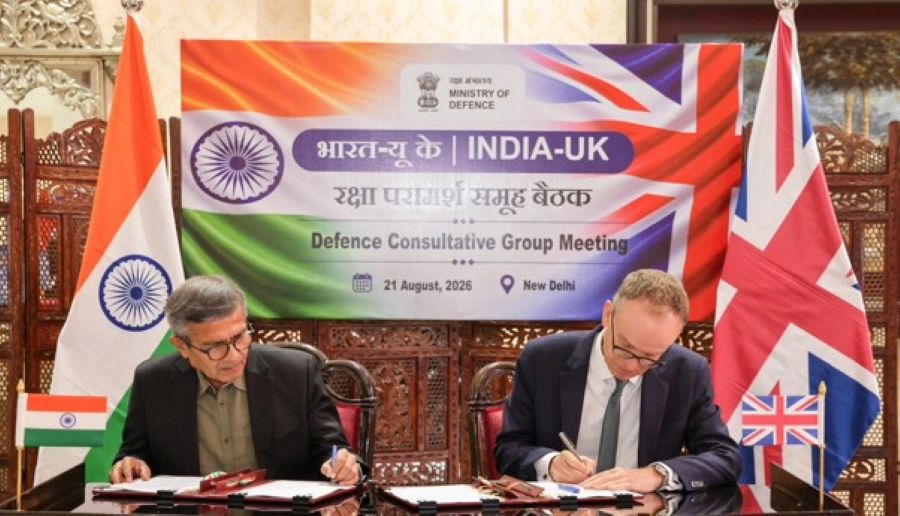
India and the United Kingdom are pushing their defence relationship towards co-development and co-production, with a focus on fighter engines, naval propulsion and emerging technologies.
According to British officials, the two sides are working on an indigenous combat-air engine for the Advanced Medium Combat Aircraft (AMCA), electric propulsion for four Landing Platform Docks (LPDs), and closer links between Indian and British defence startups.
The two countries are also expanding military-to-military cooperation, including the deployment of Indian Air Force instructors to train Royal Air Force pilots. Meanwhile, an expanded Indian order for British Lightweight Multirole Missiles (LMMs) is expected to be finalised soon, with the requirement now running into several hundred missiles.
A senior British defence official told media persons in New Delhi that the relationship was increasingly moving beyond procurement towards the development of capabilities that could eventually be manufactured and exported jointly.
“The very exciting areas in particular are innovation, acceleration of ideas, generation from startups to delivery to production in certain niche technologies and areas,” the official said.
Startups emerge as a key focus
Britain is seeking to connect Indian defence startups and smaller companies with British industry and supply chains, particularly in emerging and niche technologies.
British officials have already brought a group of UK small and medium-sized enterprises to India to explore partnerships with Indian startups.
The aim is to help promising technologies move from prototypes into military capabilities and eventually into scaled production.
“We have various mechanisms for sort of encouragement of the innovators, but also acceleration of some of those ideas that might start in a garage,” the official said.
The British side is also looking at Indian companies becoming part of UK defence supply chains, with the official stressing that resilient supply chains do not necessarily mean keeping production within national borders.
“Supply-chain resilience and national security… doesn’t mean everything has to be based in the UK,” he said. “What it has to be based on is where the system or the ecosystem is dependable with trusted partners.”
Rolls-Royce pitches AMCA engine partnership
The most strategically significant area of cooperation is the proposed Rolls-Royce partnership for India’s AMCA fighter.
Rolls-Royce and Reliance Industries announced earlier this month their strategic intent to jointly develop and manufacture an indigenous combat-air engine for AMCA, with plans to explore an Aerospace Gas Turbine Complex in India covering design, development, manufacturing and testing.
A British official said the proposal envisages cooperation with Indian industry and the Gas Turbine Research Establishment (GTRE), rather than simply supplying a finished engine.
He also drew a distinction between the British proposal and France’s competing Safran offer, arguing that the key issue for India was not merely technology transfer but ownership of the underlying technology.
“You can only offer 100% technology of the technology that you own,” he said.
The UK side sees a larger opportunity in eventually developing engines jointly with India for global markets.
“What we think is more likely is that, having worked with Rolls-Royce, India and the UK, actually what we would look to do is the bigger prize… collaborative global exports,” the official said.
The official also linked the proposed engine programme to future generations of combat aircraft, describing aerospace development as a process of “spiralised development”, in which experience from one generation feeds into the next.
“Nobody has produced 120-plus kilonewton engines… which hasn’t come from the generations before,” he said, adding that such experience could eventually contribute to engines in the 145-kilonewton-plus class expected for future sixth-generation platforms.
He stressed, however, that India’s engagement with the UK’s Global Combat Air Programme should not be interpreted as formal membership of the programme.
Four LPDs to anchor naval propulsion cooperation
In the maritime domain, Britain expects an IGA covering four LPDs equipped with integrated electric propulsion to be signed shortly, according to the British official.
The programme is part of the India-UK Electric Propulsion Capability Partnership and is intended to develop India’s domestic capability in advanced naval propulsion.
The official said the LPD programme could become a testbed for wider applications across the Indian Navy, including destroyers and frigates and potentially future aircraft carriers.
The partnership is significant for India as it seeks to build greater domestic expertise in propulsion systems for increasingly sophisticated naval platforms.
Indian fighter instructors to train RAF pilots
Three Indian Air Force Qualified Flying Instructors are due to travel to the UK to train Royal Air Force pilots, including on Britain’s Hawk training system and another aircraft.
The British official described this as the first time Indian fighter instructors would be integrated into the UK’s fast-jet training system in this manner.
“The Indian pilots and the Indian system is… very compatible,” he said.
The arrangement will help address Britain’s shortage of qualified instructors while strengthening interoperability between the two air forces.
Missile order rises to several hundred
Alongside the longer-term industrial programmes, India and Britain are close to finalising a major missile deal.
The two governments announced in October 2025 their intention to proceed with a £350 million government-to-government acquisition of Lightweight Multirole Missile systems for the Indian Army.
British officials now say the Indian requirement has increased significantly and will run into several hundred missiles. Once signed, it would make India the second-largest customer for LMM after Ukraine.
Manufactured by Thales UK in Belfast, the laser-beam-riding missile is designed to engage a range of targets, including light armoured vehicles and aerial threats. It can be deployed from shoulder-fired, tripod and vehicle-mounted launchers.
The missile has acquired particular relevance from the experience of the Ukraine war, where relatively inexpensive air-defence weapons are being used against drones and other aerial threats.
British officials said the Indian order would be one of the largest LMM procurements outside Ukraine.
The missile deal is also expected to support a broader India-UK complex-weapons partnership, with British and Indian companies already working together on laser-beam-riding missile systems.
In February 2025, Thales UK and Bharat Dynamics Limited signed a contract for an initial supply of High Velocity Missiles (STARStreak) and launchers, with the two companies subsequently looking to expand cooperation on LMM production.
From procurement to co-development
The two sides are now discussing not only equipment procurement but also future-force design, military training, advanced propulsion, emerging technologies, startups, industrial resilience and potential export markets.
For India, the attraction is greater access to advanced technology and domestic manufacturing capability. For Britain, India offers a large industrial base and the potential to develop and manufacture defence systems at scale.
The British official said the ultimate objective was a long-term partnership in which the two countries could develop capabilities together rather than simply transact equipment.
The shift is already reflected in the broader India-UK Defence Industrial Roadmap, which envisages increased co-development and co-production across advanced technologies and complex weapons.
Huma Siddiqui