


India and China have agreed to push for an “early and substantial harvest” in boundary delimitation talks, signalling a potentially significant shift from the long-standing emphasis on a comprehensive package settlement of the disputed 3,400-km boundary.
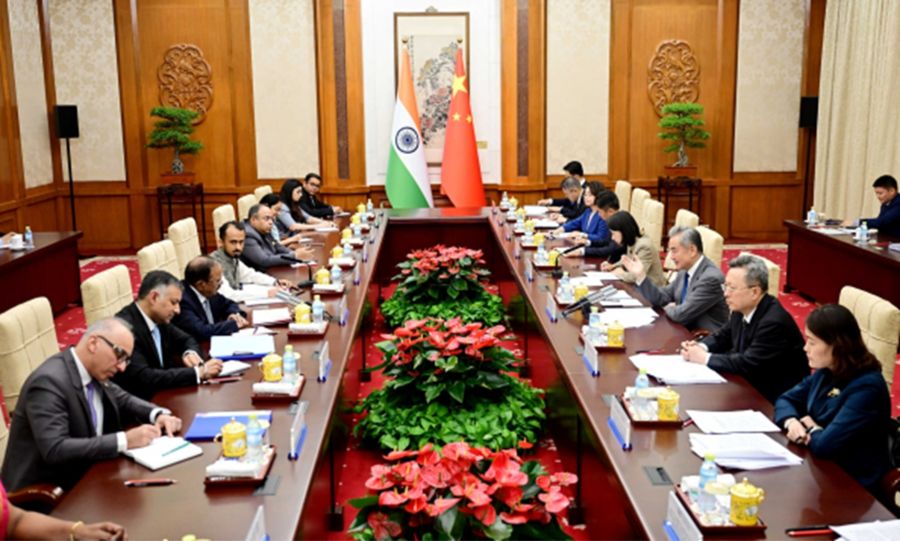
The understanding emerged from the 25th round of Special Representatives’ (SR) talks between National Security Advisor Ajit Doval and Chinese Foreign Minister Wang Yi in Beijing on August 25, where the two sides held what officials described as a candid and in-depth exchange on the boundary question.
The most consequential outcome was an agreement to activate two existing mechanisms, the Expert Group on Boundary Delimitation and the Working Group on Border Management under the Working Mechanism for Consultation and Coordination (WMCC), to work, respectively, on an “early and substantial harvest” of boundary delimitation and on strengthening border management.
The first task for both groups will be to finalise their respective Terms of Reference in accordance with the eight-point outcome issued by the Ministry of External Affairs on Wednesday.
The formulation is significant because it opens the door to incremental progress on the boundary rather than waiting for an agreement covering the entire frontier. It also comes against the backdrop of efforts by India and China to stabilise ties following the military confrontation in eastern Ladakh.
The two sides, however, stopped short of announcing any breakthrough on the actual alignment of the Line of Actual Control (LAC) or a sector-wise settlement.
They reiterated their commitment to negotiate a framework for the final settlement in accordance with the 2005 Agreement on Political Parameters and Guiding Principles and subsequent understandings reached through the SR mechanism. The stated objective remains a “fair, reasonable and mutually acceptable” solution.
The talks also produced a series of measures aimed at preventing a fresh military crisis along the LAC.
India and China agreed that ground situations would be addressed promptly through existing diplomatic and military channels, including the WMCC, local commander-level meetings and other agreed mechanisms. They also discussed ways to improve mutual understanding of the LAC in “appropriate areas” for better border management.
Two additional meeting points were agreed for General-Level Mechanism/Senior Highest Military Commander meetings, while two additional military hotline channels were agreed for the eastern and middle sectors.
The outcome suggests that the immediate focus is as much on managing the boundary as on resolving it.
Lt Gen Rakesh Sharma (retd), who commanded a Corps in Ladakh, described the meeting as essentially consolidatory and cautioned against over-interpreting the outcome. But he pointed to the “early harvest” formulation as an important change in India’s approach.
Sharma said the formulation could indicate a greater willingness to pursue a sectoral approach, making progress in areas where agreement may be easier, rather than waiting indefinitely for a comprehensive settlement.
“If we say only a package deal, we are not moving,” Sharma told BharatShakti Editor-in-Chief Nitin A. Gokhale.
He also stressed that any movement on the boundary would have to be accompanied by measures to reduce the risk of another confrontation, particularly with large numbers of troops still deployed close to the LAC. The priority, he said, should be to reduce the risk of an accident escalating into a larger crisis. “It takes one spark to light the fire,” he warned.
Beyond the boundary, the two sides also recorded progress on trans-border cooperation. India welcomed China’s decision to increase the number of batches for the Kailash-Manasarovar Yatra, while both sides noted the reopening of three designated border trading points.
They agreed to strengthen cooperation in border trade, pilgrimage and other areas, with the stated aim of creating conditions for dialogue, peace and cooperation in the border regions.
The two countries also agreed to hold the next meeting of the India-China Expert-Level Mechanism on Trans-border Rivers in September and continue discussions on hydrological data sharing and renewal of relevant memoranda of understanding.
The next round of SR talks will be held in India in 2027.
For now, the outcome represents a calibrated attempt to move the boundary dialogue beyond crisis management. Whether the “early and substantial harvest” produces tangible movement on delimitation or remains another procedural commitment will depend on how quickly the two working mechanisms settle their mandates and begin substantive negotiations.
Team BharatShakti