



Key Takeaways
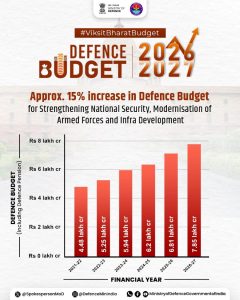
- Defence leads with the highest allocation at Rs 7.85 lakh crore, accounting for 14.68% of the Union Budget-strengthening preparedness, driving innovation, and reinforcing India’s national security
-
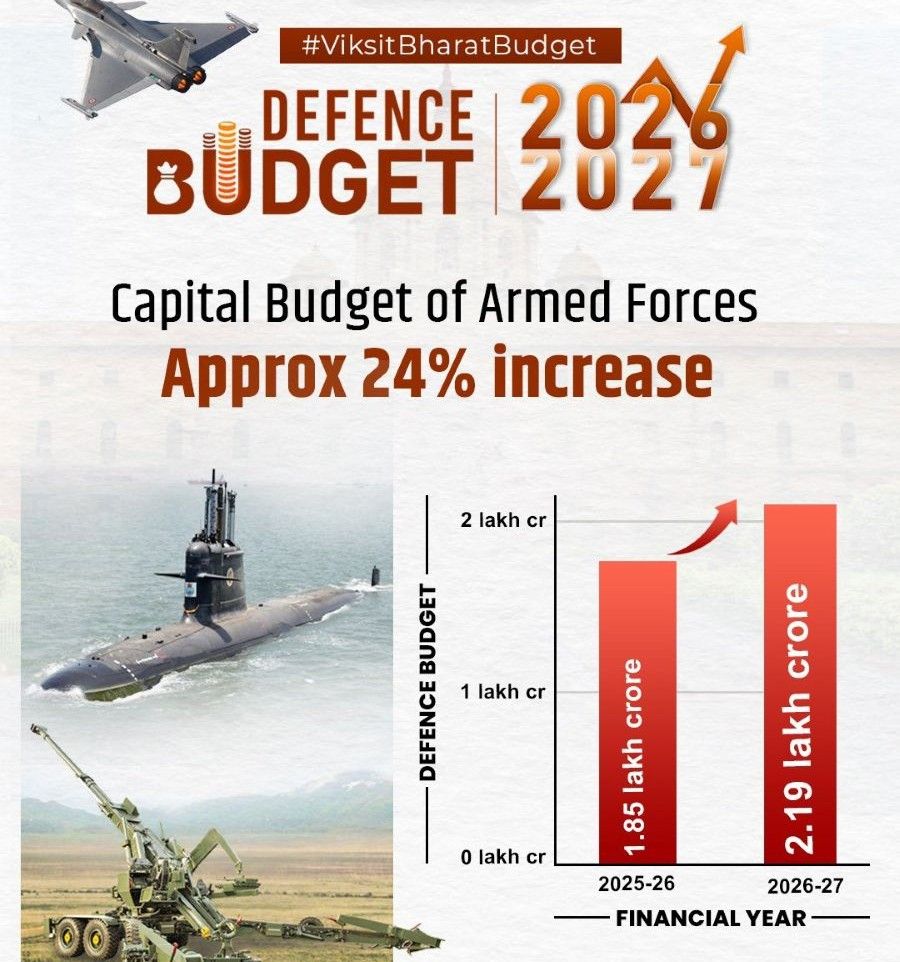
Capital outlay for modernisation increased by nearly 24% to Rs 2.19 lakh crore
-
Higher capital spend linked to initial payments for major acquisitions
-
Aircraft and aero-engines receive the largest share of capital funds
-
Customs duty relief announced for defence and aerospace manufacturing
-
No defence-specific policy announcements in Budget speech
The sharp increase in capital expenditure in the Union Budget 2026-27 is driven in part by initial payments for major defence acquisitions, including large platforms such as fighter aircraft and conventional submarines, according to official sources.
Finance Minister Nirmala Sitharaman on February 1 announced a total allocation of Rs 7.85 lakh crore for the Ministry of Defence, marking an increase of around 15% over last year’s Rs 6.80 lakh crore.
The capital outlay for modernisation has been raised by nearly 24% to Rs 2.19 lakh crore, compared to Rs 1.80 lakh crore in 2025-26. Officials indicated that the higher allocation provides room for advance and milestone payments linked to contracts in the pipeline.
These include big-ticket purchases, such as additional Rafale fighter jets and conventional submarines, among other major platforms.
The increased spending comes months after India’s military operations during Operation Sindoor in May last year, which underscored the importance of sustained funding for combat readiness and force modernisation.
As per the budget documents, the FY27 defence allocation covers defence services (revenue), capital expenditure, defence pensions, and civil establishments under the ministry.
Defence services (revenue) have been allotted Rs 3.65 lakh crore, covering salaries, allowances, maintenance, and day-to-day operational requirements.
Defence pensions account for Rs 1.71 lakh crore, while civil establishments have been allocated Rs 28,554.61 crore.
Within the capital budget, the aircraft and aero-engines segment has received the highest allocation of Rs 72,780 crore, up from Rs 63,734 crore in the previous financial year.
The naval fleet segment has been allotted Rs 25,024 crore, compared to Rs 21,397 crore last year.
Officials said the enhanced capital outlay signals the government’s focus on the timely execution of acquisition programmes and strengthening domestic defence manufacturing.
While no defence-specific policy initiatives were announced in the Budget speech,
Sitharaman proposed exempting basic customs duty on components and parts required for the manufacture of civilian, training, and other aircraft.
She also announced a waiver of customs duty on raw materials imported for maintenance, repair, and overhaul by defence units, a move expected to support the defence aerospace ecosystem.
India enters Budget 2026-27 with defence manufacturing at record levels. Indigenous defence production stood at Rs 1.26 lakh crore in 2024, while defence exports reached Rs 21,083 crore.
In FY 2024–25, defence production touched Rs 1.54 lakh crore, and exports rose to Rs 23,622 crore, continuing the upward trend seen over the past decade.
Despite the steady rise in allocations, defence spending as a share of GDP has remained relatively stable. In 2025-26, defence expenditure was estimated at around 1.9% of GDP.
Overall, the 2026-27 defence budget reflects the government’s continued emphasis on modernisation, big-platform acquisitions, and self-reliance, even as defence spending grows more in absolute terms than as a share of the economy.
Ravi Shankar

Dr Ravi Shankar has over two decades of experience in communications, print journalism, electronic media, documentary film making and new media.
He makes regular appearances on national television news channels as a commentator and analyst on current and political affairs. Apart from being an acknowledged Journalist, he has been a passionate newsroom manager bringing a wide range of journalistic experience from past associations with India’s leading media conglomerates (Times of India group and India Today group) and had led global news-gathering operations at world’s biggest multimedia news agency- ANI-Reuters. He has covered Parliament extensively over the past several years. Widely traveled, he has covered several summits as part of media delegation accompanying the Indian President, Vice President, Prime Minister, External Affairs Minister and Finance Minister across Asia, Africa and Europe.