



Editor’s Note
Recent conflicts, from Ukraine to West Asia, have underscored the decisive role of precision firepower and drones in modern warfare. For artillery, the shift is no longer merely about guns and rockets but about integrating sensors, drones and loitering munitions into a seamless kill chain. The Indian Army’s move to raise Shaktibaan Regiments and Divyastra Batteries reflects this transformation. These formations aim to compress the sensor-to-shooter cycle while extending the reach and accuracy of artillery fire. This article examines how these emerging formations could redefine the role of artillery in future Indian military operations.
The war in Ukraine, the Gaza conflict, and the ongoing battle in Iran offer a plethora of lessons for armies worldwide. To state just one example that’s being pursued across continents, the arsenals of drones being amassed by nations are phenomenal. Drones have been recognised as important and decisive enough on battlefields to rewrite military doctrines. Today, casualties of drone operators, as well as casualties inflicted by drones, exceed any other causatives for casualties in Ukraine. And drone attacks in the Gulf countries (GCC) are driving crude oil prices steeply north.
Battlefield Scenario
To view the issue through a focused lens, drones have become the primary means of delivering firepower. They enhance and expand our existing firepower delivery means at a cost far lower, and hence available for more liberal use in the combat zone; swarms being a typical example. Today, the optimal utilisation of manoeuvre forces does not lie in assaults by these forces, supported by artillery fire, but in employing firepower to maul enemy defences close to destruction, and in manoeuvre forces wiping out the enemy’s residual strength and gaining control of the ground.
With the success of manoeuvre forces becoming increasingly dependent on the destruction of the enemy through the application of firepower, there is a shift from the prevalent contact–kinetic operational methodology to a more non-contact–kinetic approach to warfighting. In this new scenario, UAVs, drones, loiter ammunition and the like, have made a powered ingress.
Indian Artillery’s Approach to Meet New Battlefield Requirements
The approach adopted today favours precision ammunition and longer ranges, among other goals. Dumb artillery shells with larger zones of fire at the target result in greater ammunition expenditure and lower target damage. Further, the time required to engage the target increases, thereby making artillery assets more vulnerable to enemy location and counter-battery fire.
The other thrust of the artillery lies in prioritising the longer range of their guns and rockets. A lot is being done in this area, as explained in the article on ammunition published in Bharatshakti on 19 February 2026.
The next important issue for the artillery, and indeed for all components of the forces, is reducing response time. The sensors detecting the enemy’s firepower platforms, manoeuvre forces, or other fleeting targets must be processed quickly by the decision makers, and engagement ordered by the nominated shooter with great speed and accuracy. Obviously, the need is to put all these elements into a single loop with near-simultaneous access to the information.
There are varied areas in which the Artillery is trying to absorb technology and sharpen its teeth. The Army is also evolving new organisations, such as the Rudra Brigades and Bhairav Battalions. Artillery, too, is reorganising to make its fire more effective. Among these new organisations are the Shaktibaan Regiments and Divyastra Batteries.
Shaktibaan Artillery Units
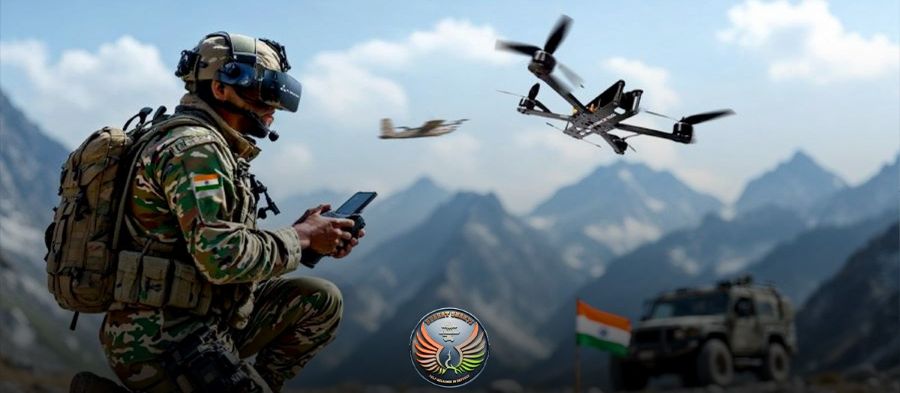
The Shaktibaan regiments are being equipped with drones and loiter ammunition, in addition to guns. These will have longer ranges with loiter ammunition ranging up to 200km. The long-distance drones would go progressively up to 700km. Such an increase in range, combined with accuracy and the ability to bring down fire almost immediately with loiter ammunition pre-deployed in the area, would considerably reduce response time.
According to Maj Gen PK Chakravorty (Retd), “The Drones available in a Shaktibaan Battery could be employed as a swarm. Integral Drone troops will be authorised to such regiments that could saturate the battle space and shorten the Observe – Orient – Decide and – Act loop.”
The depth of the Corps Commander’s area of influence will also increase. Range limitations of gun systems also limit the frontage of a Corps offensive. Guns on one thrust line of advance of a Corps are not always able to support the advance on the other thrust, or manage to do so only at maximum range, with attendant logistical problems.
The Army’s strike formations, including the mountain strike Corps, are being armed with Shaktibaans. A total of 15 to 20 such regiments are planned to be raised. The Indian defence industry complex can produce most of the equipment and the ammunition being scaled to these regiments.
Divyastra Battery
Divyastra fire units are to be integrated with the existing artillery resources in our formations. Divyastra batteries will have UAVs, surveillance and strike capabilities.
These batteries will be authorised to artillery formations at the divisional level that are mostly in a defensive role. According to Maj Gen PK Chakravorty (Retd), “These batteries are being equipped with Loiter ammunition and Remotely Piloted Aircraft and a unique sensor to shooter link. As such, these batteries will be able to carry out surveillance, reconnaissance, engagement of the target and post-strike damage assessment.”
The hunter-killer roles have been combined, with the battery’s integral resources able to detect the enemy and bring down fire to inflict attrition, creating an opportunity for manoeuvre elements to progress the capture of ground.
While these batteries address the sensor shooter gap, the depth of engagement will necessarily be dependent on the guns of the unit. With rapid improvements in ammunition and ambitious ranges being targeted by both the DRDO and also the private munitions industry, a discernible capability development is in motion.
Battles Beyond Sindoor Operations
While we performed commendably in the conflict, there is no way that our forces can rest on their laurels. Fortunately, that’s also a lesson that seems to have been imbibed pretty deftly by the forces. The war in Iran rests primarily on the delivery of firepower with precision and volume. It also involves integrating drones into operations. On both counts, and on a lot more, we are progressing. The question is not about a dearth of ideas, foresight or planning; it’s more about timelines and budgets.
Brig SK Chatterji (Retd)

He was commissioned into the Regiment of Artillery after having graduated from the Indian Military Academy. A graduate of Defence Services Staff College, and Senior Command course at the Army War College, he commanded a medium artillery regiment in high altitude area, an artillery brigade in deserts, and a Corps artillery brigade in intense counter insurgency environment in Kashmir Valley.
A prolific writer, the officer has written a book: Vintage Guns of India.
Recently, he has co-authored the book: Home of the Brave. History of Rashtriya Rifles.
He has a chapter in the book: Know India Better; a chapter in another book yet to be published.
He has over 300 articles on various subjects in newspapers and military magazines in India, US, Canada, Singapore and Hong Kong.
He has also, edited the book: The Guardsman; and drafted the Regiment of Artillery History.