As Chief of Defence Staff (CDS), Gen Anil Chauhan races against time to roll out the formation of Joint Theatre Commands before he demits office in May 2026, the three services are preparing for the inevitable changes that are bound to come in the functional aspects of the three forces when the new structures are put in place.
After Prime Minister Narendra Modi’s unambiguous directive to complete the first phase of theaterisation (announcing their formation and composition) before India’s 2nd CDS completes his extended tenure next summer, there is a sense of urgency in the Department of Military Affairs (DMA) and the Ministry of Defence (MoD).
The Indian Air Force (IAF), which seemed to buy into the idea somewhat reluctantly, has reportedly sent its observations/objections to the Chiefs of Staff Committee (CoSC), headed by Gen Chauhan, on how the IAF can be utilised in the proposed Joint Theatre Commands.
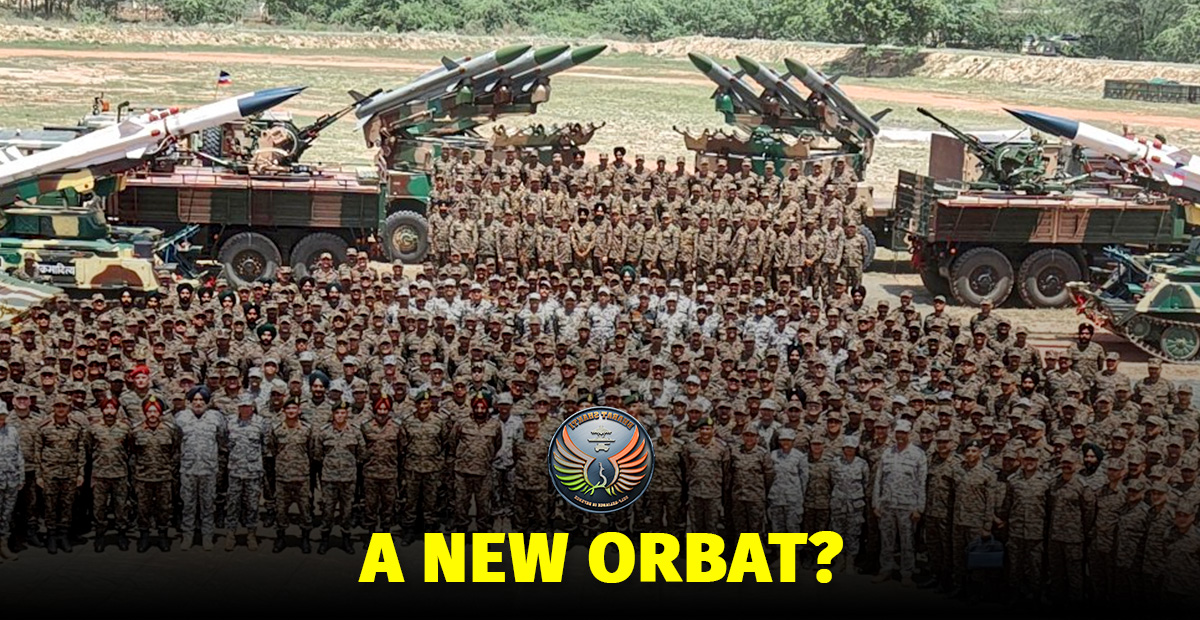
The Indian Army is also reportedly taking a relook at its ORBAT (Order of Battle) along both the Pakistan border and the China frontier. The rejigged ORBAT, if accepted and approved, will also fit in well with the proposed Theatre Command structure.
As is well known by now, the CoSC, headed by the CDS and comprising the three service Chiefs, has finalised the formation of three Joint or Theatre Commands. All available indications point to two adversary-specific joint commands, the Northern Theatre Command (for the China frontier) to be headquartered in Lucknow, the Western Theatre Command (against Pakistan) with its headquarter in Jaipur and one Maritime Theatre Command to be based in Thiruvananthapuram for the maritime domain.
With 14 Corps-level formations at its disposal and another likely to be raised soon, Army HQ is attempting to achieve a practical balance of forces on both fronts. Essentially, the main objective of the exercise is to rationalise force deployment against a bigger adversary, China, as well as allow Northern Command to fully concentrate on Pakistan. The Northern Command is currently overburdened with four Corps (1, 14, 15 and 16) and is responsible for guarding both the Pakistan and China borders.
There is a school of thought that the Leh-based 14 Corps under Northern Command, guarding the Line of Actual Control (LAC) in Eastern Ladakh, besides looking after the Siachen battlefield and the Kargil-Batalik-Drass segment of the Line of Control (LoC) against Pakistan, should be allocated to the current Central Army Command, headquartered in Lucknow.
One view is that 14 Corps under Central Command makes both geographical and functional sense. Currently, the Command is responsible for securing the China border from Himachal Pradesh to Uttarakhand, while the Sikkim-Arunachal Pradesh portion of the Northern Frontier falls under the Eastern Command. If the Eastern Ladakh portion of the LAC is brought under the Central Command, it will then be responsible for guarding the China frontier, from Daulat Beg Oldie (DBO) in Ladakh to Lipulekh and the Nepal border, and extending to Sikkim.
This arrangement will ensure that only two major Army commands (Central and Eastern) guard the China frontier. It will allow them to build capability and function in a coordinated manner, meeting the challenge of China’s continuous aggression along the unsettled border. The Udhampur-based Northern Command, on the other hand, will be free to deal with Pakistan and its proxy war in Jammu and Kashmir.
Others question the rationale for such a proposal, pointing out that the 14 Corps is also currently responsible for the LoC with Pakistan in the Kargil-Drass-Batalik Sectors and for the deployment on the Siachen Glacier. But with the Zozilla tunnel about to become functional, ensuring all-weather connectivity between the Kashmir Valley and Ladakh and another road coming up between Turtuk and Chorbatla, both the formations—the 8 Mountain Division, guarding the Kargil-Drass-Batalik sector and the Siachen Brigade, headquartered at Partapur near Turtuk–can continue to function under the 15 Corps and Northern Command. However, administratively and logistically, they can still be serviced by units under 14 Corps, which counters this view.
If the 14 Corps is indeed brought under the Central Command, the proposed Northern Theatre Command will geographically stretch from Daulat Beg Oldie (DBO) in Ladakh to Kibithu in Eastern Arunachal Pradesh. The two existing Army Commands—Eastern and Central—and their formations will make up for the proposed China-facing Northern Theatre Command. It can consist of 14, 33, 3 and 4 Corps in addition to two Strike Corps, 1 and 17. Simultaneously, the Army has plans to augment security in the middle sector of the India-China border. The Bareilly-headquartered Uttar Bharat Area (a static formation, largely entrusted with administrative duties) is currently transiting from an Area HQ to a ‘combatised area’. Whether it becomes a full-fledged Corps is a speculation that has done the rounds earlier without any concrete outcome. But even as a ‘combatised area,’ it can serve as an additional formation in the Northern Theatre Command.
The Western Theatre Command, meant to cover the entire frontier with Pakistan from Tangdhar to Bikaner, will have the 10, 11, 12, 15, 16 Corps, besides the two Strike formations 2 and 21, as land formations under its command.
That leaves the Yol-based 9 Corps. It can be treated as a Dual Task Formation or DTF to be deployed as and when required in either of the two land theatres, and is likely to be one of the proposals.
Theatre Commands will, of course, need to include the IAF, which currently has seven commands, and the Indian Navy, with its three existing Commands. How they will fit into the three proposed Joint Theatre Commands is for another commentary soon.
Nitin A. Gokhale

Author, thought leader and one of South Asia's leading strategic analysts, Nitin A. Gokhale has forty years of rich and varied experience behind him as a conflict reporter, Editor, author and now a media entrepreneur who owns and curates two important digital platforms, BharatShakti.in and StratNewsGlobal.com focusing on national security, strategic affairs and foreign policy matters.
At the beginning of his long and distinguished career, Gokhale has lived and reported from India’s North-east for 23 years, writing and analysing various insurgencies in the region, been on the ground at Kargil in the summer of 1999 during the India-Pakistan war, and also brought live reports from Sri Lanka’s Eelam War IV between 2006-2009.
Author of over a dozen books on wars, insurgencies and conflicts, Gokhale relocated to Delhi in 2006, was Security and Strategic Affairs Editor at NDTV, a leading Indian broadcaster for nine years, before launching in 2015 his own digital properties.
An alumni of the Asia-Pacific Centre for Security Studies in Hawaii, Gokhale now writes, lectures and analyses security and strategic matters in Indo-Pacific and travels regularly to US, Europe, South and South-East Asia to speak at various international seminars and conferences.
Gokhale also teaches at India’s Defence Services Staff College (DSSC), the three war colleges, India's National Defence College, College of Defence Management and the intelligence schools of both the R&AW and Intelligence Bureau.
He tweets at @nitingokhale