


India’s defence diplomacy is undergoing a visible shift. As New Delhi seeks to reduce dependence on traditional suppliers and deepen indigenous capability under the “Make in India” and “Atmanirbhar Bharat” frameworks, a new set of partners is steadily moving to the centre of India’s strategic calculus: Europe, South Korea, and Vietnam.
The trend became more pronounced during Prime Minister Narendra Modi’s five-nation European tour between May 15 and 20, during which discussions on semiconductors, clean energy and trade were accompanied by a strong push for defence industrial cooperation, technology sharing and co-development partnerships.
From Italy’s renewed defence outreach to Sweden’s expanding manufacturing footprint, South Korea’s growing role in advanced weapons collaboration, and Vietnam’s interest in India’s BrahMos missile system, the emerging pattern signals a broader transformation in India’s defence requirements – one driven less by outright imports and increasingly by co-creation, technology absorption and strategic diversification.
Beyond Buyer-Seller Relationships
India’s defence partnerships are no longer being structured around simple procurement contracts. Instead, New Delhi is pressing foreign manufacturers to integrate into India’s domestic industrial ecosystem through joint ventures, local manufacturing and technology partnerships.
That shift was most visible in Rome this week, where India and Italy elevated ties to a “Special Strategic Partnership”. Prime Minister Modi and Italian Prime Minister Giorgia Meloni unveiled a defence industrial roadmap centred on co-development and co-production of military platforms.
The roadmap opens the door to collaboration on helicopters, naval systems, marine weapons, and electronic warfare technologies – sectors where India is looking to build long-term domestic capabilities rather than remain dependent on imports.
“Our Defence Industrial Roadmap has paved the way for co-development and co-production,” Modi said after talks in Rome, underscoring that India wants future partnerships to move beyond transactional acquisitions.
The development is particularly significant because defence ties between the two countries had remained constrained for years following the AgustaWestland helicopter controversy, which effectively froze Italian firms out of the Indian market.
Officials now view the reset as part of India’s broader effort to diversify suppliers amid global geopolitical uncertainties and supply-chain disruptions.
Gr Capt (Dr) RK Narang, Senior Fellow at the Manohar Parrikar Institute for Defence Studies and Analyses, said India is consciously seeking to transform defence partnerships from licence-production arrangements into collaborative technology ecosystems.
“Most of our collaborations have not yet matured at the level of joint IPR creation in defence and emerging technologies,” Narang said. “New country partnerships provide fresh perspectives for collaborative development of critical technologies and create opportunities for equal partnerships in emerging domains.”
He said India’s growing industrial capacity has encouraged European countries to view Indian industry as a more reliable long-term partner.
“European nations have shown greater confidence in Indian industry. Geopolitical uncertainties have placed India as a viable and dependable partner for co-creation and mutually beneficial technological development,” he added.
Sweden’s Expanding Defence Footprint
Among European partners, Sweden has emerged as one of the most active players in India’s defence industrial landscape.
India and Sweden elevated ties to a Strategic Partnership during Modi’s visit on May 17, with defence cooperation forming a central pillar of the relationship.
Swedish defence major Saab has already established a manufacturing facility in Jhajjar, Haryana, for the Carl-Gustaf M4 weapon system – India’s first 100 per cent FDI-backed defence manufacturing project.
The facility reflects a larger trend in India’s defence strategy: attracting foreign manufacturers not merely as exporters, but as long-term industrial stakeholders embedded within India’s supply chain.
Saab is also aggressively pitching the Gripen E fighter aircraft for the Indian Air Force’s 114 Multi-Role Fighter Aircraft programme, offering full technology transfer and local production if selected.
Kent-Ake Molin, head of Saab’s Gripen for India programme, had earlier said the company could deliver the first aircraft within three years of contract signing while establishing a full production line in India.
Beyond fighter aircraft, Swedish firms are expanding into electronic warfare systems, battlefield radar technologies, UAV manufacturing and advanced anti-armour weapons.
A proposed Rs 500 crore UAV facility by Swedish company Promoteq in the Uttar Pradesh Defence Corridor further underlines Europe’s growing confidence in India’s defence manufacturing ecosystem.
Anshuman Tripathi, a former member of India’s National Security Advisory Board (NSAB), said India’s defence industry has crossed an important threshold.
“The Indian defence manufacturing ecosystem has gone past an inflexion point sufficient to make viable international collaborations for state-of-the-art products,” Tripathi said.
“In this increasingly multipolar world, India’s industrial viability is leading to mutually beneficial partnerships extending from Europe to South Korea.”
South Korea and the Technology Push
While Europe is emerging as a major defence-industrial partner, South Korea is increasingly becoming central to India’s ambitions in advanced military technologies and next-generation weapons systems.
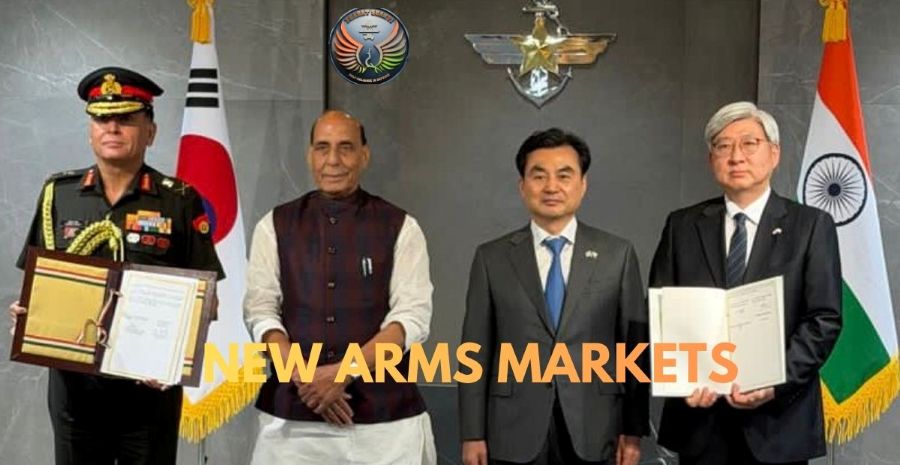
During Defence Minister Rajnath Singh’s visit to Seoul this week, both countries reviewed defence cooperation spanning maritime security, emerging technologies, logistics, industrial production and military exchanges.
The discussions included plans for collaboration on laser weapons, mobile air defence systems, artificial intelligence, and advanced sensors, according to sources familiar with the talks.
The two sides also discussed expanding the India-Korea Defence Innovation Accelerator Ecosystem (KIND-X), which aims to integrate the defence innovation ecosystems of both countries.
Two agreements between Larsen & Toubro and Hanwha Aerospace were signed during the visit, reinforcing an already successful partnership built around the K9 Vajra-T self-propelled artillery gun programme.
The K9 Vajra project has emerged as one of India’s most successful examples of licensed production evolving into industrial collaboration, with the artillery systems now deployed along India’s northern borders.
But cooperation is now extending well beyond artillery.
Both countries are exploring collaboration in naval shipbuilding, submarine technologies, lithium-ion battery systems and advanced maritime capabilities.
Tripathi said India and South Korea possess complementary strengths that could reshape Indo-Pacific maritime cooperation.
“South Korea has long pursued indigenous aircraft carrier capability while India possesses decades of operational experience with carrier battle groups,” he said.
“Collaboration on carrier development and doctrine could accelerate timelines, reduce costs and significantly strengthen South Korea’s maritime posture.”
Defence officials say India’s emphasis on emerging technologies – including AI, autonomous systems, semiconductors, cyber capabilities and space-based technologies – aligns closely with South Korea’s industrial strengths.
Vietnam and India’s Export Ambitions
At the same time, India’s defence outreach is increasingly being driven by exports.
Vietnam has emerged as the latest country exploring the acquisition of the BrahMos supersonic cruise missile, with negotiations reportedly nearing conclusion.
If finalised, Vietnam would become the third foreign operator of the missile after the Philippines and Indonesia.
The discussions reflect growing regional interest in Indian-made systems that have demonstrated operational credibility.
The BrahMos missile gained renewed international attention following “Operation Sindoor” in 2025, when India used the system during retaliatory strikes against Pakistan after the Pahalgam terror attack.
Indian officials believe the missile’s demonstrated combat capability has significantly improved its export prospects across Southeast Asia, West Asia and Latin America.
During Defence Minister Rajnath Singh’s visit to Hanoi this week, India and Vietnam signed agreements on artificial intelligence and quantum technologies, while also discussing maritime security, defence industry cooperation and military training.
The widening scope of India-Vietnam defence ties reflects broader Indo-Pacific strategic convergence as countries seek stronger regional security partnerships amid growing geopolitical competition.
A Strategic Shift in Thinking
For strategic analysts, the emerging pattern is less about replacing one supplier bloc with another and more about creating diversified, resilient and technologically beneficial partnerships.
Prof. Swasti Rao said India’s defence posture reflects a larger shift in strategic thinking.
“The convergence is happening at the right time,” she said, noting that India has simultaneously emerged as a growing defence exporter while strengthening its indigenous manufacturing capability.
The broader signalling is also geopolitical.
As Europe recalibrates supply chains and Indo-Pacific security concerns intensify, India is increasingly being viewed not only as a defence market but as a strategic manufacturing and technology partner capable of supporting global industrial resilience.
For New Delhi, the message is equally clear: future defence preparedness will depend not only on acquiring weapons, but on controlling technologies, securing supply chains and building collaborative industrial ecosystems.
That transition is now reshaping the architecture of India’s defence partnerships – from Europe to East Asia and beyond.
Ravi Shankar

Dr Ravi Shankar has over two decades of experience in communications, print journalism, electronic media, documentary film making and new media.
He makes regular appearances on national television news channels as a commentator and analyst on current and political affairs. Apart from being an acknowledged Journalist, he has been a passionate newsroom manager bringing a wide range of journalistic experience from past associations with India’s leading media conglomerates (Times of India group and India Today group) and had led global news-gathering operations at world’s biggest multimedia news agency- ANI-Reuters. He has covered Parliament extensively over the past several years. Widely traveled, he has covered several summits as part of media delegation accompanying the Indian President, Vice President, Prime Minister, External Affairs Minister and Finance Minister across Asia, Africa and Europe.