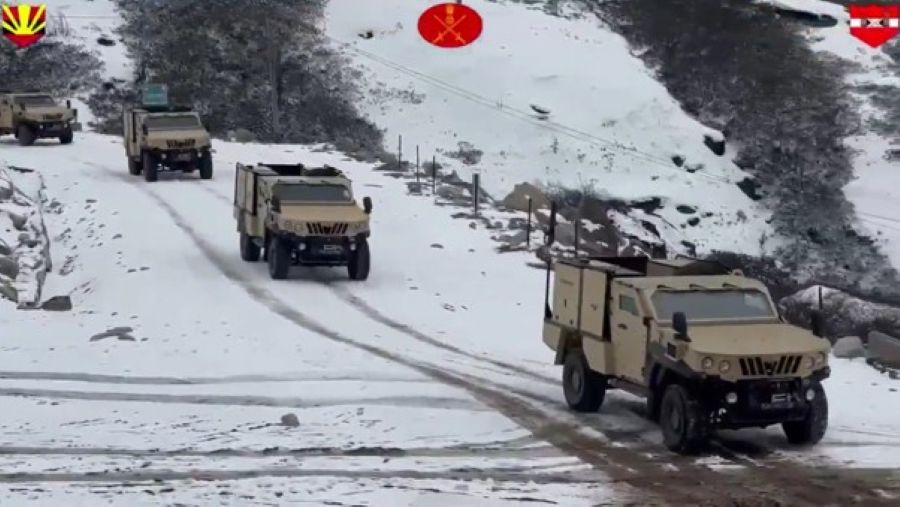
The Indian Army has initiated the process to acquire an indigenous Mortar Specialist Vehicle (MSV), seeking a highly mobile, computer-assisted platform that can significantly improve the accuracy, speed and survivability of mortar detachments on the battlefield.
In a Request for Information (RFI) issued to domestic defence manufacturers under the Defence Acquisition Procedure (DAP) 2020, the Army outlined requirements for a wheeled, crew-operated vehicle capable of automating fire-control functions for both 81 mm and 120 mm mortar systems.
The move reflects the Army’s broader effort to modernise infantry fire support and introduce greater precision into tactical engagements, particularly in high-threat environments where rapid response and mobility are critical.
According to the RFI, the proposed system will use an onboard ballistic computer to automatically calculate and apply firing data received from forward observers and mortar fire controllers. The Army believes such automation can substantially reduce human error, improve first-round hit probability and cut engagement timelines.
Military planners argue that conventional mortar operations remain heavily dependent on manual calculations and crew proficiency, factors that can affect accuracy and increase ammunition expenditure. An automated system would enable mortar teams to quickly engage targets and relocate before enemy counter-battery fire can be brought to bear.
The Army has specified that the vehicle should be operated by a two-member crew and be capable of deploying and aiming within 20 seconds. Re-aiming after firing should take no more than five seconds, while accuracy levels are expected to remain within zero to two mils in both elevation and azimuth.
The vehicle is expected to carry around 54 mortar rounds and should be designed with sufficient growth potential to accommodate larger-calibre mortar systems in the future.
The operational requirements highlight the Army’s focus on deployment in diverse, challenging terrain. The MSV must attain speeds of at least 80 kmph on highways and 40 kmph on secondary roads, while offering a range of 400 km on roads and 250 km in cross-country conditions.
Notably, the platform must be capable of operating at altitudes up to 17,000 feet and in temperatures ranging from minus 25°C to plus 50°C, underscoring its intended role along India’s northern borders.
The Army has also sought key survivability features, including STANAG Level-1 ballistic protection against small-arms fire and shell splinters, along with anti-drone protection cages, an increasingly common battlefield requirement following lessons from recent conflicts.
The proposed MSV programme aligns with the Army’s wider artillery modernisation drive, which has seen the induction of M777 ultra-light howitzers, the advancement of the indigenous Advanced Towed Artillery Gun System (ATAGS), and the expansion of the Pinaka rocket force. If pursued, the automated mortar vehicle would bring similar precision and networked firepower to infantry formations at the tactical level.
Team BharatShakti