India has completed the final development trials of its next-generation Ballistic Missile Defence (BMD) shield, marking a significant milestone in the country’s strategic defence capabilities. This achievement positions India among a select group of nations capable of intercepting Intercontinental Ballistic Missiles (ICBMs).
The two-day trials, conducted by the Defence Research and Development Organisation (DRDO) on June 10 and 11, validated a multi-layered missile defence architecture designed to neutralise incoming ballistic missiles both outside and within the Earth’s atmosphere.
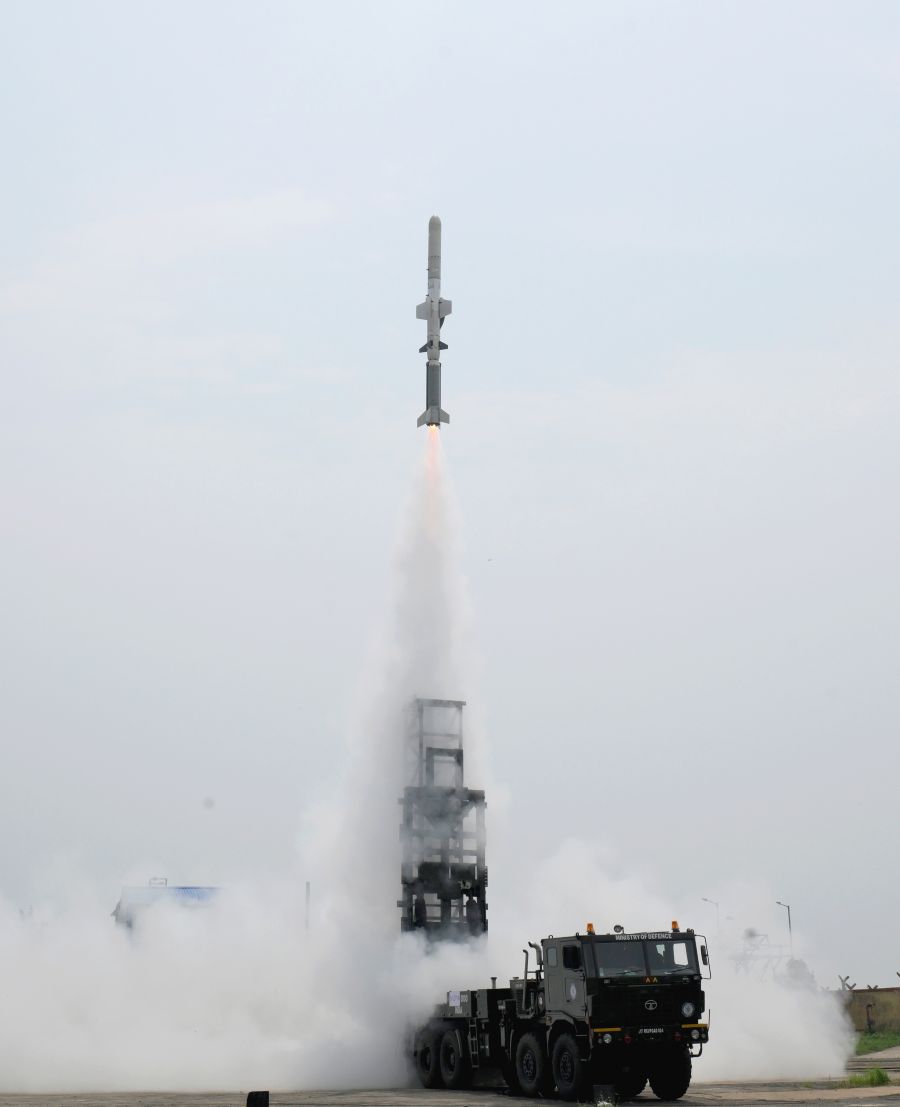
During the tests, two interceptor missiles were successfully launched to engage targets in different scenarios: one operated in the exo-atmospheric layer, beyond Earth’s atmosphere, while the other operated in the endo-atmospheric layer, within it.
In an official statement, the DRDO said it had demonstrated “multiple crucial technologies” aimed at strengthening India’s ability to counter evolving missile threats.
“The interceptors successfully engaged their respective targets. The systems are designed and developed with the latest technologies to address emerging missile threats,” the statement said.
The maiden flight test of the Naval Anti-Ship Missile-Medium Range (NASM-MR) was also carried out successfully.
The successful completion of these trials is being seen as a major step forward for India’s strategic deterrence posture, as only a select group of countries currently possess operational capabilities to engage long-range ballistic missiles, including those in the ICBM class.
Decades in the Making
India’s BMD programme was launched in 1999, against the backdrop of Pakistan’s nuclear weapons tests a year earlier and China’s rapid advances in missile technology.
The shield has been developed as a two-tier defence system, capable of intercepting hostile missiles at different stages of their terminal flight.
The first successful BMD interception took place in November 2006, when a modified Prithvi-II missile target was destroyed at an altitude of around 48 km, demonstrating endo-atmospheric interception capability.
The programme has since evolved through multiple phases.
Phase-I, declared complete in 2019, centred on the Prithvi Defence Vehicle (PDV) and the Advanced Air Defence (AAD) interceptor systems, providing protection against short- and medium-range ballistic missile threats.
The recently concluded trials are linked to Phase II, which is intended to deal with more sophisticated and longer-range threats. This phase relies on the AD-1 and AD-2 interceptor missiles, designed to engage high-speed ballistic missiles, including those with ranges associated with ICBM-class systems.
Preparing for Future Threats
DRDO has already initiated work on Phase III of the BMD programme, aimed at countering emerging classes of strategic weapons.
The next generation of interceptors, internally designated AD-AH and AD-AM, is being developed to neutralise threats such as hypersonic weapons, manoeuvrable glide vehicles, and missiles equipped with Multiple Independently Targetable Re-entry Vehicle (MIRV) technology.
MIRVs enable a single ballistic missile to carry multiple nuclear warheads, each capable of striking different targets. Hypersonic glide vehicles, meanwhile, can alter their trajectories during flight, making them significantly harder to track and intercept.
The development of capabilities against such threats reflects the changing nature of missile warfare and the growing emphasis on layered air and missile defence systems worldwide.
The Architecture Behind the Shield
India’s BMD system extends far beyond interceptor missiles.
The architecture comprises specialised launch vehicles, long-range tracking radars, Launch Control Centres (LCCs), and a central Mission Control Centre (MCC). These assets are geographically dispersed and linked through secure communication networks to ensure rapid threat detection, decision-making and interception.
Among the most critical components of the shield are its radar systems.
In the mid-2000s, India inducted the Swordfish long-range tracking radar, developed with Israeli assistance. The active electronically scanned array (AESA) radar is derived from Israel’s Green Pine radar used in the Arrow missile defence system, but incorporates substantial indigenous elements.
Over the years, DRDO has developed more advanced indigenous radar systems with enhanced range and improved tracking capabilities to support future phases of the programme.
NASM-MR Test Also Successful
Alongside the BMD trials, DRDO also carried out the maiden flight test of the Naval Anti-Ship Missile-Medium Range (NASM-MR), further expanding India’s indigenous missile portfolio.
The anti-ship missile is intended to provide the Indian Navy with a modern stand-off capability against maritime targets at medium ranges.
Senior DRDO scientists and officials from the armed forces witnessed all three tests.
The latest demonstrations underscore DRDO’s push to develop indigenous solutions for increasingly complex battlefield challenges, even as India prepares for an era defined by hypersonic weapons, advanced ballistic missiles, and multi-domain threats.
Ravi Shankar

Dr Ravi Shankar has over two decades of experience in communications, print journalism, electronic media, documentary film making and new media.
He makes regular appearances on national television news channels as a commentator and analyst on current and political affairs. Apart from being an acknowledged Journalist, he has been a passionate newsroom manager bringing a wide range of journalistic experience from past associations with India’s leading media conglomerates (Times of India group and India Today group) and had led global news-gathering operations at world’s biggest multimedia news agency- ANI-Reuters. He has covered Parliament extensively over the past several years. Widely traveled, he has covered several summits as part of media delegation accompanying the Indian President, Vice President, Prime Minister, External Affairs Minister and Finance Minister across Asia, Africa and Europe.