


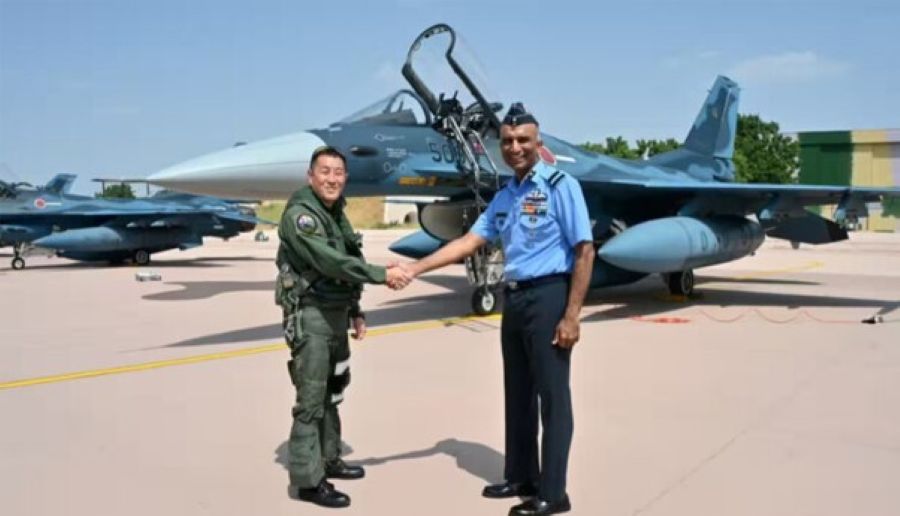
Japanese fighter aircraft have operated from Indian soil for the first time, while the Air Chiefs of India and Japan flew sorties in Tejas fighters during Exercise Veer Guardian-2026 at Jodhpur, marking a new phase in bilateral air force cooperation.
The 14-day exercise, being conducted at Air Force Station Jodhpur from September 9 to 22, brings together frontline aircraft from the Indian Air Force (IAF) and the Japan Air Self-Defense Force (JASDF) for advanced operational missions, professional exchanges and discussions on mission planning, engineering and aerospace safety.
The IAF is participating with its indigenous Light Combat Aircraft Tejas, Su-30MKI and Rafale fighters, while Japan has deployed its F-2A multirole fighter aircraft. The Japanese fighters were ferried from Tsuiki Air Base in Japan, marking the first deployment of JASDF fighter aircraft to India for a bilateral exercise.
Air Chiefs Fly Tejas, Highlight Growing Defence Partnership
Speaking at Air Force Station Jodhpur on Sunday, Air Chief Marshal Amar Preet Singh described the maiden deployment of Japanese fighter aircraft to India as a significant milestone in defence cooperation between the two countries.
Japanese Air Self-Defense Force Chief of Staff General Takehiro Morita also participated in the exercise, flying a Tejas fighter alongside an Indian pilot. Air Chief Marshal Singh undertook a sortie in another Tejas. The two Air Chiefs also exchanged badges as a gesture of mutual respect and partnership.
Singh said joint exercises provide both air forces with an opportunity to learn from each other, strengthen operational capabilities and develop a deeper understanding of their respective practices. He emphasised that the partnership was built on mutual respect, professional trust and a shared commitment to peace and stability.
Morita described the Tejas as a symbol of India’s technological innovation and the Make in India initiative. Flying the indigenous fighter, he said, gave him an opportunity to reflect on the contributions of military personnel and industry experts involved in its development.
The exercise includes advanced operational missions and professional interactions covering mission planning, engineering and aerospace safety. These engagements are intended to improve tactical proficiency and operational synergy between the two air forces.
Singh, while discussing India’s indigenous fighter programme, said a substantial number of Tejas aircraft had been ordered, although some deliveries had been affected by global supply-chain challenges. He also expressed confidence in the future development of India’s indigenous combat aircraft programme.
What the F-2 Deployment Means for India–Japan Air Cooperation
The arrival of Japan’s F-2 fighters in Jodhpur represents an expansion of the geographical scope of India–Japan air force exercises. Until now, bilateral air exercise engagements had been conducted with the Indian contingent travelling to Japan. The 2026 edition brings Japanese combat aircraft to an Indian air base for the first time.
The development comes amid expanding strategic cooperation between New Delhi and Tokyo, including defence exchanges, military exercises and coordination on Indo-Pacific security.
Both countries are members of the Quad, alongside the United States and Australia. Their security concerns include China’s growing military presence across the Indo-Pacific, although the exercise is officially focused on strengthening interoperability, operational skills and professional cooperation.
Strategic Context: China and the Indo-Pacific
The exercise is taking place against the backdrop of overlapping security concerns faced by India and Japan. India confronts China along its Himalayan frontier, while Japan has raised concerns over Chinese military activity around the East China Sea and the western Pacific.
These parallel security challenges have contributed to closer strategic engagement between New Delhi and Tokyo. However, the official objectives of Veer Guardian-2026 centre on air force cooperation and operational synergy rather than any stated China-specific mission.
Japan’s decision to deploy its F-2 fighters to India can therefore be viewed in the context of broader bilateral defence engagement, while the exercise itself remains a platform for military training and professional exchange.
From Japan to India: Evolution of Veer Guardian
India and Japan conducted their inaugural Veer Guardian air exercise in Japan in January 2023, at Hyakuri and Iruma airbases. The 2026 exercise at Jodhpur marks a significant geographical expansion of the bilateral engagement, with Japanese fighter aircraft now operating from an Indian air base.
The participation of the F-2A alongside the Tejas, Su-30MKI and Rafale offers both air forces an opportunity to strengthen their understanding of different aircraft, operational procedures and mission requirements.
With the exercise scheduled to conclude on September 22, its operational outcomes and the lessons derived from the deployment will be relevant to the future development of India–Japan air force cooperation.
Team BharatShakti