



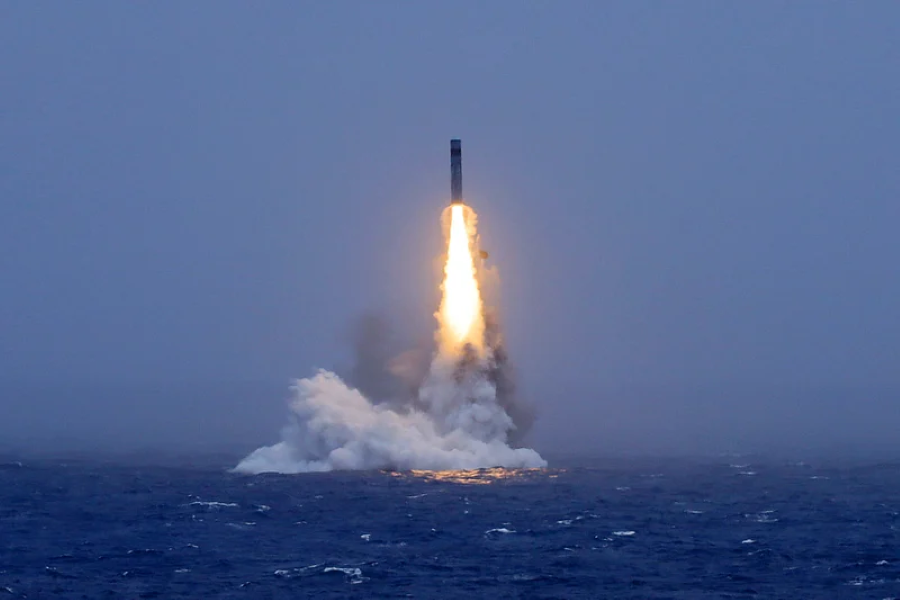
China’s test launch of a submarine-launched ballistic missile (SLBM) into the South Pacific has done more than demonstrate a technological breakthrough. Defence experts say the test marks a significant shift in Beijing’s maritime nuclear posture that could intensify strategic competition across the Indian Ocean.
The missile, widely assessed by defence analysts to be the Julang-3 (JL-3), was fired on a full operational trajectory from a nuclear-powered submarine, signalling that China’s sea-based nuclear deterrent has entered a more mature phase. The launch also triggered protests from Australia, New Zealand and Japan, with concerns over the missile being fired into the South Pacific Nuclear Free Zone.
Captain Sarabjeet Singh Parmar (Retd), a naval analyst, said the test reflected a broader pattern in Beijing’s strategic conduct.
“China’s expanding maritime footprint is no longer confined to port visits, naval exercises or bilateral engagements. Conducting a ballistic missile test in waters covered by the Treaty of Rarotonga, despite having ratified its protocols, demonstrates the same blatant disregard for international commitments that Beijing has shown in the South China Sea despite being a signatory to UNCLOS,” he said.
Brig Arun Sehgal (Retd), Director of the Forum for Strategic Initiatives, said the launch validates China’s transition to a secure “bastion strategy”, allowing its ballistic missile submarines to threaten intercontinental targets while remaining inside heavily protected waters such as the South China Sea.
“The JL-3’s estimated range of over 10,000 km fundamentally changes China’s nuclear posture. Earlier, Chinese submarines had to venture deep into the Pacific, exposing themselves to US anti-submarine forces. With the JL-3, they can strike intercontinental targets from protected coastal bastions, substantially enhancing the survivability of China’s nuclear deterrent,” Sehgal said.
According to him, the test was not merely about extending missile range but about proving the weapon under real operational conditions.
“A full-trajectory launch validates atmospheric re-entry, terminal guidance, booster performance and, potentially, MIRV deployment. It is an important milestone in the operational maturity of China’s sea-based nuclear force,” he noted.
For India, however, the larger concern lies in the strategic consequences rather than the missile itself.
Sehgal said China’s strengthened second-strike capability could allow the People’s Liberation Army Navy (PLAN) to redeploy more of its advanced attack submarines into the Indian Ocean Region instead of escorting ballistic missile submarines in the Pacific.
“As China’s ballistic missile submarines become more secure in home waters, the PLAN gains greater flexibility to push conventional attack submarines into the Indian Ocean. That significantly compounds India’s two-front security challenge by extending Chinese military pressure from the Himalayan frontier into India’s maritime backyard,” he said.
The development also underlines the growing asymmetry between China’s and India’s undersea nuclear capabilities. While China has demonstrated an operational intercontinental sea-based deterrent, India’s submarine-launched ballistic missile programme continues to evolve with shorter-range systems and future long-range capabilities still under development.
“The capability gap is becoming increasingly visible. China’s sea-based deterrent has achieved operational maturity, whereas India’s maritime nuclear leg remains a work in progress. It has implications for deterrence stability across the Indo-Pacific,” Sehgal observed.
Beyond military capability, he warned that China is likely to intensify undersea surveillance operations across the Indian Ocean through its expanding network of tracking ships and dual-use oceanographic research vessels.
“Hydrographic and acoustic mapping of the Indian Ocean directly supports submarine operations. These activities improve China’s ability to conceal its own submarines while enhancing its capacity to detect and track India’s Arihant-class nuclear submarines,” he said.
The timing of the missile test, coinciding with expanding security cooperation among Indo-Pacific nations and joint Chinese-Russian naval exercises, also carries geopolitical messaging, Sehgal argued. By demonstrating a credible sea-based nuclear strike capability, Beijing is signalling that any external military intervention in a future Taiwan contingency would carry significantly higher strategic risks.
Defence analysts say the launch reinforces India’s ongoing push to strengthen anti-submarine warfare capabilities, accelerate theatre command integration, expand maritime surveillance and deepen security cooperation with Quad partners as the strategic contest in the Indo-Pacific increasingly shifts beneath the sea.
Ravi Shankar

Dr Ravi Shankar has over two decades of experience in communications, print journalism, electronic media, documentary film making and new media.
He makes regular appearances on national television news channels as a commentator and analyst on current and political affairs. Apart from being an acknowledged Journalist, he has been a passionate newsroom manager bringing a wide range of journalistic experience from past associations with India’s leading media conglomerates (Times of India group and India Today group) and had led global news-gathering operations at world’s biggest multimedia news agency- ANI-Reuters. He has covered Parliament extensively over the past several years. Widely traveled, he has covered several summits as part of media delegation accompanying the Indian President, Vice President, Prime Minister, External Affairs Minister and Finance Minister across Asia, Africa and Europe.