



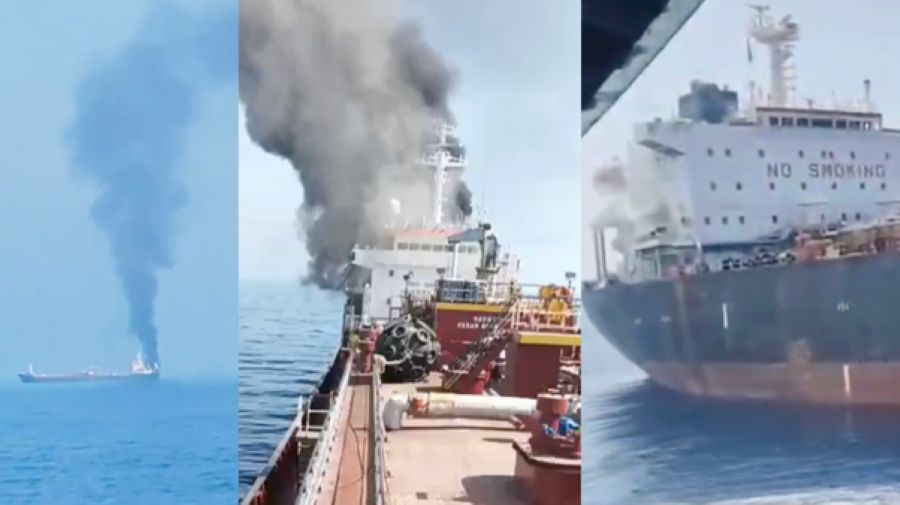
India has unveiled a ‘Seafarer-First’ emergency response framework anchored by Standard Operating Procedures (SOPs). This initiative was prompted by the recent death of an Indian sailor in Omani waters, following an Iranian missile strike on his ship. The incident triggered urgency into the government’s efforts to enhance protection for Indian seafarers operating in conflict zones.
Government figures show that since the West Asia conflict intensified earlier this year, 13-14 Indian seafarers have been killed, three remain missing, while authorities have facilitated the evacuation of 3,918 seafarers from the region.
The Ministry of Ports, Shipping and Waterways (MoPSW) initiative also underlines a difficult reality. While nearly 150 Indian seafarers are currently serving on seven Indian-flagged vessels in the Persian Gulf, another 18,000 Indian seafarers are employed across the Gulf and West Asia, most of them aboard foreign-flagged ships.
The new SOP seeks to bridge this gap by extending government support to Indian seafarers irrespective of the flag their vessels fly.
The Shipping Minister, Sarbananda Sonowal, has directed real-time vessel-by-vessel monitoring, the appointment of dedicated liaison officers for every affected seafarer, and round-the-clock coordination involving the Directorate General of Shipping (DGS), the Indian Navy, Indian missions in Iran and Oman, and other ministries.
The framework aims to ensure verified, real-time information on navigational safety, coastal-state advisories and route status, while coordinating port-of-refuge arrangements, hospitalisation, medical evacuation, repatriation, management of mortal remains and updates on ongoing investigations.
Indian Navy, IFC-IOR Form Operational Backbone
The SOP rests heavily on the Indian Navy’s expanding maritime security architecture in the region.
Amid continuing tensions in West Asia, the Navy has maintained more than five frontline warships in the Gulf of Oman and the Arabian Sea under Operation Urja Suraksha. Their mission is to protect India-bound merchant traffic carrying crude oil, LNG and LPG as vessels emerge from the Strait of Hormuz, providing layered security escorts beyond conflict-prone waters.
The government has also placed the Gurugram-based Information Fusion Centre-Indian Ocean Region (IFC-IOR), operated by the Indian Navy, on standby to support Indian-flagged vessels and coordinate emergency assistance whenever required.
Working as India’s maritime information hub, IFC-IOR can fuse shipping data, monitor vessel movements, assess threats and share real-time information with multiple agencies, making it central to the SOP’s emphasis on continuous situational awareness.
Officials are also closely monitoring Indian crew members serving on ships operating in and around the Strait of Hormuz.
Meanwhile, amid escalating US-Iran tensions and recent attacks on commercial shipping, the Directorate General of Maritime Administration (DGMA) has issued an emergency advisory directing shipping companies to suspend deployment of Indian seafarers on vessels transiting the Strait of Hormuz until further orders.
“In view of the heightened security situation in the Gulf region, the DGMA has directed Ship Owners, Ship Managers and RPSL Companies to avoid deploying Indian seafarers on vessels undertaking voyages through the Strait of Hormuz until further orders,” the regulator said on July 15.
Implementation Challenge: Foreign Flags Remain Blind
The real test, however, lies in implementation.
India has around 1,500 vessels, of which fewer than 60 qualify as large ships of 10,000 tonnes or more. Ensuring compliance by Indian-flagged ships may not prove difficult. The challenge begins with the far larger number of foreign-flagged vessels employing India’s over three lakh seafarers.
Many of these ships operate under flags of convenience, in which owners register vessels in countries such as Panama or Liberia despite having little or no commercial connection with those countries. Such registrations often help shipowners avoid stricter labour, safety and environmental regulations while reducing tax liabilities.
The problem becomes acute when these vessels enter conflict zones or come under suspicion for activities such as carrying sanctioned or illegally traded oil.
Indian crew members aboard such ships may have committed no wrongdoing, yet they often bear the consequences. Because the vessels fly flags of convenience, the flag states may be unwilling or simply lack the capacity to provide meaningful assistance during crises.
That remains the biggest operational gap the new SOP will eventually have to address.
Single Dashboard, Single Point of Contact
At the centre of the response framework is a real-time digital dashboard that will track vessel position, ownership, cargo, crew strength, crew welfare, threat assessment, intended voyage, next port of call and the availability of emergency facilities, providing authorities with a comprehensive operational picture of every vessel of concern.
Each liaison officer will function as the single point of contact for affected families, coordinating medical updates, travel documentation, repatriation, assistance under the Seafarers Welfare Fund and compensation-related issues.
The Shipping Ministry has also directed shipowners, vessel managers, and recruitment agencies that employ Indian seafarers in the region to submit compliance reports. The objective is to ensure that no Indian seafarer is compelled to sail without adequate information, protection and institutional support.
The framework is backed by a 24×7 grievance support mechanism, including a dedicated WhatsApp service, allowing seafarers and their families to seek immediate assistance.
Reiterating the Government’s commitment, Shipping Minister Sarbananda Sonowal said:
“India has expressed its strong resentment and objection to the manner of attacks on defenceless civilian merchant vessels. We shall ensure that our seafarers’ families are supported and cared for. I want to assure every Indian seafarer and their family that the entire Government is committed to assisting you in every possible way, and at all costs.”
Aishwarya Parikh