


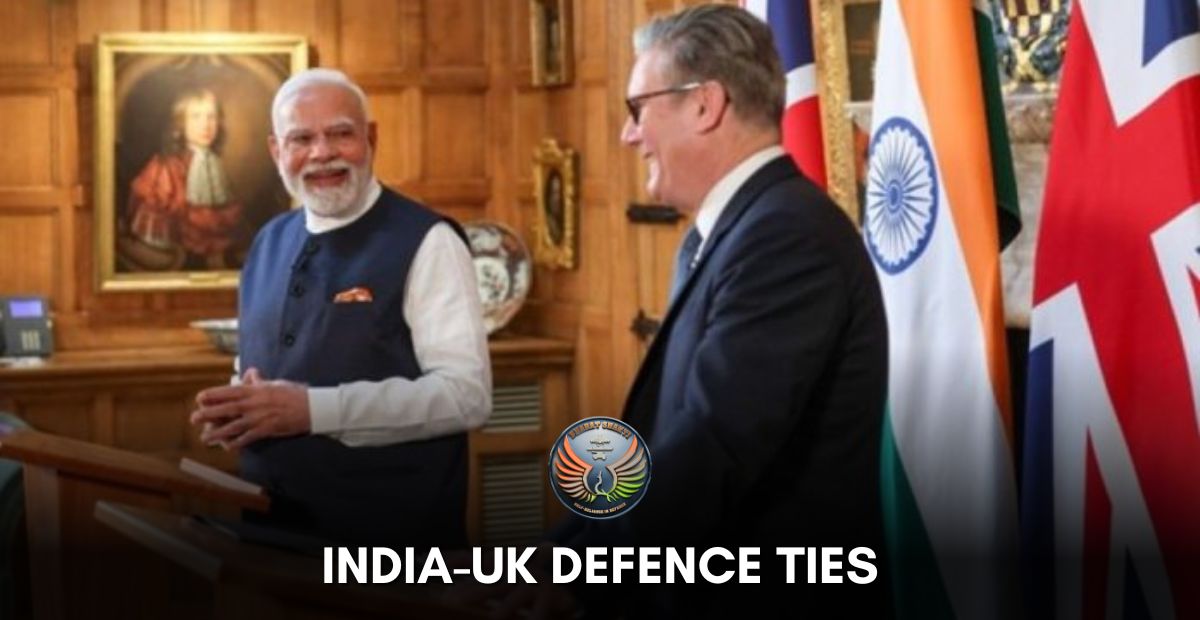
In a strategic move underscoring India’s defence diversification agenda, New Delhi is looking increasingly towards Europe and particularly the United Kingdom as a key partner in co-developing next-generation military capabilities. Prime Minister Narendra Modi’s recent visit to the UK marked a significant step forward, with both nations unveiling a 10-year Defence Industrial Roadmap poised to transform bilateral defence cooperation.
The agreement comes at a time when India is actively seeking to reduce its traditional reliance on Russian platforms while being cautious of over-dependence on the United States. Instead, New Delhi is pursuing a “third path” – deepening strategic and industrial ties with European partners who bring advanced technology, collaborative frameworks, and respect for India’s push for defence self-reliance.
A Strategic Roadmap for a Shared Future
At the heart of the latest India-UK initiative is a decade-long plan that focuses on joint research, technology co-creation, and expanded interoperability between the armed forces of both nations. The Roadmap is designed to enhance supply chain resilience, promote joint innovation in defence manufacturing, and improve military readiness across domains.
From electric propulsion systems to next-gen jet engines, initiatives like the Electric Propulsion Capability Partnership (EPCP) and Jet Engine Advanced Core Technologies (JEACT) are already in motion. These are expected to pave the way for future platforms that are not just “Made in India” but “Created with India.”
Maritime Security in the Indo-Pacific
Maritime security forms a cornerstone of the collaboration. Under the UK-supported Indo-Pacific Oceans’ Initiative (IPOI), both countries have agreed to establish a Regional Maritime Security Centre of Excellence to combat non-traditional threats such as piracy, smuggling, and illegal fishing across the Indian Ocean.
The UK’s growing presence in the Indo-Pacific is noteworthy. With seven permanent military bases in the wider region, including in Singapore, Oman, and the British Indian Ocean Territory, and seven Royal Navy vessels on active deployment, Britain is positioning itself as a serious security stakeholder in Asia’s waters.
India, in turn, has reaffirmed its role as a logistics hub for UK forces operating in the region, a nod to New Delhi’s increasing geopolitical weight and shared vision with London for a stable Indo-Pacific.
Stronger Military and Technological Bonds
The defence roadmap is not just about hardware. It encompasses greater military-to-military cooperation through joint exercises, officer exchanges, and embedded instructors in training institutions across the Army, Navy, and Air Force.
Joint development of critical future technologies such as underwater systems and directed energy weapons is also on the agenda, backed by academic partnerships and industry collaboration. The emphasis is clear: co-develop, co-produce, and share intellectual property, hallmarks of a modern strategic alliance.
It aligns with India’s broader ambition to become a global defence manufacturing hub under its “Atmanirbhar Bharat” (self-reliant India) initiative.
Eyeing the Next Frontier: Fighter Jet Engines
India is also scouting for European collaborators on its flagship Advanced Medium Combat Aircraft (AMCA) programme, an ambitious stealth fighter project estimated to cost $7 billion. While France’s Safran remains a front-runner in co-developing a new engine, the UK’s Rolls-Royce has also submitted a proposal, betting on its historical ties and cutting-edge turbine technology.
Analysts see this as part of a larger trend, India’s calculated shift to engage multiple partners, access frontier technologies, and insulate itself from geopolitical supply chain shocks.
Shared Values, Shared Security
Beyond weapons and warships, India and the UK have committed to deeper cooperation on cybersecurity, counter-terrorism, and migration security. The agreement includes provisions for intelligence sharing, joint action against proscribed terrorist groups, and a mutual pledge to uphold the rules-based international order.
Both sides also reaffirmed their commitment to counter radicalisation, disrupt terror financing networks, and combat the exploitation of emerging technologies by extremist entities.
A New Chapter
This deepening of India-UK defence ties is not an isolated development but part of a broader European pivot in India’s strategic calculus. With continental powers like France, Germany, and the UK offering sophisticated platforms and political alignment, India is expanding its defence diplomacy beyond its traditional corridors.
For Britain, partnering with India, one of the world’s largest and fastest-growing defence markets, means not just economic opportunity but strategic relevance in the Indo-Pacific. For India, it’s about access, autonomy, and building trusted partnerships in a rapidly polarising world.
As PM Modi and his British counterpart outlined during the high-level talks, the two democracies are not just planning for the next arms deal but laying the foundation for a future of co-developed security, where innovation, independence, and interoperability drive the agenda.
Huma Siddiqui