


Editor’s Note
Pakistan is often portrayed as a fragile, failing state perpetually on the brink of collapse. Yet, despite chronic internal fault lines and external pressures, it has repeatedly demonstrated an ability to adapt, survive, and reassert relevance on the global stage. This two-part opinion piece examines the underlying drivers of Pakistan’s resilience and strategic behaviour, and assesses what these realities mean for India’s long-term national interests.
Part I
What Makes Pakistan Tick? Resilience Amidst Chronic Fault Lines
Contours of the Complex Web Which Binds Pakistan
The Military DNA
Pakistan’s birth and foundational logic made resilience an imperative. While India defined herself through democracy, constitution, pluralism and civil rule, Pakistan grew around a perceived existential threat; fear of Hindu domination. Security, not democracy, became its core foundational principle, with the military emerging as the most coherent national institution from birth. Weak civilian structures, zero political accountability and continuity, and a greedy, wealthy elite society allowed the armed forces to showcase themselves as the only disciplined, modern, and resource-rich entity capable of managing Pakistan.
General Ayub Khan’s military coup in 1958 set the stage and trajectory for a “garrison state,” where the army not only defends borders but also shapes identity, ideology, and national policy. Of Pakistan, Voltaire’s famous quote is very apt: ‘while most nations have armies, the Pakistan Army has a nation’.
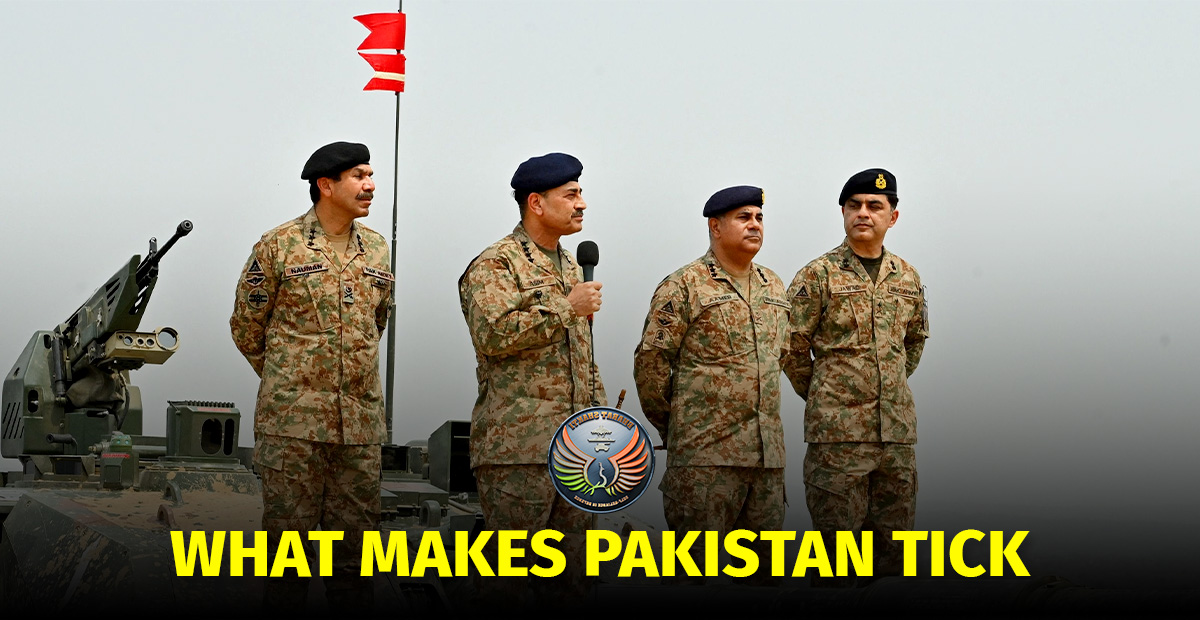
Civilian governments may fall, the economy can collapse, and insurgencies may rage, but the army, as the ultimate arbiter, has provided a strange form of stability, even if authoritarian. It thus forms the entity called Pakistan. Ironically, in today’s times of ‘transactional realpolitik’, many nations, including the super democracy USA, prefer to do business with the Pakistan military, as was evident with the special luncheon meeting of President Trump with Pakistan Army Chief General Asif Munir.
Modus Operandi of the Army: Controlled Chaos
The duo of the military-Intelligence agency (ISI) functions as both guardian and manipulator. They allow instability to manifest within manageable limits, without allowing it to spiral out of control, to justify their dominance and presence. To solidify their relevance and indispensability, they have painted India as an eternal enemy ready to dismember them.
ISI, in particular, has mastered the art of managing domestic politics and foreign/external affairs while ensuring the army remains pivotal. A prime example is their expertise at state-sponsored terrorism using non-state actors and terrorist/jehadi groups like Jamait-e-Islami, Lashkar-e-Taiba, Jaish-e-Mohammad (during the Afghan war against USSR/Russia, and India), but holds the taps of escalation.
Of late, these same outfits have come back to bite them. Interestingly, even when Pakistan had political governance (Imran Khan, current dispensation), they were essentially ‘hybrid’, with the army controlling/ manipulating them.
Exploitation of Geo-Strategic Location
Geographic location could be a curse or a blessing, but Pakistan has certainly ensured its strategic utility. Pivoting around South Asia, with a gateway to China, India, the Central Asian Republics, Iran, and the Arabian Sea, it has made itself central to major powers as a vital component of the great game and the keeper of a critical geopolitical intersection.
Interestingly, just like a double agent in the espionage world, Pakistan has played the game with dexterity by catering to all ideologies. From being a frontline state against Soviet expansion in the 1950s (CENTO, SEATO), to US GWOT (Global War on Terror) post 9/11; projecting itself as the icon of the Islamic Ummah (community) and the sole NWS (Nuclear Weapon State); to being the prima donna of China’s Belt and Road Initiative through the China–Pakistan Economic Corridor (CPEC). Historically, it enjoys deep ties with Turkey and exploits them.
The Adhesive: Ideology and Islam
Pakistan is an ‘Islamic Republic’ despite Jinnah’s initial vision of a secular state. Religion remains a crucial psychological adhesive, providing legitimacy to the elite and unity to a diverse population, transcending ethnic and language fault lines among Punjabis, Sindhis, Baloch, and Pashtuns. The army, pioneered by Gen Zia-ul-Haq, smartly institutionalised, consolidated and reinforced religion within the state and military, and embedded Islamic education, Sharia laws and wove the clergy into the polity.
Pakistan likes to project itself internationally as a moderate soft power in the “Muslim Leadership” role within the OIC. Ideology is a double-edged sword, and Pakistan is now realising its folly, and bearing the consequences of ‘running with the hares and hunting with the hounds’, when it comes to sponsoring and supporting Islamic fundamentalist groups by patronising a few of them as ‘good terrorists’!
Nuclear Deterrence: Deliberate Policy of Ambiguity Forming the Ultimate National Safeguard
The entire world, especially global powers, views Pakistan as an unstable, turbulent nation possessing nuclear weapons controlled by the army. Pakistan claims ‘Full Spectrum Deterrence’ (FSD) and has deliberately maintained an ambiguous nuclear policy. It is known that its capability is aimed at India, but it exploits its status by projecting the possession of the ‘Islamic Bomb’. It is holding tactical nuclear weapons, and the threat of its employment in conventional operational scenarios further compounds the danger and instability in the region.
Pakistan perceives that the nuclear deterrent also equalises the conventional asymmetry with India. It provides psychological assurance to the populace and strategic confidence to policymakers. While most nations perceive nuclear weapons as a political tool, Pakistan uses them both as a military and political deterrent. Pakistan’s strategic all-weather relationship with China and the newly confirmed linkage of its nuclear assets with the USA have added to the uncertainty in an already turbulent, volatile neighbourhood; we must remember that Operation Sindoor is still ongoing. The impact on nuclear balance globally and regionally due to the suspension of all agreements and the expansion of the nuclear ecosystem by all NWS is a vast topic in itself.
Deft Diplomacy and Management of Global Image
Even the most die-hard critics will hand it to Pakistan for repeatedly getting out of self-created geopolitical and diplomatic cul-de-sacs and re-emerging and reinventing its image from pariah to partner, by displaying remarkable diplomatic agility and strategic vision.
Who else other than Pakistan can turn from being a “terror sponsor” to a “victim of terrorism,” and from “instability exporter” to “peacemaker” in Afghanistan? It confabulates in global forums – OIC, SCO, and UN peacekeeping missions, while projecting an image of a responsible Muslim power.
Pakistan astutely leverages its diaspora globally (the Gulf and the West) to maintain soft power and remittance flows. Most recently, Pakistan’s rapprochement with Russia, the USA, Turkey, and the Arab Nations, apart from deepening and balancing its relations with China, would leave even Kissinger in awe. This balancing act and constantly changing narratives, combined with the emergence of a totally transactional world, allow Pakistan to remain strategically relevant even amid economic and political crises. Hence, the repeated IMF bailouts, military assistance from numerous nations (USA, China, Russia, Turkey, et al.), and a fresh impetus to CPEC ensure Pakistan remains afloat.
Too Big, Too Critical, and Too Nuclear to Fail
Pakistan has successfully convinced the global powers that not only is it geo-strategically and politically vital and relevant, but also too dangerous to collapse. The image of an NWS, with multiple internal dissensions and external confrontations, with Islamic fundamentalist groups holding sway, collapsing, is too nightmarish to contemplate and allow. Most in India, too, feel that a stable, cohesive Pakistan is far better for regional stability than an imploding one.
National Pride, Pakistani Diaspora and Social Resilience
The idea of Pakistan as a “homeland for Muslims” and a “fortress of Islam” resonates deeply. The COAS, Gen Asif Munir, has recently exploited this sentiment during Op Sindoor (still ongoing) internally and internationally. The madrassa education supplements the narrative. The public is made to feel that Pakistan stands tall even amidst strife and global conspiracies, as it fights India and terrorism in its own backyard. Undoubtedly, society has shown a remarkable ability to adapt. The informal sector (over 60% of GDP) sustains millions through small trade, agriculture, and remittances. Overseas workers, particularly in the Gulf, send home over $30 billion annually, cushioning domestic instability. Pakistan’s youthful demography (median age ~22) provides energy and volatility but can also cause internal upheaval.
The Current Resurgence: A roundup of Global Manoeuvres
In the last five years, after years of geopolitical wilderness, internal political turbulence, economic distress, and diplomatic marginalisation, Pakistan appears once again to be repositioning itself in the regional and global order, following a deft hedging policy and an active transactional diplomatic, economic, and military policy. Buoyed by renewed Chinese investment under the second phase of the CPEC, recalibrated ties with the United States and Russia, and active diplomacy with Turkey, Iran, Gulf and Central Asian states, Islamabad is demonstrating its historic ability to “re-emerge” from crisis through geopolitical manoeuvring.
In a deja vu scenario, reminiscent of the USA-Russia Cold War in Afghanistan, Pakistan sees scope to extract gains by not fully aligning with any single great power, preserving room to pivot between Beijing, Washington, Gulf patrons, and others. Her hedging foreign policy aims to maximise economic inflows, security guarantees, and diplomatic space amid shifting great-power competition in South Asia and the Middle East.
Pakistan is expanding defence/economic ties with Turkey, seeking large-scale financing and security cooperation from Saudi Arabia, testing warmer ties with Russia in defence and energy, and trying to stabilise relations with Iran (not least over the stalled gas pipeline and border frictions). These moves aim to secure investment, energy, military hardware, and political backing, while retaining strategic autonomy in a tense regional environment. Islamabad is smartly offering projects that give outside powers a tangible economic stake in Pakistan; while it appears to be paying dividends, future adverse implications are being ignored, for another day!
Country-Specific Moves in Brief:
USA: Re-Engagement and Economic Bargaining
- Strategic Access: 2025 saw rare direct meetings between President Trump and Pakistan’s Army Chief and political leaders, signalling a thaw after years.
- Economic Pitch: Islamabad is promoting US investment in infrastructure (proposed Pasni port and rare minerals projects) as a counter-balance to China’s model. Use renewed US access (White House, Senate contacts) to secure targeted US private and public investment in projects that broaden Pakistan’s investor base, while simultaneously offering China formal guarantees and co-investment frameworks so Beijing does not see this as a binary choice.
- Strategic Objective: diversify economic partnerships and regain diplomatic space without triggering Chinese distrust.
- Risk: engagement remains transactional and reversible; shifts in Washington’s (and even China’s) politics could limit tangible gains.
China: Strategic Core Partner – Calibrate Dependence
- CPEC Evolution: The CPEC remains Pakistan’s strategic anchor but is being restructured for sustainability and co-investment.
- Policy Shift: Islamabad seeks renegotiated terms and diversified financing while preserving Beijing’s strategic and military partnership.
- Challenge: Balancing US overtures without undermining Chinese confidence.
Turkey: Defence Industrial Collaboration and Reinforce Traditional Bonds
- Ankara is a historical and low-political-cost partner, not accompanied by the same great-power strings that China or the US might bring.
- Military Technology: Joint production of UAVs, armoured vehicles, and naval systems underscores deepening defence cooperation.
- Diplomatic Symmetry: Shared positions on Palestine and OIC issues strengthen mutual legitimacy.
- Advantage: Ankara provides diplomatic support and defence technology without political strings, suiting Pakistan’s diversification drive.
Saudi Arabia: Financial Guarantor and Security Partner
- Entered the Saudi–Pakistan mutual defence arrangement.
- Investment and Loans: remains the largest short-term liquidity source through oil credit lines and deposits.
- Institutional Mechanism: Cooperation under Pakistan’s Special Investment Facilitation Council has expanded to defence and energy.
- Strategic Value: Saudi funds sustain Pakistan’s fiscal stability; however, overreliance exposes Islamabad to Gulf geopolitical turbulence.
Russia: Opportunistic Re-Engagement
- Energy and Defence MOUs: New agreements on LNG, pipeline feasibility, and arms collaboration indicate a pragmatic thaw.
- Strategic Logic: Islamabad gains leverage and alternative technology sources, while Moscow gains leverage in the region (especially India).
- Constraint: Deep cooperation is limited by Indian sensitivities and Western sanctions dynamics.
Iran: Managing Geographic and Geopolitical Realties
-
- Geography, a long border, and immediate economic and security needs shape Pakistan’s relationship with Iran.
- Pipeline Diplomacy: For economic dividends, Pakistan pursues the long-stalled Iran–Pakistan gas pipeline while seeking US sanction waivers.
- Border Management: Despite cross-border militant incidents, both sides emphasise trade expansion and joint security mechanisms.
To Be Continued
In Part II, the author will discuss the way forward for India to deal with Pakistan.
Lt Gen PR Kumar