






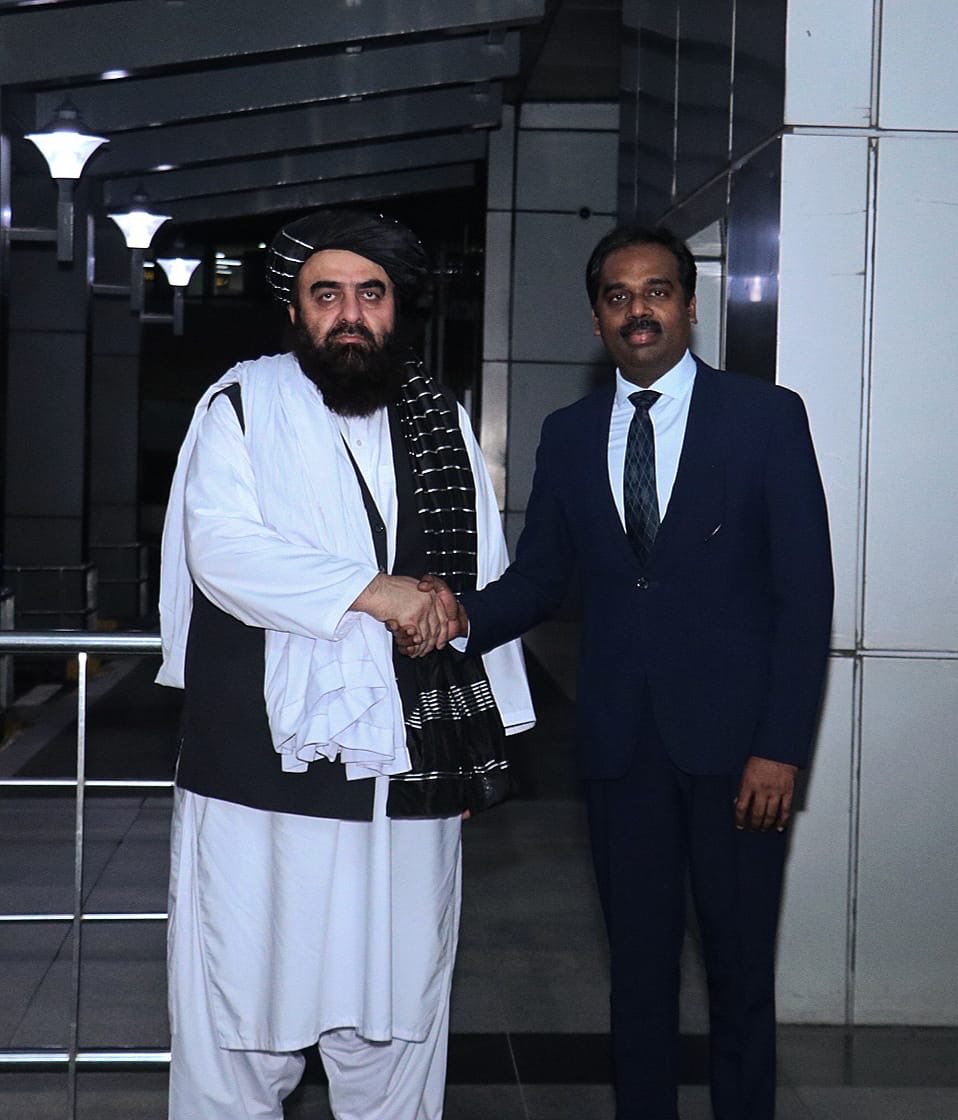
As Afghanistan’s acting Foreign Minister Amir Khan Muttaqi begins his first official visit to India on Thursday, the shadow of Bagram Airbase looms large over the bilateral diplomatic agenda. The visit coincides with growing regional unease over reports that the United States may be exploring ways to regain access to the strategic airbase outside Kabul. This move could reconfigure the security calculus across the Indo-Pacific and Eurasia.
Bagram, under Taliban control since the U.S. withdrawal in 2021, has re-entered global headlines following remarks by former U.S. President Donald Trump, who described the base as a “strategic necessity.” He pointed to its location — barely an hour’s flight from China’s Xinjiang province — and hinted at its potential use in countering Beijing’s growing influence. His comments have reignited old anxieties about Afghanistan becoming once again a staging ground for great-power competition.
Regional Pushback
The idea of renewed U.S. military presence has drawn swift and coordinated opposition. At the recent Moscow Format talks, India joined Russia, China, Iran, Pakistan, and several Central Asian states in issuing a joint statement explicitly rejecting any foreign military infrastructure in Afghanistan or its neighbouring countries. The declaration underscored that such moves would threaten regional peace and stability, reaffirming support for Afghanistan’s sovereignty under Taliban rule.
For India, this alignment represents a quiet but notable recalibration. Traditionally a close strategic partner of the United States, New Delhi is now signalling a more autonomous position — one that privileges regional consensus over external intervention. This stance is consistent with India’s emerging view that long-term stability in Afghanistan can only be achieved through regional dialogue and Afghan-led governance, not renewed militarisation.
India’s Strategic Calculus
The prospect of the U.S. reclaiming Bagram raises several concerns for New Delhi. A re-militarised Afghanistan could once again become a theatre for proxy rivalries — between the U.S. and China, or Iran and the West — jeopardising India’s developmental investments and counterterrorism coordination. It could also complicate India’s cautious engagement with the Taliban, which has thus far focused on humanitarian assistance, infrastructure support, and ensuring Afghan territory is not used by anti-India terror groups.
Bagram’s proximity to China and Central Asia also adds a layer of complexity. Any renewed foreign presence there risks transforming Afghanistan into a geopolitical flashpoint, undermining the fragile equilibrium that regional players, including India, have worked to preserve since 2021.
The Bagram Factor
During its two-decade U.S. occupation, Bagram was the nerve centre of American military operations in South and Central Asia — managing logistics, intelligence, and strike capabilities that extended from the Gulf to Central Asia. Its location remains unmatched in strategic terms: equidistant from Iran, China, and Pakistan, and within reach of Russia’s southern periphery. These very advantages are now what make it a focal point of regional anxiety.
A New Phase in Regional Diplomacy
Muttaqi’s visit to New Delhi, therefore, carries significance beyond symbolic engagement. It signals a mutual willingness to find common ground amid shifting geopolitics. Both India and the Taliban regime appear intent on reinforcing the message that Afghanistan’s stability must be protected from external militarisation.
While dramatic announcements may not emerge from the visit, the underlying message is unmistakable: Bagram is no longer merely an Afghan military asset — it is a test case for the region’s collective resolve to shape its own security order, free from foreign boots on the ground.
Huma Siddiqui