



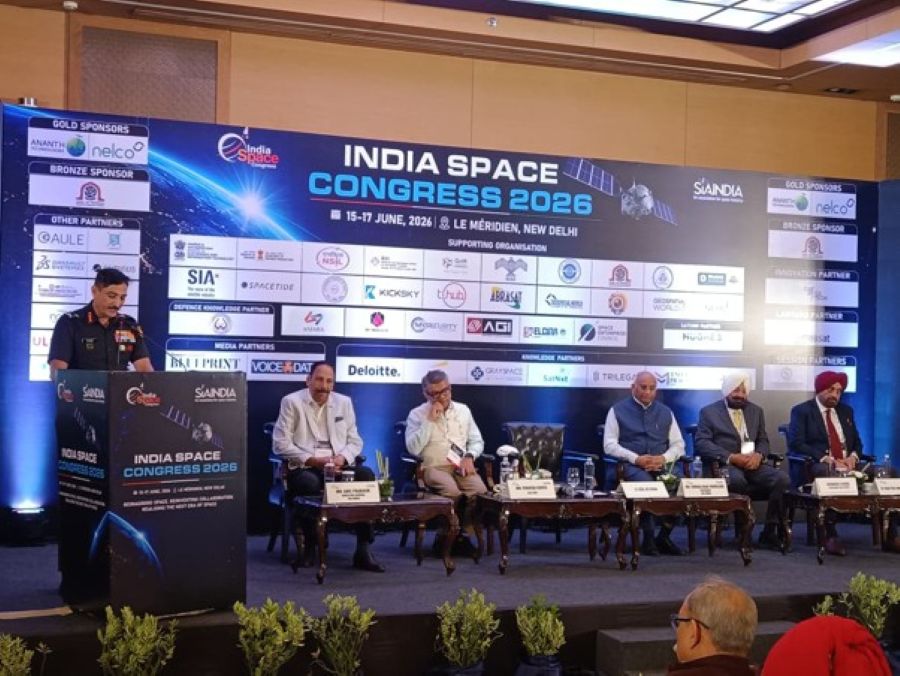
Air Marshal Ashish Singh, IAF’s Assistant Chief of Air Staff (Operations), made an uncomfortable claim during the Indian Space Congress 2026 held on Tuesday. He claimed that every nation that built real air power went on to become a space power. None did it without first owning its skies.
Explaining the importance of space as a key domain at a session titled “Seabed to Space: Securing The Strategic Continuum”, he traced the evolution of military power through four distinct eras – land, sea, air and space – arguing that each successive age was built upon the capabilities of the one that preceded it. Cavalry, he noted, shaped the era of Genghis Khan, maritime dominance determined the course of the next three centuries, and the twentieth century was defined by air power. The twenty-first century, he said, will be determined by mastery of space. In that transition, air power is not merely another phase in the continuum but the critical bridge to the space age.
“It is the jump-off technology, the fusion layer that hands its engineers, its industrial habits, and its hardware forward to whatever comes next,” he observed.
History agrees with him, though not in a comfortable way.
In August 1940, the Luftwaffe was winning the Battle of Britain. Hitler’s own Directive No. 17 had the priority right: destroy the RAF’s airfields and radar first, and then invade. Then a German bomber crew got lost and dropped its load on London by accident. Churchill sent eighty-one bombers to Berlin in retaliation. Furious, Hitler diverted the whole campaign onto London itself. Fighter Command, days from being broken, was handed its reprieve. Germany never regained air superiority over Britain, and Operation Sea Lion was shelved for good.
One emotional decision, one diversion from the decisive target, cost Germany the war’s air dimension.
The deeper irony is what Germany did with the resources it diverted instead. It built the V-2, the world’s first ballistic missile, justified partly as a substitute for the bombers it was losing over England. Germany lost the war anyway. But Wernher von Braun surrendered to the US Army, not the Luftwaffe.
The Americans ran Operation Paperclip, put Braun to work, and used his rocket lineage to put Explorer 1 into orbit by 1958 and the Saturn V on the Moon by 1969. The USSR did the same in its own zone, with its own captured engineers, and built the R-7 that launched Sputnik.
The country that invented the technology lost the right to use it. Both winners of the air war inherited it instead and walked straight from command of the sky to command of orbit.
That is the Air Marshal’s case for decision makers in Delhi to start thinking of the IAF as the IASF, an Indian Air and Space Force, until a separate Space Force is created.
The US, France, and now China have built sovereign engines, sovereign launch capability, and sovereign doctrine before seriously reaching for orbit. India is still negotiating with each of those suppliers, one at a time.
The Tejas Mk1A tells that story on its own. HAL now has GE F404 engines and more than twenty airframes, yet has still not delivered a single jet to the IAF since the program’s original 2024 deadline, missed so often that a frustrated IAF Chief told HAL at the Aero India 2025 show, “At the moment, I am just not confident in HAL.” Squadron strength has slipped to 29 against a sanctioned 42, a number that, given current induction rates and the retirement of the Jaguar, Mirage 2000 and MiG-29 fleets, stays stagnant for the next two decades.
The Kaveri engine, India’s own answer, still manages barely 49–51 kN against the GE F404’s 78-84 kN, and an afterburning version, Kaveri 2.0, that could power upcoming fighters, remains years away. The AMCA fares no better: GE’s F414 powers its first version with the hot-section technology withheld, and its more powerful variant, co-developed with France’s Safran, still awaits clarity and CCS (Cabinet Committee on Security) approval.
Even the Su-30MKI, the IAF’s backbone, needs Moscow’s terms to re-engineer itself into a “Super Sukhoi.” And the 114-jet Rafale order, the successor to the 126-jet MMRCA tender abandoned in 2015, is stalled for the same reason: Paris withholds the interface control documents, fearing a Russian back door entry into French source code via India’s S-400 and BrahMos.
Three different countries, three different vetoes, one air force trying to operate as a single coherent machine.
Air Marshal Singh’s appeal to the room was direct: see the pattern now, before the government is forced to relearn it the hard way. Germany had the rocket and lost the right to fly it. Britain had the radar and the victory, and still ran out of money to chase the next domain. The nation that gets to space first is the one that owns its own skies first, on its own engines, answering to no one else’s veto. India is still renting half of its sky. Until that changes, the runway to space stays exactly half-built.
Koustubh Ghormade