


India’s nuclear arsenal will not be treated as a standalone domain of warfare, but as part of the broader contours of Multi-Domain Operations -MDOs’ “cognitive warfare” dimension, Chief of Defence Staff Anil Chauhan said on Thursday, underlining an evolving military doctrine shaped by deterrence and perception management.
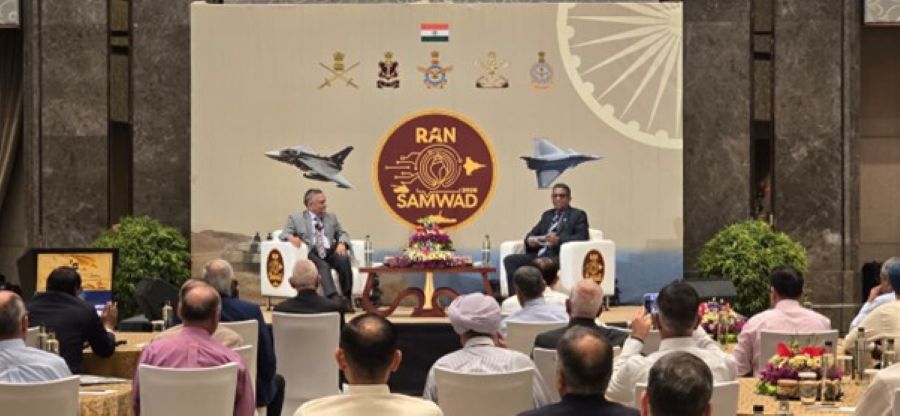
Speaking at the tri-service seminar Ran Samwad in Bengaluru, Gen. Chauhan said nuclear weapons are not viewed as instruments of warfighting but as tools that operate in the realm of the mind.
“We don’t consider nuclear weapons as warfighting. It is a deterrent in the mind; therefore, it falls under the cognitive domain in MDO. Nuclear does not form a separate domain as such,” he said during a panel discussion.
The seminar, hosted at the Air Force Training Command, focused on preparing the armed forces for Multi-Domain Operations (MDO), a framework that integrates land, air, sea, cyber, space and cognitive warfare. The inclusion of the cognitive domain reflects the growing emphasis on shaping adversary behaviour, achieving decision-making superiority, and setting escalation thresholds.
Referring to statements made by Prime Minister Narendra Modi after Operation Sindoor, the CDS reiterated that India would not be constrained by nuclear coercion.
In a fireside chat with BharatShakti Editor-in-Chief Nitin Gokhale, Gen. Chauhan said India’s responses across the escalation ladder have become “dynamic and proportionate,” signalling what he described as a “new normal” in strategic posture.
India’s nuclear doctrine, he noted, continues to rest on credible deterrence, with ballistic missile systems designed exclusively for nuclear delivery. At the same time, he indicated parallel advancements in emerging technologies, including hypersonic capabilities, which could complement deterrence dynamics without altering the core doctrine.
Army Chief Upendra Dwivedi, speaking during a question-and-answer session, said discussions on nuclear issues within the MDO framework have gained traction over the past two years despite earlier hesitations. “Nuclear capability is a reality. It must be discussed in terms of both offensive and defensive planning, including force projection and orchestration,” he said.
The remarks come amid growing global unease over nuclear stability, driven in part by ongoing conflicts such as the Russia-Ukraine war and tensions involving the United States and Iran. Analysts warn that weakening arms control regimes and heightened geopolitical rivalry could push more states to either declare nuclear capabilities or expand existing arsenals.
According to the Stockholm International Peace Research Institute, nine countries possessed nuclear weapons in 2025, collectively holding an estimated 12,121 warheads. Of these, about 9,585 are considered potentially operational, with nearly 3,900 deployed and around 2,100 maintained on high operational alert. There are also concerns that over a dozen countries will endeavour to change their nuclear stance in the wake of the West Asia war scenario.
Strategic experts caution that shifts in nuclear postures and doctrines may become more frequent as nations adapt to an increasingly volatile security environment, raising concerns of a gradual drift towards a “new normal” in nuclear deterrence and proliferation.
Ravi Shankar, Bangaluru

Dr Ravi Shankar has over two decades of experience in communications, print journalism, electronic media, documentary film making and new media.
He makes regular appearances on national television news channels as a commentator and analyst on current and political affairs. Apart from being an acknowledged Journalist, he has been a passionate newsroom manager bringing a wide range of journalistic experience from past associations with India’s leading media conglomerates (Times of India group and India Today group) and had led global news-gathering operations at world’s biggest multimedia news agency- ANI-Reuters. He has covered Parliament extensively over the past several years. Widely traveled, he has covered several summits as part of media delegation accompanying the Indian President, Vice President, Prime Minister, External Affairs Minister and Finance Minister across Asia, Africa and Europe.