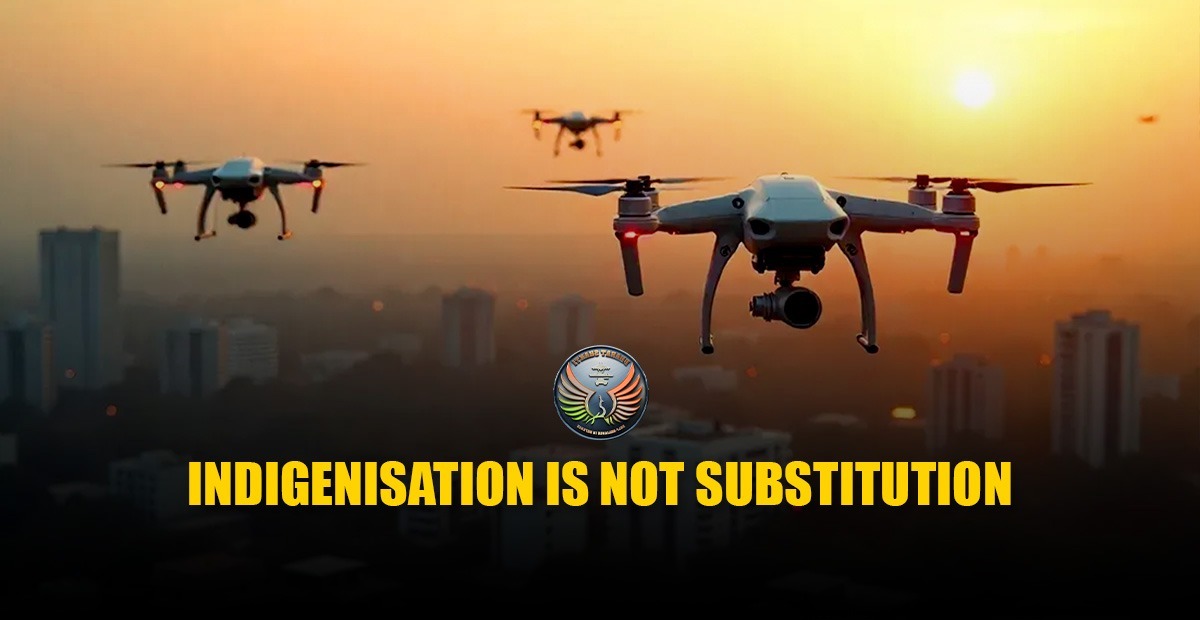
India’s drone ecosystem debate often conflates very different categories of risk. These need clearer separation.
The first is supply chain dependency. Wartime disruptions, sanctions, export controls, logistics bottlenecks, and geopolitical escalation can severely affect component availability. A drone ecosystem heavily dependent upon external suppliers may struggle to sustain operations during prolonged conflict.
This is particularly critical for consumable systems like FPVs and loitering munitions where production continuity directly affects battlefield endurance.
The second risk concerns embedded vulnerabilities. Firmware compromise, telemetry exposure, hidden software dependencies, cloud-linked architectures, malicious updates, and embedded backdoors are all legitimate concerns in military systems.
However, this discussion requires technical realism rather than exaggerated fear narratives. Many risks can be mitigated through:
- isolated military architectures,
- controlled firmware environments,
- local mission systems,
- segmented communication layers,
- encrypted operational frameworks,
- and air-gapped deployment structures.
Security must be treated as an engineering challenge, not merely a political slogan.
But perhaps the most ignored risk is operational irrelevance.
A drone that cannot survive electronic warfare, cannot integrate into wider command systems, cannot function under GNSS degradation, cannot coordinate with other systems, or cannot adapt rapidly under battlefield pressure may become ineffective regardless of its origin.
The modern battlefield increasingly depends upon integrated architectures combining:
- ISR,
- EW,
- relays,
- autonomous navigation,
- loitering munitions,
- AI-assisted targeting,
- and distributed communications.
The greatest vulnerability may not be espionage. It may be battlefield irrelevance.
India Needs a Unified Drone Architecture
This may be the single most important issue confronting India’s military drone ecosystem.
India does not merely need more drones. India needs a unified operational architecture capable of integrating drones across services, vendors, missions, and battlefield roles.
Today’s ecosystem remains fragmented. Different manufacturers use different flight controllers, different ground control stations, different communication protocols, different payload integration standards, and different software environments. Many systems operate as isolated vendor silos.
This fragmentation creates enormous operational limitations.
The future battlefield will involve simultaneous interaction between:
- ISR drones,
- loitering munitions,
- relay drones,
- EW systems,
- autonomous swarms,
- battlefield management systems,
- artillery networks,
- and AI-assisted decision architectures.
Without common integration layers, these systems remain fragmented tactical tools rather than integrated battlefield capabilities.
India therefore needs to think beyond platforms and toward open operational architectures:
- plug-and-play integration frameworks,
- common communication standards,
- API-driven military ecosystems,
- unified command-and-control layers,
- multi-vendor interoperability,
- modular payload architectures,
- and scalable battlefield integration systems.
Open ecosystems such as MAVLink, PX4, and ArduPilot demonstrate aspects of such approaches globally. Ukraine’s experimentation with operational integration systems similarly highlights the importance of unified battlefield layers.
The future battlefield will not reward the best drone.
It will reward the best integrated system.
AI Will Become the Real Differentiator
The centre of gravity in unmanned warfare is gradually shifting from hardware toward cognition.
Artificial Intelligence will increasingly determine battlefield advantage.
Initially, drones were remotely piloted systems. But contested environments are forcing greater autonomy. GNSS denial, communication jamming, degraded networks, and electronic warfare are making continuous human control increasingly difficult.
This is driving the rise of:
- edge AI,
- onboard navigation,
- autonomous target recognition,
- collaborative swarming,
- adaptive routing,
- terrain-aware navigation,
- AI-assisted EW adaptation,
- and autonomous mission execution.
Future systems may increasingly operate with intermittent communications, degraded signals, or fully denied environments. Human operators may shift from direct piloting toward supervisory control.
This changes the very nature of military capability.
The decisive layer is slowly moving from hardware to cognition.
And cognition is fundamentally a software problem.
Why India Must Think Beyond Procurement
Traditional defence procurement systems are poorly aligned with the realities of unmanned warfare evolution.
Drone warfare evolves too quickly for static acquisition cycles.
Platforms may become outdated within months. Software updates continuously alter battlefield effectiveness. Tactical modifications emerge directly from operator feedback. Battlefield learning cycles increasingly resemble technology start-up ecosystems more than traditional defence production.
This requires new institutional models.
India needs:
- continuous experimentation,
- spiral development,
- operational innovation cells,
- rapid field feedback loops,
- battlefield technology labs,
- direct military-startup interaction,
- iterative procurement pathways,
- and adaptive testing architectures.
Frameworks such as iDEX and emergency procurement mechanisms represent important beginnings. But the scale of transformation required is much larger.
Because in drone warfare, acquisition cycles themselves can become vulnerabilities.
A Practical Roadmap
India’s long-term success will depend not on isolated procurement decisions, but on ecosystem building.
This requires simultaneous investment across multiple layers.
India must gradually build component sovereignty across:
- batteries,
- RF systems,
- optical payloads,
- compute modules,
- embedded electronics,
- and flight controllers.
India must establish open military standards enabling interoperability across systems and vendors.
India must create dedicated testing ecosystems capable of evaluating:
- electronic warfare resilience,
- GNSS-denied operations,
- swarm coordination,
- AI-assisted autonomy,
- and contested battlefield survivability.
India must strengthen military-industry feedback loops so battlefield learning rapidly influences product evolution.
And most importantly, India must invest deeply in software and AI sovereignty.
Because over time, the competitive advantage will increasingly reside not merely in flying platforms, but in autonomous architectures, mission software, AI models, data fusion systems, and integrated battlefield decision systems.
The Real Question Before India
The real question before India is not whether India can manufacture drones.
India clearly can.
The deeper question is whether India can build a military innovation ecosystem capable of:
- adapting at wartime speed,
- integrating at scale,
- surviving contested environments,
- evolving continuously under operational pressure,
- and combining manufacturing depth with software-driven battlefield agility.
Because warfare itself is changing.
The battlefield is no longer centred around isolated platforms operating independently. It is becoming a dense network of sensors, autonomous systems, electronic warfare layers, AI-assisted decision architectures, and continuously evolving software-defined capabilities.
The drone is no longer the capability. The system is.
Brigadier NP Singh (Retd)

Brigadier Narendra Pratap Singh (Retd) is a Defence Technology Strategist, AI and Digital Transformation Leader, and former Director of Artificial Intelligence in the Indian Army. He is currently the CEO of Mindsprintz Consulting, advising defence organisations, startups, and industry on artificial intelligence, autonomous systems, digital transformation, and the future of warfare.