Japan insisted earlier this week that the Quad is “not the framework for military cooperation” even as the four-country bloc expanded maritime surveillance coordination across the Indian Ocean, and advanced discussions on defence-industrial cooperation across the Indo-Pacific.
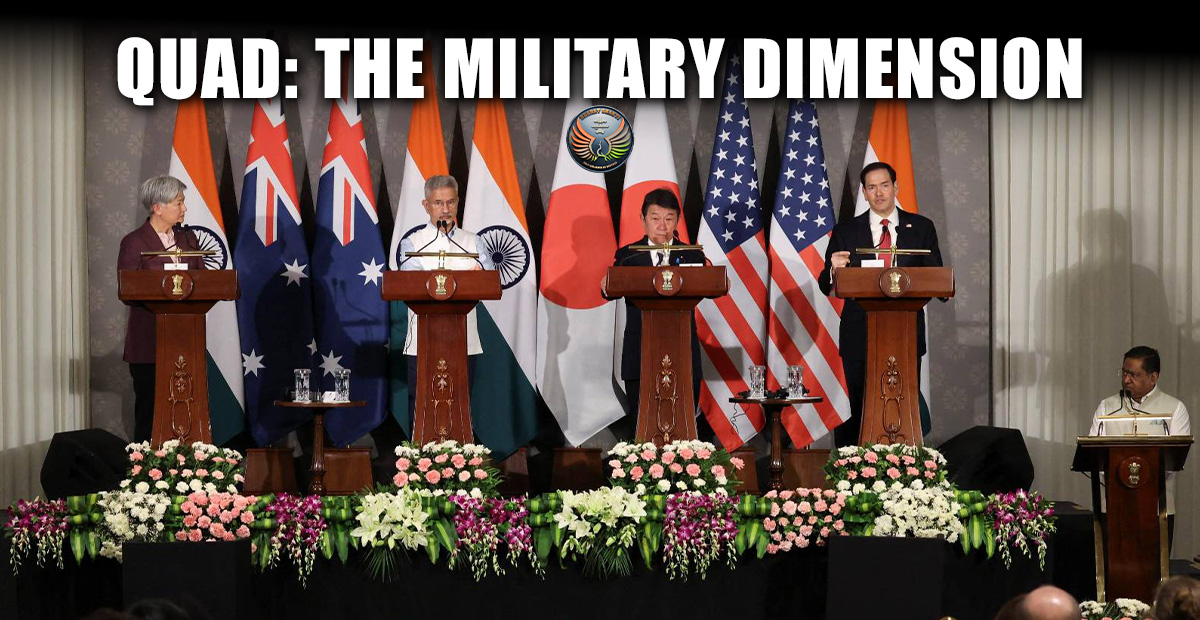
In a special briefing after the Quad foreign ministers’ meeting in New Delhi, Toshihiro Kitamura, press secretary to Japan’s foreign minister, pushed back against growing scepticism in India that President Donald Trump’s outreach to China could weaken the grouping’s strategic focus.
Kitamura stressed that the United States remained “fully committed to promoting this Quad initiative,” pointing to Secretary of State Marco Rubio’s decision to host a Quad foreign ministers’ meeting immediately after Trump’s inauguration.
Much of Tuesday’s briefing focused less on diplomacy than on the Quad’s increasingly security-oriented agenda.
Among the key announcements was an expansion of the Indo-Pacific Maritime Domain Awareness initiative into the Indian Ocean, broadening a surveillance framework that previously focused on Pacific island states and Southeast Asia.
“This time we have decided to expand our cooperation to Indian Ocean countries,” Kitamura said. “That is one of the steps we have taken.”
The expanded initiative will rely partly on private satellite data sharing and coordinated maritime monitoring among Quad members.
Whether the grouping was gradually evolving into a more overt security coalition as tensions grow across the Taiwan Strait, South China Sea and Indian Ocean, he insisted the Quad was not becoming a military alliance.
“The Quad itself is not the framework for military cooperation,” he said. “Such military cooperation has not been discussed during this meeting.”
Still, the briefing underscored how deeply defence and strategic issues now shape Quad cooperation.
About Japan’s recent offer of its Mogami-class frigates to India, “Recently we have signed a contract of co-production, co-development with the Australian government,” Kitamura said, referring to Japan’s expanding defence partnerships. But on India, he added, “at this moment there is no concrete discussion in this regard.”
Instead, Japan and India are focused on talks involving advanced Japanese naval radar systems.
“We have the discussion to export our advanced site combined antenna called Unicorn,” Kitamura said, describing the technology as “a very high-technology antenna for vessels.”
He also acknowledged that Russia’s invasion of Ukraine had fundamentally altered Japan’s security thinking and accelerated changes to Tokyo’s traditionally restrictive defence posture.
“Since the invasion of Ukraine by Russia, the way of warfare dramatically changed,” he said. “No country can protect ourselves by ourselves.”
Japan has since loosened restrictions on defence exports as part of a broader effort to strengthen its defence-industrial base and sustain long-term military readiness.
“We need expanding our customer market to other countries,” he said, while stressing that Japan’s pacifist principles remained intact. “We don’t export any equipment to countries in conflict.”
The Quad ministers also unveiled a new Indo-Pacific energy security initiative aimed at reducing vulnerability to oil supply disruptions following instability around the Strait of Hormuz.
He disclosed that Japan had engaged in intensive diplomacy with Iran since late February, including six phone calls between Japan’s foreign minister and his Iranian counterpart.
“We have highlighted the importance of free and open navigation,” he said, adding that secure sea lanes “should be maintained around the world, including the Strait of Hormuz.”
Japan initially had 645 tankers affected by disruptions in the Gulf, according to him, though some vessels have since resumed operations.
Under the new initiative, Quad countries will coordinate on strategic petroleum reserves, emergency fuel responses and financing support for developing countries seeking to diversify oil imports beyond the Middle East.
“We try to make countries more resilient in terms of energy security,” Kitamura said.
On a question whether the Quad’s momentum had slowed amid Trump’s direct engagement with Beijing and uncertainty surrounding the next leaders’ summit, Kitamura acknowledged the concerns but insisted cooperation among the four countries remained strong.