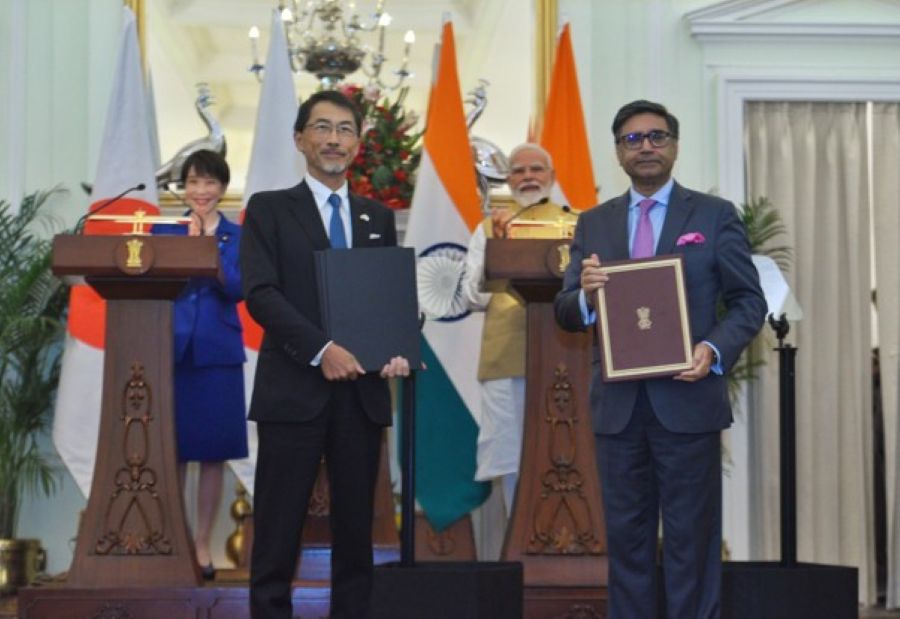
India and Japan have taken their defence partnership into a new phase by launching their first-ever co-development programme for military equipment, signalling a move beyond exercises and strategic dialogue towards collaborative defence manufacturing and technology development.
Among the important announcements made during Japanese Prime Minister Sanae Takaichi’s visit to New Delhi is the joint development of the UNICORN (Unified Complex Radio Antenna) mast for Indian Navy warships, a project both governments described as the first defence co-development initiative between the two countries.
Prime Minister Narendra Modi called the agreement a “new chapter” in bilateral defence ties, saying the partnership would now extend to jointly developing technologies that contribute to maritime security, regional stability and a rules-based order in the Indo-Pacific.
The UNICORN system integrates multiple communication antennas into a single mast, reducing the radar signature of naval vessels while improving onboard communications. The technology is expected to enhance the stealth characteristics of future Indian naval platforms. It represents one of the most advanced examples of defence technology cooperation between New Delhi and Tokyo.
The project builds on a Memorandum of Implementation signed by the two governments in Tokyo in November 2024, laying the groundwork for co-developing the integrated antenna system for Indian Navy ships.
Beyond the flagship project, both countries agreed to widen defence industrial cooperation under India’s Make in India programme, opening the door for greater collaboration in the design, development and manufacture of defence equipment.
The announcements indicate that India and Japan are gradually shifting their security partnership from operational cooperation to defence-industrial collaboration. This trend has gathered pace as both countries seek trusted partners amid growing geopolitical uncertainty in the Indo-Pacific.
Addressing media persons after the summit, Foreign Secretary Vikram Misri said defence cooperation was no longer confined to military exchanges but was increasingly focused on building long-term industrial capabilities.
He said discussions covered cooperation across naval, land and air systems, as well as emerging technologies and unmanned platforms, with both governments examining opportunities across the entire defence production chain.
The two sides also agreed to expand naval engagement in the Indian Ocean, including a joint exercise involving a Japanese Maritime Self-Defence Force destroyer and an Indian Navy warship. He said the next India-Japan 2+2 Foreign and Defence Ministers’ Dialogue will be held in Tokyo before the end of the year to review progress across the strategic partnership.
The defence agenda reflects growing convergence between the two countries as they respond to evolving security challenges across the Indo-Pacific. Both governments have repeatedly emphasised the importance of maintaining freedom of navigation, resilient supply chains and a rules-based maritime order.
During the media interaction, questions were raised about Japan’s proposal to cooperate with India on the Mogami-class stealth frigate programme, under which Tokyo has reportedly offered extensive technology transfer for local construction of the advanced warships.
Misri clarified that the issue did not figure in the leaders’ discussions during the summit.
“There was no discussion on the Mogami-class frigates as such,” he said, adding that the designated agencies of both countries remain in contact on a range of naval, land and air systems and that specific proposals could be considered at an appropriate stage.
While the clarification indicates that the frigate proposal has not yet entered the political decision-making stage, officials acknowledged that shipbuilding remains one of several areas where defence-industrial cooperation could expand in the future.
Huma Siddiqui