Outdated assets, vulnerabilities in ground systems, and reliance on foreign technologies hinder India’s military satellite communications infrastructure. Experts highlighted this situation during an open discussion at the India Space Congress 2026.
The session on “Secure SATCOM for Air, Naval and Tactical Operations” assessed the state of India’s military satellite communications at a time when the armed forces are moving towards integrated theatre commands and increasingly rely on network-centric operations.
Chairing the session, Lt Gen Anil Kapoor (Retd), former Director General of Information Systems in the Indian Army, said many of the challenges he grappled with nearly two decades ago continue to persist, albeit on a much larger scale under theatreisation.
Using the acronym “SATCOM”, he outlined five critical concerns that require sustained attention, skilled manpower, deep technologies, cyber resilience, orbital congestion and manufacturing capability. He also referred to the difficulties associated with India’s regional navigation system, NavIC. He cautioned against continued dependence on foreign GPS services, a vulnerability that has affected Indian military operations in the past.
Brigadier Navjot Singh Bedi, who has worked extensively on jointness issues within the Integrated Defence Staff, argued that military satellite communications must be designed to remain functional even under sustained attack.
“Satcom will be jammed or knocked out in any real conflict,” he observed, stressing that systems must be capable of degrading gracefully. “Losing the link to headquarters should not mean losing the fight on the ground.”
Drawing lessons from the multi-domain operations such as Operation Sindoor and India’s demanding operational geography, which stretches from the Himalayas to an extensive coastline, Brig Bedi described satellite communications as “not a luxury but often the only option” for commanders operating in remote or contested environments.
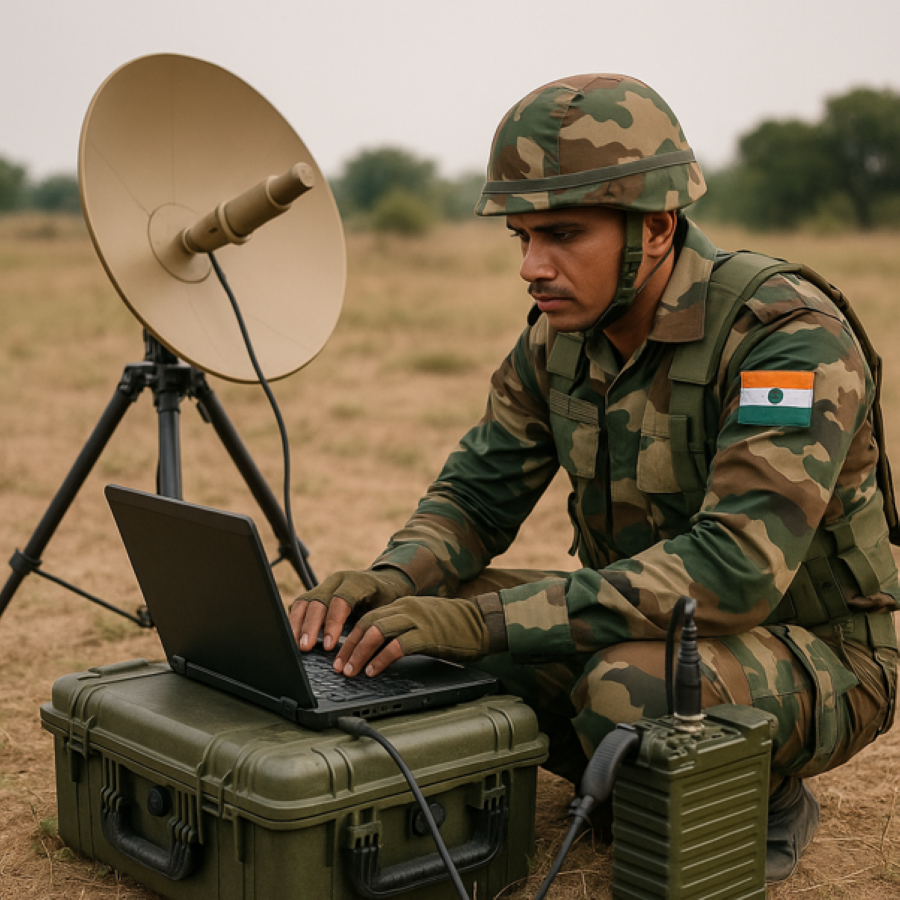
Offering an industry perspective, Siddhartha Abburi of Avantel said India possesses the skills and manufacturing ecosystem needed to produce satellite communication terminals and software-defined radios. He cited the company’s work with ISRO, the Navy, BEL and DRDO as evidence of domestic capability.
However, he acknowledged that the country’s military satellite fleet has not evolved at the same pace.
According to Abburi, many satellites currently supporting defence communications are older geostationary platforms with limited bandwidth, designed primarily for receive-only functions. While modern military applications such as real-time drone feeds demand data transmission rates measured in megabytes or gigabytes, several existing systems still operate at far lower capacities.
The discussion also highlighted changing trends in the global satellite industry.
Paul Krzystoszek of SES advocated the use of multi-orbit, multi-band satellite networks capable of switching seamlessly between different frequency bands and orbital regimes to improve resilience during conflict.
Donald Chew of Astranis promoted his company’s micro-geostationary satellites, describing them as smaller, cheaper, and deployable within 14 to 18 months, compared with the significantly longer timelines of conventional geostationary satellites.
While both approaches reflect a broader shift towards layered satellite constellations rather than relying on a few large platforms designed to remain operational for decades, the proposals also underscored India’s continuing dependence on overseas providers for such capabilities.
Brig Bedi, in his concluding remarks, returned to the issue and maintained that “indigenisation is the solution.”
Cybersecurity concerns emerged as another major theme during the session.
Suhas Gopinath of Globals, whose company supports cyber-defence for Indian Navy satellite communication terminals and is empanelled with CERT-In, warned that vulnerabilities in ground infrastructure could prove as damaging as attacks on satellites themselves.
“Anything with an IP address can be hacked,” he said, recounting an instance in which his team identified an unpatched maritime satellite terminal and demonstrated how it could be exploited to gain access to a merchant vessel’s data and control systems.
He cautioned that compromised terminals could remain dormant for extended periods, silently collecting information before being activated to cause physical damage, likening them to “an invisible, non-human sleeper cell”.
Unlike the orbit pitches, this read less like sales talk and more like a warning that India’s wider terminal base is still catching up.
The session concluded with the same themes: multi-orbit and multi-band architecture, AI-driven spectrum management, and tighter cyber hygiene for every terminal in service. For India, the session was less a showcase of new technology than an honest reckoning with where it still falls short: manpower, an ageing satellite fleet, and unpatched ground systems, even as foreign vendors queue up with a fix. The real question for Indian planners is whether to keep buying that fix, keep calling screwdrivergiri – ‘Make in India’, or finally build it at home.
Koutubh Ghormade