Second of a two Part Series on India’s Pacific Vision
Part I: Securing India’s Ocean: From Africa to Malacca
For decades, India’s maritime outlook was shaped by geography.
The Indian Ocean was its natural sphere of influence, carrying the sea lanes that sustained its trade, energy supplies and economic growth. Securing those waters was therefore seen as the cornerstone of India’s maritime strategy.
That assumption no longer holds.
The rise of China as a naval, economic and technological power has blurred the once-clear distinction between the Indian and Pacific Oceans. Beijing’s expanding presence across Southeast Asia and the Pacific means that developments thousands of kilometres east of the Strait of Malacca increasingly affect the security of waters much closer to India’s shores.
India’s response has been notably different from that of many other major powers. Rather than pursuing formal alliances or an extensive network of overseas military bases, it has sought to build a web of partnerships stretching from Southeast Asia to the Pacific. Each relationship serves a distinct purpose, but together they are designed to strengthen a free, open and resilient Indo-Pacific without forcing countries into rival blocs.
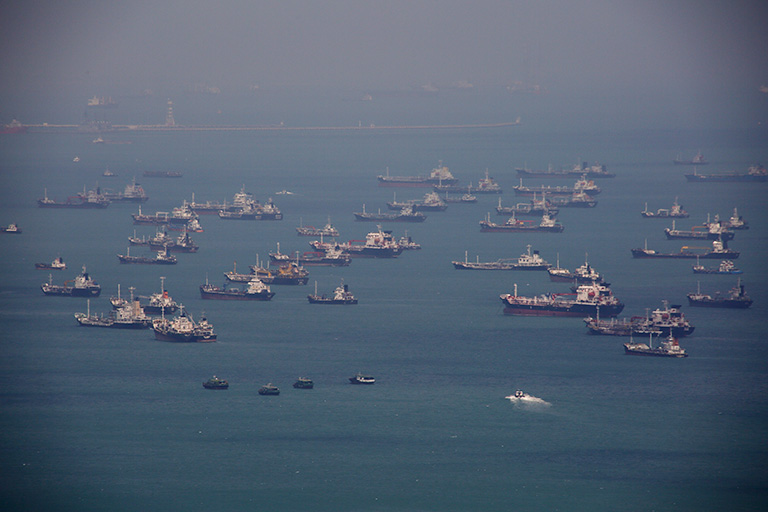
Indonesia marks the beginning of that outward-looking strategy. Sitting astride the Strait of Malacca, it occupies one of the world’s most important maritime gateways, through which a substantial share of global trade and energy supplies passes every year. Cooperation around Sabang, together with India’s growing capabilities in the Andaman and Nicobar Islands, has strengthened maritime domain awareness at either end of the strait. It is a practical partnership that reflects India’s preference for enhancing regional security without seeking permanent military footprints.
Andaman & Nicobar Command. ‘Arc of Power’ Episode I. Rutland Beach Joint Service Amphibious Assault
Beyond Southeast Asia, India’s priorities broaden. Partnerships with Japan and Australia illustrate how maritime power itself is changing. Japan has become a vital partner in advanced manufacturing, semiconductors, critical minerals and secure supply chains, recognising that economic resilience and technological leadership are now integral to national security.
Australia, meanwhile, has deepened defence cooperation through logistics agreements, more sophisticated naval exercises and closer maritime surveillance. Together, these relationships demonstrate that influence at sea increasingly depends not only on warships, but also on trusted technology, industrial capacity and resilient logistics.
That shift becomes even more apparent in the Pacific Islands, a region often overlooked because of the small size of its populations. Yet these island nations occupy an outsized place in the strategic geography of the Indo-Pacific.
Cleo Paskal, Senior Fellow at the Foundation for Defence of Democracies and one of the world’s foremost experts on island geopolitics, argues that the region is routinely misunderstood.
“The Pacific Islands are like oases in a desert,” she says. “They are crucial locations from which to resupply and interdict.”
The comparison captures the strategic value of the region. Like an oasis, an island’s importance lies not in its size but in its location. Countries such as Kiribati command exclusive economic zones stretching across millions of square kilometres of ocean—Kiribati’s EEZ alone is comparable in size to India itself. Control over these vast maritime spaces carries implications for shipping, fisheries, communications, logistics and military operations across the Pacific.
The island nations understand that importance better than anyone. “The locals know it, having lived through centuries of colonisation and war,” Paskal observes. “Some are trying to use that leverage to play potential partners off each other, without internalising that the aims of the different partners are very different.”
That perspective also explains why the Pacific cannot simply be viewed through the lens of great-power rivalry. While outside powers often frame the region as another arena of strategic competition, the concerns of Pacific governments are frequently much closer to home.
“Domestic priorities are more based on human security than geopolitical consideration,” Paskal says. “This is an arena in which India excels.”
India’s record in these areas gives it an opportunity that many larger powers do not possess. Over the past two decades, New Delhi has built a reputation across the developing world through affordable healthcare, digital public infrastructure, disaster relief, education and capacity building. These may appear far removed from traditional maritime strategy, but in many parts of the Indo-Pacific they carry greater political weight than the arrival of another warship.
Paskal illustrates the point with an example from the Solomon Islands. During the tenure of a government widely regarded as being close to Beijing, dialysis equipment donated by India remained boxed and unused, while the only functioning dialysis machine had been donated by China and operated by a Chinese doctor who answered to the Chinese Embassy.
“That gave them extraordinary power over life and death,” she says. It was a reminder that influence is not exercised only through naval bases or security agreements. Control over essential services can create dependence just as effectively.
For Paskal, the lesson extends well beyond one incident. “India’s story is not well known in the region, which is how Beijing likes it because it offers another pathway to human security,” she argues. She believes India has a compelling story to tell, not simply because of its democratic credentials but because it has spent decades tackling many of the same challenges confronting Pacific societies.
Whether it is strengthening village economies, improving food security, expanding affordable healthcare or managing the disruptive effects of Chinese digital platforms such as TikTok, India’s own experience offers practical lessons that resonate with local priorities.
That, she believes, is where India enjoys a comparative advantage. While strategic competition in the Pacific is often portrayed as a contest of military power or infrastructure financing, many island governments are looking for partners who can help improve everyday life. Human security, economic resilience and institutional capacity remain the immediate concerns of their citizens.
Countries that can contribute meaningfully in those areas are likely to build deeper and more enduring relationships than those whose engagement is driven solely by geopolitical competition.
Watch 'The Arc Of Power' documentary series from the Andaman & Nicobar Command on our sister channel StratNews Global.
This reflects a broader shift in the way maritime power is exercised. For much of the twentieth century, naval strength was measured in ships, submarines and overseas bases. Those capabilities remain indispensable, but they are no longer sufficient. The contest for influence now extends into technology, digital infrastructure, resilient supply chains, critical minerals, healthcare and trusted institutions. Sea power increasingly depends on what happens ashore.
India’s engagement beyond Malacca reflects that evolution. Indonesia helps secure one of the world’s most important maritime chokepoints. Japan strengthens India’s technological resilience at a time when semiconductors and critical minerals have become strategic assets. Australia expands operational reach and defence cooperation across the eastern Indian Ocean and beyond. The Pacific island nations, meanwhile, demonstrate that influence cannot be sustained through military presence alone. It also depends on whether countries see value in the partnership being offered.
Recognising that reality, New Delhi has quietly redefined what maritime strategy means. Ships and submarines remain essential, but they are now only part of a much larger picture that includes resilient supply chains, technological partnerships, development assistance and trusted relationships.
As India looks east, it is not simply extending its diplomatic reach. It is adapting to a world in which maritime influence is measured not only by the ability to control the seas, but also by the ability to shape the political, economic and human landscape that surrounds them.
Ramananda Sengupta

In a career spanning three decades and counting, I’ve been the foreign editor of The Telegraph, Outlook Magazine and the New Indian Express. I helped set up rediff.com’s editorial operations in San Jose and New York, helmed sify.com, and was the founder editor of India.com. My work has featured in national and international publications like the Al Jazeera Centre for Studies, Global Times and Ashahi Shimbun. My one constant over all these years, however, has been the attempt to understand rising India’s place in the world.
I can rustle up a mean salad, my oil-less pepper chicken is to die for, and it just takes some beer and rhythm and blues to rock my soul.