



India is moving to strengthen the Indian Navy’s ability to sustain prolonged operations far from its home ports with the launch of the country’s first indigenous Fleet Support Ship (FSS), a capability that will be increasingly important as the Navy seeks to maintain a persistent presence across the Indian Ocean Region.
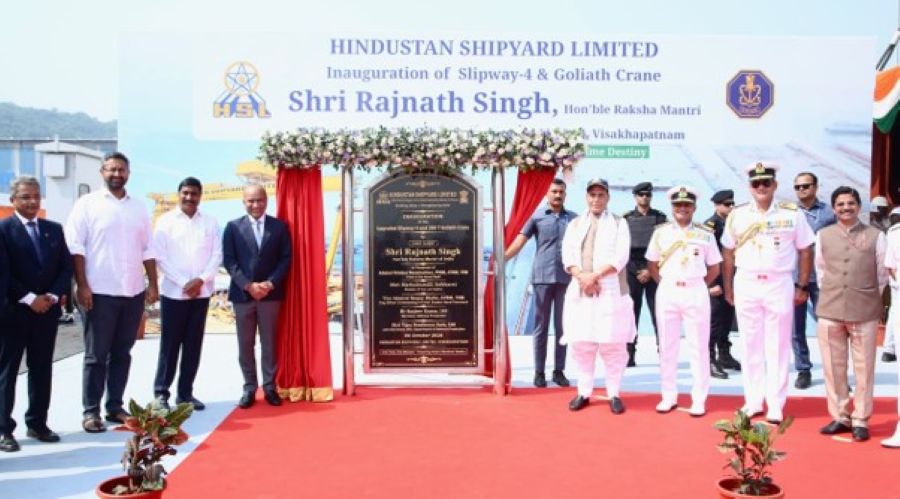
Defence Minister Rajnath Singh launched first Fleet Support Ship (FSS-1) named ‘Surya’, at Hindustan Shipyard Limited (HSL) in Visakhapatnam on Tuesday. He also laid the keel of the fifth ship in the programme and inaugurated an upgraded shipbuilding slipway and a 300-tonne Goliath Crane.
The three developments underline a larger objective: building not only more ships for the Navy but also the industrial capacity to construct increasingly large and complex vessels in India.
“The launch of FSS-1 is a symbol of achievement, the keel laying of FSS-5 is a symbol of resolve and the new Slipway is a symbol of our growing capability,” Singh said.
Enabling longer naval deployments
Fleet Support Ships are a critical component of a blue-water navy. Unlike frontline warships, their primary role is to keep the fleet supplied and operational at sea through replenishment of fuel, water, ammunition, stores and other essential supplies.
For the Indian Navy, which is increasingly operating across the wider Indian Ocean and maintaining deployments in distant waters, such vessels can reduce dependence on shore-based support and enable task groups to remain at sea for longer periods.
The FSS programme is therefore aimed at strengthening the Navy’s reach, endurance and operational flexibility.
Built indigenously by HSL, Surya and its sister ships will feature enhanced cargo and fluid capacity, first-line maintenance workshops and a helicopter deck capable of supporting multi-role helicopters. The vessels will also have self-defence systems.
The launch of the first ship and keel laying of the fifth indicate that the programme is progressing simultaneously on construction and production lines.
HSL prepares for larger ships
The FSS milestone comes alongside a significant expansion of HSL’s shipbuilding infrastructure.
The upgraded Slipway-4 has been extended and strengthened to enable the shipyard to build and launch vessels of up to 45,000 deadweight tonnes.
A new 300-tonne Goliath Crane, spanning Slipways 3 and 4, is designed to handle heavier ship blocks and support modern block-construction techniques. Manufactured by L&T Geostructure with Konecranes under the Make in India initiative, the crane incorporates automated controls, variable-frequency drives, tandem lifting, remote diagnostics and condition monitoring.
The infrastructure upgrade is intended to allow HSL to take on larger and more complex shipbuilding programmes.
For the Indian shipbuilding sector, the significance extends beyond a single naval programme. The ability to construct large hulls, handle heavier blocks and improve construction timelines will be critical if Indian yards are to meet the Navy’s expanding requirements while also competing for international orders.
From self-reliance to global competitiveness
Singh said the next challenge for Indian shipyards was to move beyond indigenisation and become globally competitive.
“Self-reliance is an important milestone, but global competitiveness is the next big leap,” he said, calling on HSL to become a benchmark for quality, productivity and timely delivery.
He also called for Visakhapatnam to emerge as a major maritime industrial hub, leveraging the concentration of naval, port, shipbuilding and engineering infrastructure in the city.
The presence of the Eastern Naval Command, Naval Dockyard, HSL and Visakhapatnam Port provides the foundation for such an ecosystem, Singh said.
He called for closer integration between the Navy, HSL, DRDO, academia, private industry, MSMEs and startups.
“India’s maritime strength cannot be built by the Navy or shipyards alone,” he said.
The Defence Minister also urged Indian shipyards to look beyond domestic requirements and develop a presence in international shipbuilding, ship repair and maintenance, maritime technology and engineering services.
HSL, which has been under the Ministry of Defence since 2010, was accorded Miniratna Category-I status in 2025.
The FSS programme and the accompanying infrastructure expansion at HSL thus represent two sides of the same strategic requirement, giving the Navy greater endurance at sea while building an industrial base capable of supporting India’s maritime ambitions.
Team BharatShakti