






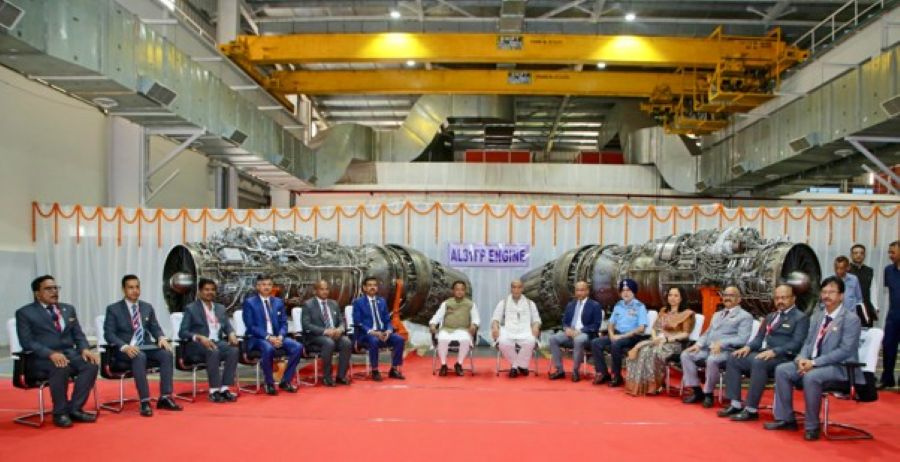
Hindustan Aeronautics Limited’s Koraput division delivered its 2,000th aero-engine on October 6, marking six decades of propulsion manufacturing, as Defence Minister Rajnath Singh announced major capacity expansion plans for the AL-31FP and Shakti engines and outlined a government push towards an indigenous high-thrust aero-engine.
The AL-31FP production capacity at Koraput will be increased from 30 to 50 engines annually with an investment of Rs 335 crore. A second production line for the Shakti engine will also be established at a cost of Rs 218 crore, taking total production capacity to up to 100 engines annually. The new Shakti line is scheduled to be fully established by 2028-29.
The announcements come as India seeks to reduce its dependence on imported propulsion technology amid growing requirements for fighter aircraft and helicopters.
Rs 5,000 crore push for indigenous high-thrust engine
Singh said the government is pursuing an indigenous high-thrust aero-engine programme with an investment of about Rs 5,000 crore, aimed particularly at strengthening the propulsion base for the Advanced Medium Combat Aircraft (AMCA) programme.
The programme envisages indigenisation of critical raw materials in partnership with Mishra Dhatu Nigam Limited (MIDHANI) and the establishment of India’s first indigenous high-thrust engine testing facility.
Singh stressed that aerospace self-reliance cannot be achieved merely through indigenous airframes and avionics, but requires domestic capability in engine design, advanced materials, precision manufacturing, testing and maintenance, repair and overhaul (MRO).
Describing the aero-engine as the “heart” of an aircraft, the Defence Minister said mastery of propulsion technology involves capabilities in advanced superalloys, thermal-barrier coatings, cooling systems, metallurgy and precision manufacturing.
AL-31FP production to rise to 50 engines annually
HAL is expanding production of the AL-31FP, the engine powering the Su-30MKI, following a 2024 government order for 240 engines.
Singh said HAL had delivered the first engine ahead of schedule despite global supply-chain disruptions and raw-material challenges. It has now delivered 63 engines against a target of 60 by the end of the second year of the contract.
The increase in annual production capacity from 30 to 50 engines is intended to strengthen the supply pipeline for the IAF’s Su-30MKI fleet.
Second Shakti line for indigenous helicopters
The second Shakti production line will cater to the propulsion requirements of India’s indigenous helicopter fleet, including the Dhruv Advanced Light Helicopter (ALH) and Prachand Light Combat Helicopter (LCH).
Singh said the additional line would increase production capacity to up to 100 engines annually, with full establishment targeted by 2028-29.
The move is significant for the helicopter ecosystem as the armed forces increasingly require assured domestic availability of engines, along with lifecycle support and upgrades.
2,000 engines in six decades
The Koraput division, established in 1964, has produced engines for several generations of Indian military aircraft, including the MiG-21, MiG-27, MiG-29 and Su-30MKI.
The facility has also overhauled more than 9,000 engines, with HAL progressively indigenising components and reducing turnaround times.
Singh said the 2,000-engine milestone represented not just a production achievement but decades of accumulated engineering expertise and experience in military propulsion.
He called for Koraput to evolve beyond an engine production facility into a wider aerospace propulsion ecosystem, with HAL nurturing suppliers, mentoring MSMEs and start-ups, supporting young engineers and working with universities and research institutions on critical technologies and components.
The Defence Minister also highlighted Odisha’s potential to emerge as a major aerospace and defence manufacturing hub, citing its mineral resources, industrial infrastructure, ports, coastline and skilled workforce, as well as the DRDO’s Integrated Test Range at Chandipur.
The latest capacity expansion and the proposed indigenous high-thrust engine programme come at a time when propulsion has emerged as one of the critical technology gaps in India’s effort to build a self-reliant combat aircraft ecosystem.
Team BharatShakti