


India and Sri Lanka on Wednesday stepped up defence cooperation with agreements to upgrade six Indian-origin L70 air defence guns operated by the Sri Lankan Air Force, while Defence Minister Rajnath Singh called for deeper maritime-security coordination between the two countries amid growing challenges in the Indian Ocean Region (IOR).
The six L70 guns will be upgraded under a Government of India grant. The weapons, earlier supplied by India to the Sri Lankan Air Force, are intended to provide enhanced protection to critical assets and strengthen Sri Lanka’s air-defence architecture.
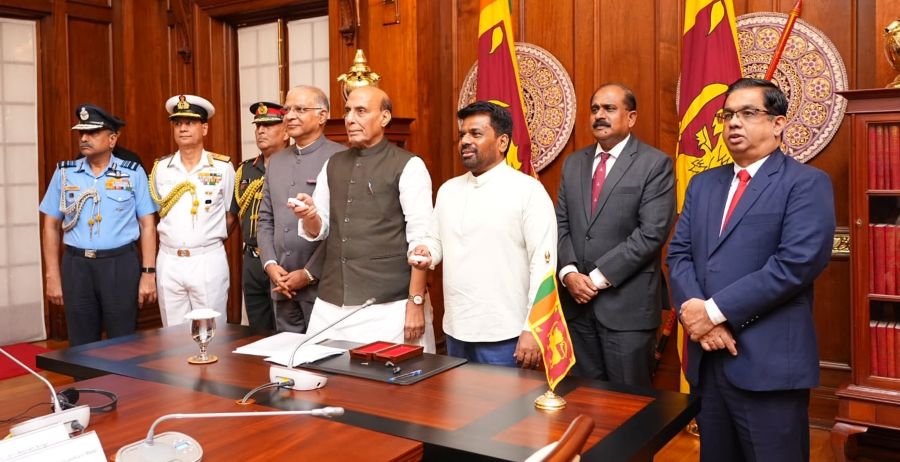
The agreement was exchanged during Singh’s meeting with Sri Lankan President Anura Kumara Dissanayake in Colombo, where the two sides also signed MoUs on cooperation between the National Defence Colleges of India and Sri Lanka and between their National Cadet Corps.
The L70 upgrade is significant as India seeks to consolidate its role as a defence partner and capacity-builder for neighbouring countries, with an emphasis on upgrading equipment already supplied rather than only pursuing new platforms.
Singh and Dissanayake also virtually inaugurated three Bailey bridges constructed by the Indian Defence Forces, underlining the broader nature of India’s security and disaster-response engagement with Sri Lanka.
Later in Colombo, Singh addressed senior Sri Lankan defence commanders and made maritime security the central theme of India’s defence engagement with the island nation, arguing that secure sea lanes, freedom of navigation, international law and uninterrupted maritime trade were essential to the collective prosperity of the IOR.
“Neither country can afford to remain indifferent to developments in the region,” Singh said, stressing the need to move beyond existing exercises and capacity-building programmes towards deeper and more institutionalised maritime cooperation.
He called for joint protocols, greater exchange of operational experience and enhanced skills to deal with emerging threats. The focus, he said, should be on building a closer maritime partnership under Prime Minister Narendra Modi’s MAHASAGAR vision.
India and Sri Lanka have already expanded cooperation in search and rescue, counter-narcotics, anti-piracy and combating human trafficking. Singh pointed to the Maritime Rescue Coordination Centre established with Indian assistance as an example of the two countries’ growing operational coordination.
The next step, he suggested, could be a more integrated Maritime Domain Awareness (MDA) framework, linking relevant agencies, navies and coast guards of the two countries to share maritime information in real time.
The agreements come as India seeks to strengthen its maritime partnerships across the Indian Ocean, where Sri Lanka’s location gives it particular strategic importance astride major commercial sea routes.
The message from Colombo was therefore two-fold: India is willing to remain a long-term security provider and capacity-builder for Sri Lanka, while seeking to anchor the relationship in a wider framework of maritime security, domain awareness and economic cooperation.
The two countries also agreed to deepen academic exchanges and knowledge sharing through their National Defence Colleges. The NCC agreement will formalise the existing youth-exchange programme, allowing Sri Lankan cadets to participate in NCC events in India.
Singh described India and Sri Lanka as “central to any strategic discourse on maritime security” in the region and said their shared geography made closer cooperation a strategic necessity rather than a choice.
Team Bharatshakti