


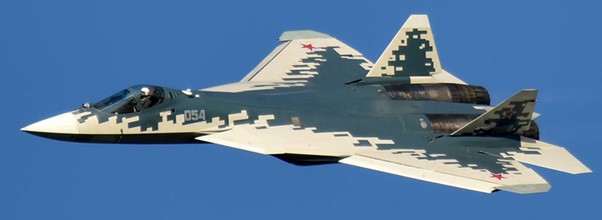
Russian President Vladimir Putin arrives in New Delhi on September 11 with a familiar defence proposition, but one that has acquired greater urgency – the Su-57E stealth fighter.
Moscow is stepping up its campaign to persuade India to acquire its fifth-generation fighter, offering not merely aircraft but joint production and access to selected technologies. The proposal is expected to figure in Putin’s discussions with Prime Minister Narendra Modi, although no immediate agreement on the Su-57E is expected during the BRICS summit.
The timing of the Russian pitch is important. India faces a widening combat-aircraft gap even as its indigenous Advanced Medium Combat Aircraft (AMCA) programme remains years away from operational deployment. China, meanwhile, already operates the J-20 and is moving rapidly towards more advanced combat-aircraft capabilities. Reports of J-20 deployments closer to India’s northern borders have added another dimension to New Delhi’s fifth-generation fighter debate.
Russia is therefore presenting the Su-57E as a bridge capability – an aircraft that could give the IAF a fifth-generation platform while AMCA moves through development and production.
The Russian offer goes well beyond an off-the-shelf sale. Moscow is proposing two aircraft initially, reportedly with long-range R-37 air-to-air missiles, followed by possible joint production of three to five squadrons in India.
More significantly, Russia is offering technology linked to the Su-57’s engine, including the possibility of manufacturing substantial components in India. The offer, however, is understood to be conditional on India committing to the fighter.
Kremlin Spokesperson Dmitry Peskov has now publicly confirmed that technology transfer is part of the discussions. “We are willing to sell the Su-57, but the Indian side also wants transfer of the technologies,” he said during a Sputnik India briefing.
That is perhaps the most consequential part of the proposal. India’s interest is not simply in acquiring another fighter. Any Russian offer will be judged against New Delhi’s long-standing demand for deeper technology access and domestic aerospace capability.
The Su-57 is not entering an empty market. India walked away from the Indo-Russian FGFA programme in 2018 after years of concerns over cost, performance, stealth characteristics, engine maturity and technology transfer.
Those reservations have not disappeared.
The IAF’s preferred route remains centred on the 114-aircraft MRFA programme, the AMCA and greater participation in the Franco-German-Spanish FCAS programme. Bringing in another Russian fighter would also have implications for logistics, training, weapons integration and fleet rationalisation.
There is consequently a fundamental tension in the Russian proposal – the Su-57 could offer India an immediate fifth-generation capability, but acquiring it could also complicate the long-term transition towards an indigenous fifth-generation ecosystem, as some analysts believe.
The Su-57 is not the only headline element of Moscow’s broader defence pitch.
Russia is pushing the proposed $11-billion-plus Sukhoi upgrade for around 260 Su-30MKIs, involving new AESA radars, avionics, electronic-warfare systems, engines and weapons. Integration of the R-37M long-range air-to-air missile is also being discussed.
Additional S-400 systems, radars and strategic submarines are also on the table, alongside proposals for greater involvement of Indian private-sector companies.
The two sides are also examining upgrades to the BrahMos missile programme.
The larger Russian objective is clear – move the relationship away from its traditional buyer-seller model towards co-production, technology partnerships and eventually joint development.
For India, however, the Su-57 decision will ultimately come down to a more difficult strategic calculation – whether an imported fifth-generation fighter is worth using as a bridge to AMCA, or whether that bridge could end up delaying the destination.
Ravi Shankar

Dr Ravi Shankar has over two decades of experience in communications, print journalism, electronic media, documentary film making and new media.
He makes regular appearances on national television news channels as a commentator and analyst on current and political affairs. Apart from being an acknowledged Journalist, he has been a passionate newsroom manager bringing a wide range of journalistic experience from past associations with India’s leading media conglomerates (Times of India group and India Today group) and had led global news-gathering operations at world’s biggest multimedia news agency- ANI-Reuters. He has covered Parliament extensively over the past several years. Widely traveled, he has covered several summits as part of media delegation accompanying the Indian President, Vice President, Prime Minister, External Affairs Minister and Finance Minister across Asia, Africa and Europe.